
Close friend of Lao Dong Newspaper
That is Mr. Nguyen Tien Binh (68 years old, a veteran in Ben Cat ward, Ho Chi Minh City). In Mr. Binh's house, we witnessed firsthand the massive collection of Vietnamese Revolutionary Journalism. Mr. Binh shared that since returning from the army to work in a state-owned enterprise, he reads newspapers every day. Among his favorite newspapers, there is Lao Dong Newspaper.
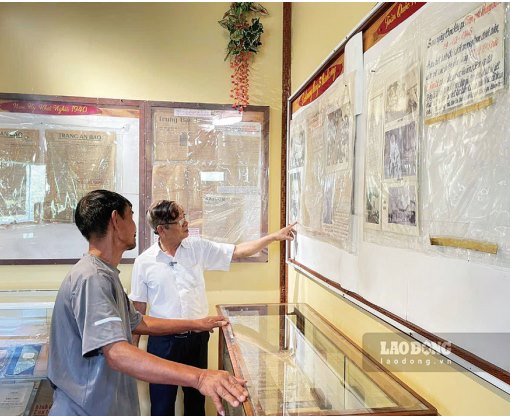
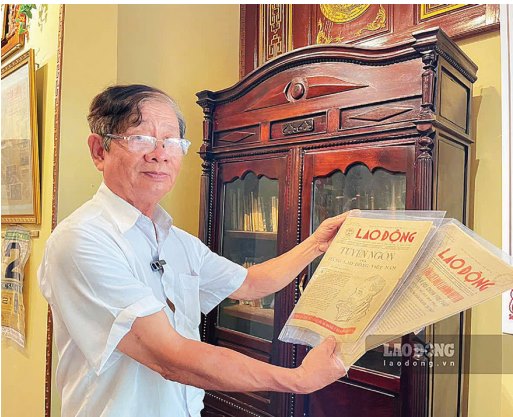
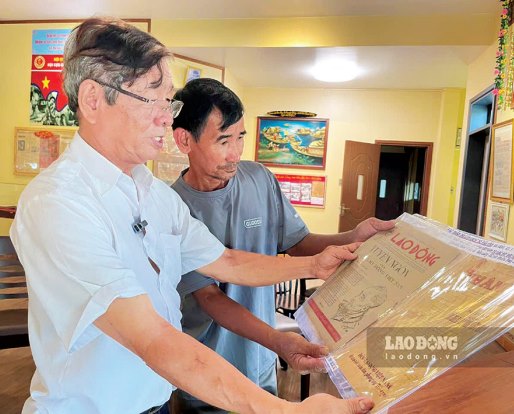
Almost every day on my desk there is Lao Dong Newspaper. This is my spiritual dish every morning. The newspaper helps me update news, grasp current affairs, politics - society. Especially grasp the living conditions of workers. From a passion for reading newspapers, I keep the newspapers as a souvenir. Gradually, later, I liked to collect and preserve newspapers that have developed along with the country's history. In which, I collected Lao Dong Newspaper products from decades ago" - Mr. Binh shared.
Notably, Mr. Binh keeps newspaper issues from 1951, 1952 of Lao Dong Newspaper. He also keeps articles of the newspaper about the National Emulation Soldiers' Congress. This is the first National Patriotic Emulation Congress, marking a major turning point, affirming the pioneering role of the working class, creating motivation for economic development, honoring advanced examples. Mr. Binh said that he is very impressed with the articles of Lao Dong Newspaper. The newspaper shows closeness to the people and workers. Quickly propagating the policies and guidelines of the Party and State to workers. In addition, Lao Dong Newspaper has actively protected the legitimate rights and interests of workers.
Up to now, I still regularly follow Lao Dong Newspaper through online newspapers. I hope that Lao Dong Newspaper will develop more and more, bringing fast news to people and workers. I hope Lao Dong Newspaper will continue to maintain print newspapers and develop in parallel with online newspapers. I think print newspapers provide information to help readers remember longer and systemize information in more depth" - Mr. Binh shared.
Preserving nearly 100-year-old newspapers
In the two rooms, nearly 100-year-old press publications are solemnly placed by Mr. Binh in glass cabinets or framed and hung on the walls. The newspapers are systematized by Mr. Binh according to publication time, column and topic. In addition, he also numbered them in order, made lists, made notes, and explained additional data to help viewers understand more about the context of birth and the principles of each newspaper.
In journalism collection, Mr. Binh found and preserved the first newspaper printed in Vietnamese national script, Gia Dinh Bao. He also stored typical newspapers from 3 regions such as: the North had Dang Co Tung Bao (published in 1907), the South had Luc Tinh Tan Van (1907) and the Central region had Tieng Dan (published in 1919).
In addition, Mr. Binh also stores precious newspapers describing the important historical events of the Vietnamese Revolution such as the Soviet Nghe Tinh event, Nam Ky uprising, August Revolution, the day Uncle Ho read the Declaration of Independence, national resistance, revolutionary journalism in the period 1954 - 1975....
Mr. Binh said that for him, paper newspapers are the most vivid source of historical, cultural and social documents. Storing newspapers is a way to understand and preserve the value of history. "The press has recorded current events and important events of the country every day. The press affects the lives of each citizen. So, after reading it, I saved the newspapers and collected more. I try to systemize the newspapers associated with the Vietnamese Revolution from the period 1930 - 1945 and through the two resistance wars to protect the country" - Mr. Binh said.
According to collector Nguyen Tien Binh, paper newspapers always have very special value. Press publications are only published once, not reprinted like books and stories. Besides, producing paper newspaper products requires high professionalism and responsibility from journalists, because once a newspaper is published, it cannot be edited and cannot be removed. These are special things compared to electronic newspapers, television, and social networks. "When holding paper newspapers in my hands, I feel like returning to memories and recollections of a past time of myself and of national history" - Mr. Binh shared.


