Lao Dong Newspaper reporter had an interview with Mr. Le Quang Trung - former Deputy Director in charge of the Department of Employment - about this issue.

Sir, please tell us, what are the shortcomings of traditional job exchanges?
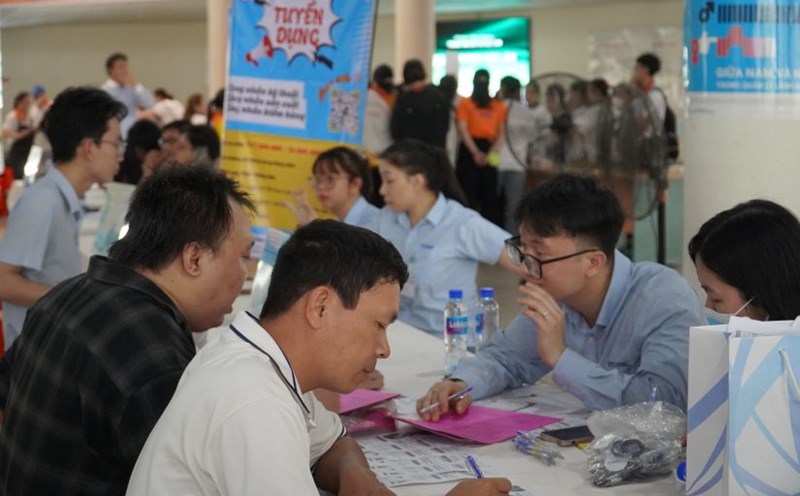
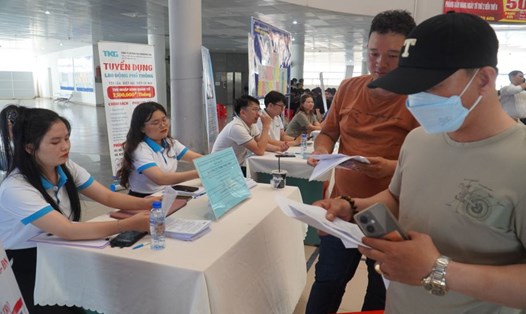
- Job exchanges, job fairs, job fairs (collectively referred to as job fairs)... have been organized since the 90s of the 20th century, bringing very encouraging results, helping labor supply and demand meet.
However, the organization of job fairs is often organized on a local scale, then reaches out to small areas (some neighboring provinces are linked to organize) and is not covered nationwide. Meaning, labor supply and demand information is not conveyed between regions, between regions, causing access to labor market information and recruitment information of businesses to be "tied" within a certain scope. This reality leads to many people who need to work but cannot find a job; many units need to recruit people but cannot access workers.
What is the significance of the National Job Floor, sir?
- I think that organizing the National Job Fair is extremely necessary and brings many practical benefits.
For example, the simplest thing is the issue of labor surplus - shortage. Previously, when not widely informed and not considered nationwide, the view would be very one-sided. This industry lacks human resources in this province but may be surplus in another province. The national job fair will overcome that shortcoming.
Please tell us what we need to do to make the National Job Floor contribute to maximum efficiency in connecting labor supply and demand as expected?
- In my opinion, there are 7 things to do. First, we must review and develop legal documents related to the organization of the National Job Floor and job exchanges in localities. Thereby, ensure that the floor operates in accordance with the provisions of law to bring the best and most effective results for workers and employers.
Second, it is necessary to build a process to organize, implement and evaluate the National Job Floor.
Third, pay special attention to the issue of labor market information in localities as well as in the Central Government. It is necessary to ensure "live" and "clean" information, accurate and sufficient to build input information. Only when there is standard input information can standard floors be implemented. At the same time, do a good job of forecasting the labor market, first of all in the short and medium term, then move towards long-term forecasting.
Fourth, there need to be standards for workers to access this information as easily as possible in all different environments.
Fifth, build a common floor and a thematic floor model for each different target group (general labor, labor with high technical expertise, elderly groups, youth groups, demobilized soldiers...).
Sixth, upgrading the conditions on facilities of job floor levels, in which special attention is paid to infrastructure suitable to current conditions (digital infrastructure, digital technology and digital human resources).
Seventh, I really hope that officials of centers and job fairs are public employees of state-owned non-business units so that they can focus on performing this task in accordance with the spirit of Convention No. 88 of the International Labor Organization ILO on connecting labor supply and demand.
Finally, in my opinion, we also need a KPI index to evaluate the effectiveness of the National Job Exchange and an index to apply to evaluate employees - those who work in the exchange to assign tasks and evaluate work efficiency.
Thank you, sir!