The birth of the Vietnamese working class
The Vietnamese working class (GCCN) was born and developed associated with the process of colonial exploitation by the French colonialists in the late 19th century. Before the French colonialists opened fire to invade, Vietnamese society was still a feudal society with two basic classes: the feudal landlord class and the peasant class; maintaining an outdated economy based mainly on small-scale agriculture production, and undeveloped industrial and service economies. After the invasion and pacification were basically completed, the French colonialists immediately began to exploit the first colony on an expanded scale throughout the country.
Alcohol and beer factories, textile factories, electricity and water, railway industries, mines, rubber plantations, coffee plantations... were born one after another, and along with that, the first team of Vietnamese workers was formed. They were farmers who were deprived of all their land, and artisans who went bankrupt and were forced to work in French capitalist enterprises.
According to pre-World War I statistics, the total number of workers in Vietnam was about over 100,000 people, mainly concentrated in some major cities such as: Hanoi, Saigon - Cho Lon, Hai Phong and Quang Ninh mining area...
After World War I, to compensate for the losses, the French colonialists carried out the second colonial exploitation with a larger scale and speed than before. They increased investment in mining, transportation, plantation, processing industry, textiles... to strengthen plundering and exploitation in colonial countries. During this period, the number of Vietnamese workers developed rapidly to over 220,000 people by the beginning of 1929.
Under the harsh oppression and exploitation of colonialism and feudalism, the Vietnamese working class united, organized and gathered together to fight for rights, leading to the formation of Friendship Associations and Mutual Assistance Associations in factories and enterprises. At the end of 1920, patriotic worker Ton Duc Thang mobilized to establish Ba Son Trade Union in Saigon, opening the struggle for class liberation and national liberation.
The birth of the Bac Ky Red Trade Union - the predecessor of today's Vietnam Trade Union
The formation and development of the Red Trade Union of Tonkin is associated with the revolutionary activities of Leader Nguyen Ai Quoc in the early years of the 20th century. He joined the British Overseas Trade Union while operating in London in the years 1914 - 1917; joined the Metal Trade Union of District 17 Paris in 1919.
Leader Nguyen Ai Quoc was the person who laid the theoretical basis and ideological foundation for the establishment of the Vietnam Trade Union organization. In the work "Duong Khach Menh", he guided: "The Trade Union is primarily for workers to travel together to have sympathy, secondly to study with each other, thirdly to improve the way workers live to be better than they are now, fourthly to preserve the rights of workers, and fifthly to help the nation and help the world". In June 1925, he founded the Vietnam Revolutionary Youth Association in Guangzhou - China and directly taught to improve political theory for students.
In the years 1925 - 1928, under the leadership of the Vietnam Revolutionary Youth League, the "Proletarianization" movement deeply penetrated into factories, enterprises, and mines to propagate and mobilize workers to actively participate in the struggle movement. The birth of the first Communist Party Cell (March 3, 1929), especially the birth of the Indochinese Communist Party (June 6, 1929) was the result of the process of mobilizing and organizing workers, of which comrade Nguyen Duc Canh was one of the founders and played an important role. In his position as a member of the Provisional Central Executive Committee, comrade Nguyen Duc Canh was assigned by the Provisional Central Committee to be in charge of mobilizing workers.
Recognizing the important role of the Trade Union organization and workers in the struggle against imperialism, exploitation, and protection of workers' rights, Comrade Nguyen Duc Canh and his comrades actively organized the workers' movement movement, first of all the Bac Ky workers' movement, to establish the Trade Union organization.
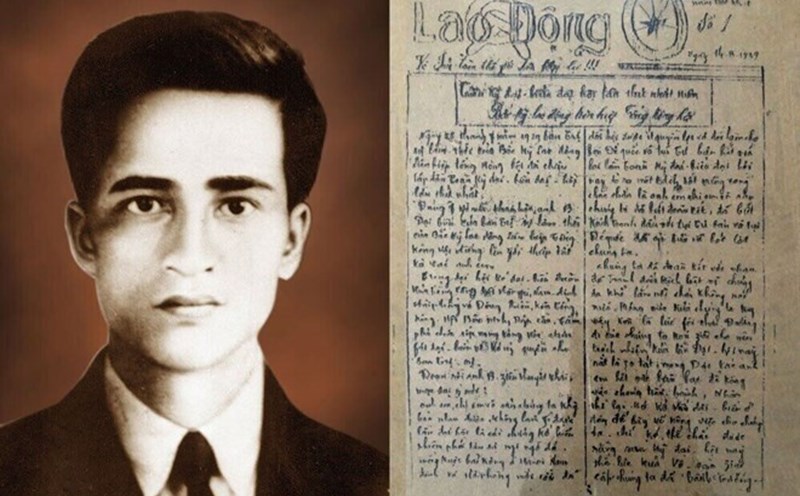
On July 28, 1929, the first Congress of Delegates of the Red General Confederation of Tonkin opened under the chairmanship of Comrade Nguyen Duc Canh. The Congress decided to establish the Red General Confederation of Tonkin, approved the Charter and organizational system of the Confederation, issued the newspaper "Lao Dong" and the magazine "Red Confederation", and elected the Provisional Central Executive Committee headed by Comrade Nguyen Duc Canh.
The event of establishing the Bac Ky Red General Confederation of Labour was a bright milestone in the history of the workers' movement and the Vietnam Trade Union. From here, the Vietnamese working class had a large revolutionary organization, operating with principles and purposes, leading the movement.