
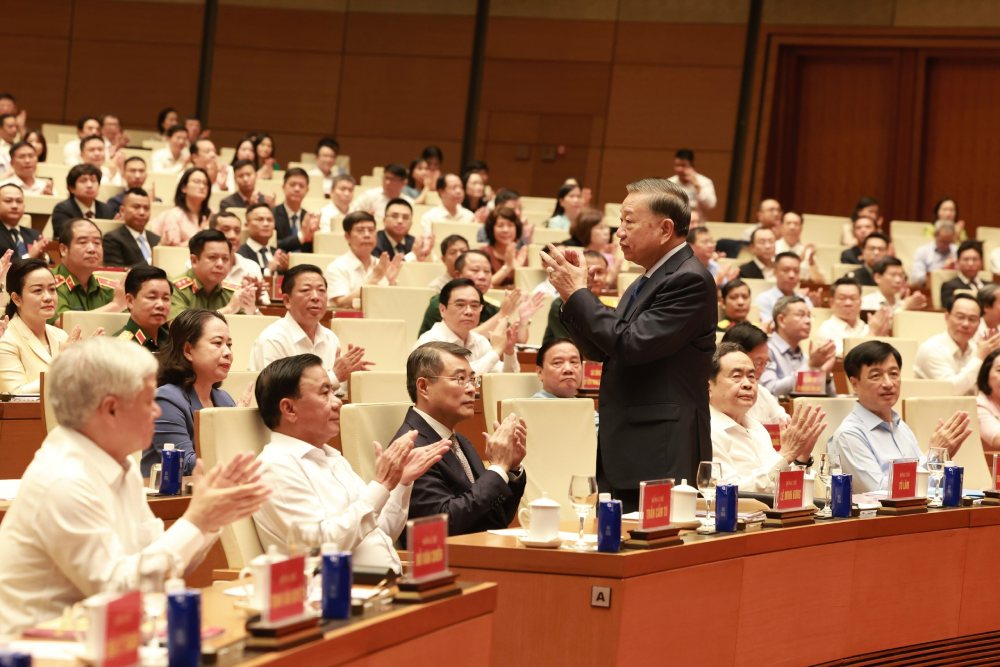
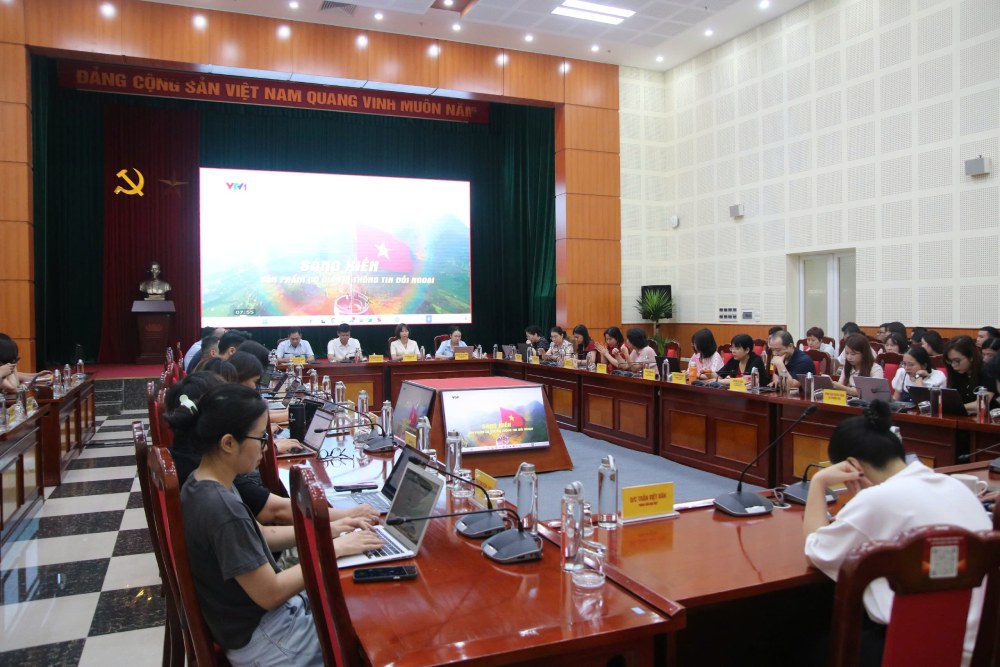
On the morning of June 30, the Politburo organized a national conference to study, study, thoroughly grasp and implement Resolution No. 10-NQ/TW dated June 8, 2026 of the Politburo on economic development with foreign investment capital.
Attending the conference were: General Secretary, President To Lam; Member of the Politburo, Prime Minister Le Minh Hung; Member of the Politburo, Chairman of the National Assembly Tran Thanh Man; Member of the Politburo, Standing Secretary of the Secretariat Tran Cam Tu; Member of the Politburo, Secretary of the Party Central Committee, Chairman of the Central Committee of the Vietnam Fatherland Front Bui Thi Minh Hoai.
Also attending the conference were members of the Politburo, members of the Secretariat, members of the Party Central Committee, and leaders of ministries and sectors.
The conference was held in a direct form from Dien Hong meeting room (National Assembly House) and online to 35,000 bridge points nationwide with nearly 2.1 million delegates participating.
Resolution No. 10-NQ/TW of the Politburo on developing the foreign-invested economy clearly states: After nearly 40 years of renovation and opening up, the foreign-invested economic sector has continuously developed, not only supplementing important investment resources, but also contributing to promoting economic restructuring, innovating growth models, forming a number of key industries, and expanding export markets.
Thereby gradually bringing Vietnam to participate more deeply in the global production network and value chain, supporting human resource development, receiving technology, and advanced management methods.
However, the quality and efficiency of attracting, managing, and using foreign investment are not commensurate with the potential and advantages and have not met the development requirements in the new stage of the country.
The rate of labor-intensive projects, resources, land, energy, processing, and assembly is still high; the rate of localization and added value formed in Vietnam is still low; linkages with domestic business sectors are not high, technology transfer is still limited; there is still a phenomenon of competition to attract investment in quantity in some localities.
The flow of indirect investment capital is still small, not commensurate with market potential. The activities of capital contribution, buying and selling, merging enterprises of investment funds, global financial institutions, and foreign investors are still limited, and management is not tight.
In the context that Vietnam is establishing a new growth model based on science, technology, innovation, digital transformation, green transformation, and improving strategic autonomy, attracting and developing a foreign-invested economy must be placed in the overall national development strategy.
The Resolution emphasizes the guiding viewpoint that: The foreign-invested economy is an important part of the national economy, not only contributing to supplementing medium and long-term capital for development investment but also a channel to receive advanced technology, modern management methods, training to improve the quality of human resources, helping to expand the market; being encouraged by the State to develop in the long term, treat equally, and compete healthily with other economic sectors according to the provisions of law.
Economic development with foreign investment is associated with the requirement to improve efficiency, strategic autonomy capacity, competitiveness of the economy, expand market networks, and deeply participate in global supply chains.
Strongly shift from the main thinking of attracting capital to the thinking of developing a national strategic investment platform; from attracting investment according to administrative boundaries to attracting according to industry clusters, value chains and innovation ecosystems.
Taking quality, efficiency, technology transfer, participation in supply chains, added value,... as the main criteria; gradually shifting from input-based incentives to support associated with the results of commitment implementation, including project life cycle management and connection with domestic enterprises.


