
U40 leads in job seekers
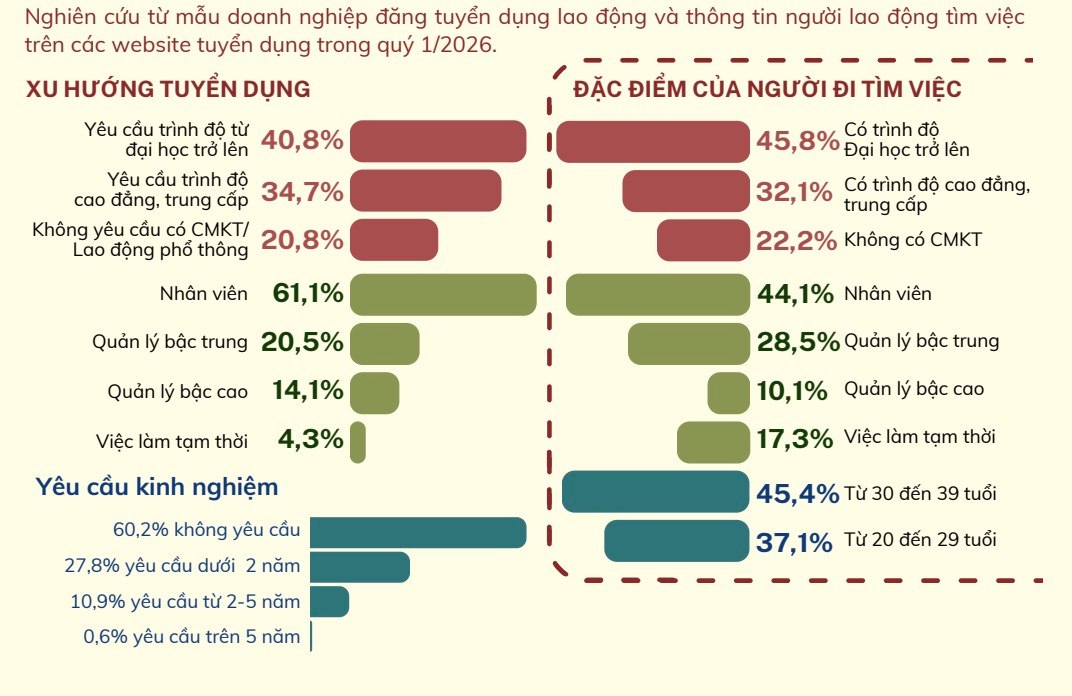
According to data released by the Ministry of Home Affairs in the first quarter of 2026, the 30-39 age group (U40) currently accounts for 45.4% of the total number of job seekers, the highest among all age groups. Meanwhile, the 20-29 age group only accounts for 37.1%.
Analyzing this trend, Dr. Nguyen Thuy Vu - Institute of Training and Development of Ho Chi Minh City (IFP) said that this is a "turning point" for the labor market.
According to her, the fact that the U40 group accounts for the highest job search rate, exceeding the 20-29 age group (37.1%), is not simply a short-term fluctuation but reflects three major trends taking place simultaneously.
First of all, the shift in working methods. After many years of being attached to stable jobs, U40 workers tend to switch from a fixed model to a more flexible one. In particular, after the impact of the COVID-19 pandemic, the model of combining office and remote work has become more popular.
In addition, a part of middle-aged workers choose to work freelance, taking on the role of consultants or project collaborators. This approach helps them be more proactive in terms of time and location, while reducing dependence on a fixed position in the business.
The second trend is career shift. According to Dr. Nguyen Thuy Vu, this is a transition from the advantage of "seniority" to "adaptability", in the context of AI and automation changing the job structure.
Many traditional positions are shrinking, forcing U40 workers to shift to service, technology or jobs that require higher human skills.
The third trend is a shift towards the occupational value system. According to experts, U40 workers no longer prioritize income as the sole factor, but increasingly prioritize the working environment and quality of life.
They tend to choose businesses with a healthy, transparent culture, limiting internal conflicts and respecting personal experience. At the same time, mental health and work-life balance are put first, instead of the hourly working model as before.
In addition, this group of workers also pays more attention to the social responsibility of businesses. Work is no longer just income, but also spiritual value, level of contribution to the community and conformity with professional ethics standards.
Ask questions about self-worth
According to Dr. Nguyen Thuy Vu, the above changes clearly reflect the shift in the psychology of U40 workers - a period often considered the "pre-middle age crisis".
At this stage, many people begin to look back on their 15-year career journey and question their self-worth. They no longer want to become an "alternative link" in the system, but tend to seek an environment that allows for clearer expression of personal identity.
Another important change is the shift in the measure of success: from title, income to mental stability and quality of life. This makes them leave high-pressure, unbalanced environments to seek more flexibility," she said.

At the same time, U40 workers also face pressure from the "clamp generation" - having to both take care of children and take care of elderly parents. This makes them increasingly prioritize stability, transparency and job control capabilities instead of high-risk opportunities.
According to experts, the U40 labor group today tends to be more cautious when choosing jobs. They not only look at job descriptions or salaries, but also evaluate business reputation, financial transparency and the actual working environment.
After many years of experience, they have a clearer "career filter", helping to distinguish between commitment and reality. This makes the job search process longer, but at the same time more selective and sustainable.


