
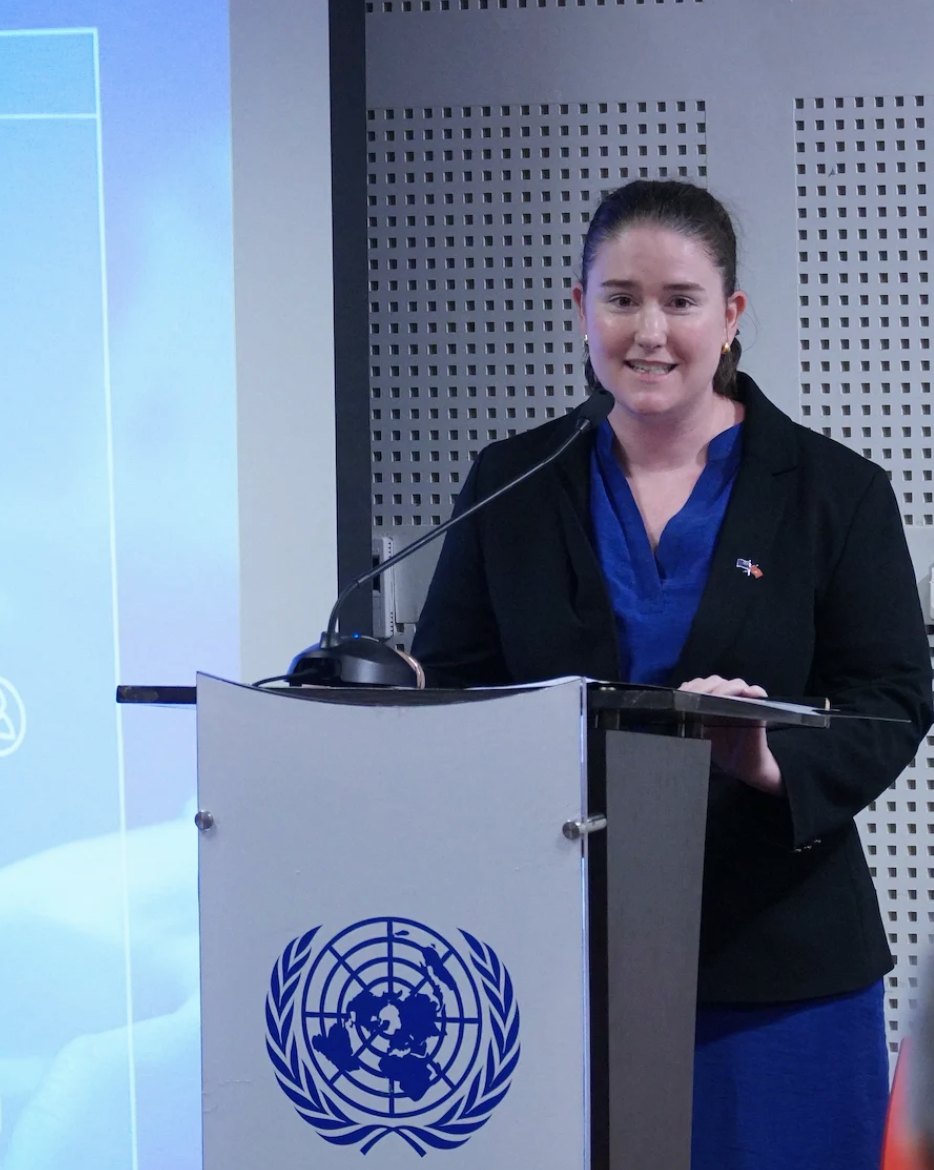
At the seminar "Artificial Intelligence and Journalism" organized by the G4 group - including the Embassies of Canada, Norway, New Zealand and Switzerland - in coordination with the United Nations Development Program (UNDP) in Vietnam, many diplomats and journalists discussed the opportunities and challenges of AI.
Ms. Leigh McCumber - Political and Economic Counselor, Canadian Embassy in Vietnam - emphasized that the press is currently operating in an increasingly "chaotic" information environment, where fake news and content created by AI are eroding public trust. However, she also acknowledges the reality that AI has been and is widely present in editorial offices - from removing audio tapes to analyzing data - and can completely optimize work performance if used responsibly. A key principle drawn from Canada's experience is absolute transparency: don't let the audience doubt whether what they are reading, listening to or watching is a product of AI or not. "AI is born to energize the press, not to replace it," Ms. Leigh McCumber affirmed.

Norwegian journalist Henrik Vold emphasized that AI ethical issues are increasing. Mr. Henrik Vold believes that AI is just a tool and cannot replace journalistic judgment. Human supervision is irreplaceable, from making editing decisions to verifying all content created by AI. "Treat chatbots like humans - but don't treat them as friends" - Mr. Henrik Vold said.
Swiss Ambassador Thomas Gass warned that AI could push journalism away from its core purpose - chasing speed, views and sensation - with the consequence of having to trade for information depth and responsibility to the community. However, AI also brings significant opportunities such as strengthening investigative journalism capabilities, opening up cross-border cooperation activities, making content more accessible and inclusive.

New Zealand Deputy Ambassador Rebecca Wood emphasized that, although AI has now gone deep into daily life and journalistic activities, it is basically still a tool - a tool whose impact completely depends on how humans use it. Ms. Rebecca Wood gave a very clear message: “As individuals, we must use AI with critical and responsible thinking. As a nation, we must build human-centered legal frameworks. As a global community, we must shape common principles and standards for the use of AI”.
According to network security expert Ngo Minh Hieu, the application of AI needs to be accompanied by measures to ensure digital security. Because if AI is used incorrectly, users may unintentionally leak personal data, internal documents or face the risk of account embezzlement.
Users should absolutely not upload sensitive information to AI platforms such as personal data, information about children or unpublished documents. Once uploaded, it is almost impossible to control completely" - Mr. Hieu warned.
According to the expert, for journalists, the risk is even greater because the nature of their profession allows them to become targets of cyber attacks or personal information gathering acts to put pressure.
Mr. Hieu said that information and images of life that seem harmless such as family and children's images can also become "weaknesses" if exploited by bad actors. "For journalists, investigating and clarifying the truth sometimes makes them targets. At that time, leaked personal information can put pressure not only on themselves but also on their loved ones" - Mr. Hieu said.

Faced with these risks, experts recommend that journalists pay more attention to information protection measures in the process of working.
Accordingly, instead of using conventional communication methods, journalists should prioritize applications with end-to-end encryption features such as Signal or WhatsApp to ensure that the exchange content is not interfered with by third parties.
For data management on cloud storage platforms such as Google Drive or OneDrive, users need to limit sharing links publicly with "anyone"; instead, access rights should be specifically assigned to each specific email address.
Mr. Ngo Minh Hieu emphasized that digital security is an aspect often overlooked in the process of applying AI to journalistic activities.
AI can promote press development, but also increase the risk of information leakage, impersonation and spread of fake news" - Mr. Hieu assessed.
According to him, from digital footprints to the risk of data leakage, journalists today are facing many risks beyond the traditional scope of operation. Personal information can be collected, identities can be stolen, and information sources can be compromised if there are no appropriate protection measures.
To ensure safety in the digital press environment, Mr. Hieu believes that press agencies need to build three important pillars, including people, processes and technology.
In which, the human factor is put first through training journalists to recognize and understand network security risks. Regarding procedures, editorial offices need to have clear regulations on AI tools allowed to be used. At the same time, it is necessary to choose safe technology platforms and implement strict password management.


