
Data aggregation and exploitation platform Metric.vn has just released a panoramic report on the online retail platform market in Vietnam 2025. Data compiled by experts from January 1st to December 31st, 2025 on 4 major e-commerce platforms: Shopee, TikTok Shop, Lazada and Tiki.
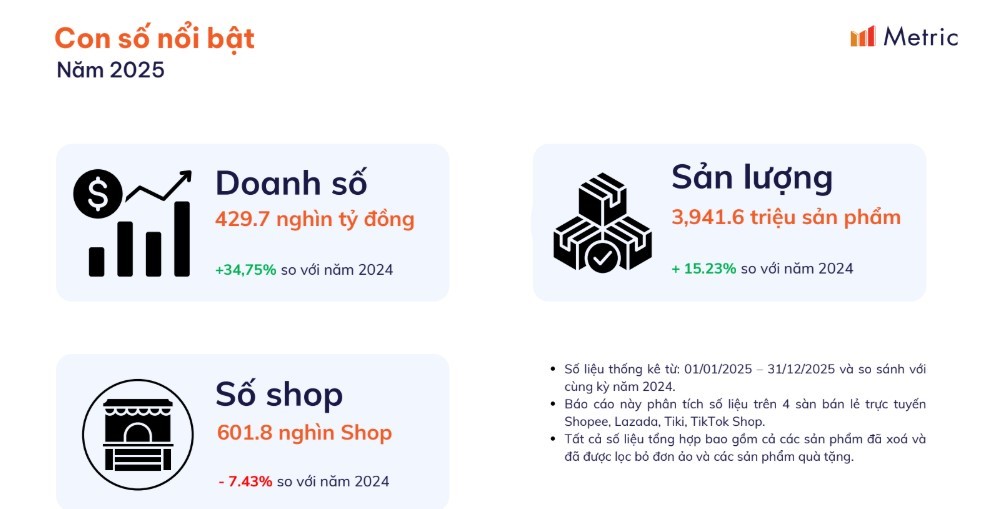
According to compiled data, revenue on these 4 major exchanges reached 429.7 trillion VND in 2025, an increase of 34.75% compared to the same period last year. 3,941.6 million products were sold on these exchanges in the past year, an increase of 15.23% compared to 2024. However, the number of shops decreased by more than 7% compared to 2024, and 601.8 thousand shops are still operating.
In 2025, Shopee continues to lead the Vietnamese e-commerce market with a sales market share of 56.04%, although the growth momentum shows signs of slowing down due to increasing competitive pressure. TikTok (TikTok Shop) recorded outstanding growth, expanding market share to 41.31%, affirming the effectiveness of the "shoppertainment" model.
The remaining e-commerce platforms accounted for about 3% of the sales market share in 2025, reflecting significant challenges in competition and scale expansion in the e-commerce market.
The beauty, home-life and women's fashion industries maintained their leading position in e-commerce sales in 2025, while consumer and health industries recorded impressive growth rates.
In 2025, the above three industries recorded the highest sales, reaching 74.4 trillion VND, 56.6 trillion VND and 54.5 trillion VND respectively. The health, children's fashion and stationery groups achieved outstanding growth rates. Meanwhile, the men's footwear group recorded a decrease. In general, consumers continue to prioritize personal care products and essential consumer goods.
In 2025, the segments under 100,000 VND and the 100,000 - 200,000 VND segment continued to dominate with sales market shares of 22.6% and 25.3% respectively, reflecting stable purchasing power in the general goods group.
However, the segment under 100,000 VND slightly narrowed from 24.4% to 22.6%, showing a trend of consumer shift to higher-value products. This reflects increasingly diverse consumer behavior, with a balance between optimizing spending and improving product quality.
It's a bit of a bit of a bit of a bit of a bit of a bit.


