
No longer stopping at traditional forecasting methods, the industry is undergoing a strong transformation in forecasting technology, applying artificial intelligence (AI) to create a "steel shield" to protect the community. We had a conversation with Dr. Hoang Duc Cuong - Deputy Director of the Department of Meteorology and Hydrology, Ministry of Agriculture and Environment about the strategy of modernizing the forecasting network, especially the role of applying AI in "quantifying" abnormal fluctuations of nature.

Three-legged bridge" in improving forecast quality
Dear Dr. Hoang Duc Cuong, reality shows that natural disasters no longer operate according to the old rules, "anomaly" has become a new normal state, and many records are continuously broken. In that context, what innovations has the Hydrometeorological sector implemented to improve the quality and accuracy of weather forecasting and warning?
- Dr. Hoang Duc Cuong: Currently, the efforts of the Department of Meteorology and Hydrology in improving forecast quality have been comprehensively implemented based on three technical pillars: monitoring technology, numerical forecasting model and application of artificial intelligence (AI). This innovation is a key factor helping the Vietnamese meteorology and hydrology industry to be increasingly proactive in responding to increasing extreme weather patterns.
Regarding monitoring and data collection, in recent times, the State has paid attention to, supplemented, and upgraded the monitoring network, gradually shifting from manual monitoring to automatic and real-time monitoring. This ensures that data and input data are always updated continuously, with high accuracy and frequency. In addition, the weather radar system has also been upgraded and supplemented with 10 weather radars, along with meteorological satellite monitoring is also applied to monitor in detail the development process of thunderstorms, allowing forecasters to identify localized rain intensity with high resolution, which is especially important in warning of thunderstorms, tornadoes, flash floods, and landslides.
We also continue to apply and improve numerical forecasting models, disaster forecasting and warning supporting technologies. Develop and master regional-scale numerical models capable of data assimilation to simulate climate and weather forecasting, simulate and forecast marine factors such as waves, currents, and tidal surges. Open-source, automated technologies are also gradually being put into use alongside commercial and traditional models to forecast and warn of hydrological events, floods and inundation.
In addition, we also focus on developing a digital technology platform integrating big data and applying warning technology from the United States transferred by the World Meteorological Organization to warn of flash floods and landslides for Vietnam and Southeast Asia.Currently, this platform is integrated on a real-time flash flood and landslide warning information system with detailed levels to the commune level.
In particular, we are gradually applying AI to forecasting and warning problems.
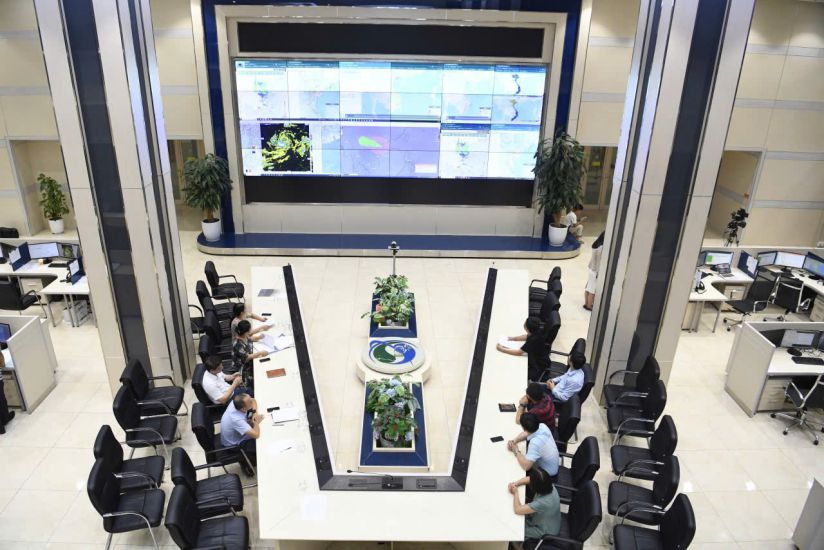
Sir, not standing outside the general trend, the Meteorological sector has begun to apply AI in the forecasting process. Is this considered a "push" for forecasting technology and how is the actual effectiveness of this model being specifically recorded, sir?
- That's right. From mid-2024, we have also cooperated with the Institute of Artificial Intelligence Research and Application (Hanoi University of Science and Technology) in applying AI to storm and heavy rain forecasting problems and hydrological factors, and at the same time building technology to identify early storm formation in the East Sea through cooperation with Hanoi University of Technology, Hanoi National University, University of Science and Technology and Indiana University (USA).
Most recently, the pilot implementation of the application of artificial intelligence (AI) to forecast storms and storm intensity in the East Sea region. One of the typical results is the CIFOMI model (Enhancing Tropical Cyclone Intensity Forecasting over the Bien Dong Sea with Foundation Model and Prompt Tuning) - a result of cooperation between the Center and the AI4LIFE Institute for Research & Application of Artificial Intelligence.
Initial results are very positive, the storm intensity forecast error in 24 hours is reduced by 10-20% compared to other models and methods being used, the model running time is also significantly improved, thanks to which forecasters have more time to focus on analyzing, evaluating and making decisions.
What are the difficulties and challenges that the Department of Meteorology and Hydrology is facing in improving the accuracy in forecasting extreme phenomena?
- We must frankly recognize three core challenges. One is the shortage of input data in key areas. The land-based station network has not yet reached the planned density, especially sparse in remote and mountainous areas - which are inherently "hot spots" of flash floods. More worrying are oceanography data. The East Sea is where storms are formed, but we still lack specialized radar systems for wave monitoring, floating buoys, drift buoys and sea stations. Lack of actual measurement data from the sea, forecast models will lose some accuracy when calculating storm intensity.
The second is the limitation of computing capacity. To run high-resolution numerical models (from 1 - 3 km) and complex AI algorithms, a supercomputer (HPC) system is needed. Currently, the server capacity of the Department, although upgraded, is still far from the world's leading forecasting centers.
But in the end, the decisive challenging factor is high-quality professional human resources. AI or supercomputer technology is just a tool. The deployment and operation of complex meteorological, hydrological, and marine numerical forecasting models not only requires a large computer but also requires a team of experts with in-depth knowledge. Currently, attracting good human resources is facing many difficulties stemming from limitations in training and the specific nature of the job. The input enrollment of the meteorological and hydrological industry is often not abundant because this industry is not attractive enough to students. Besides the 24/7 work pressure, the remuneration regime is not really competitive compared to other industries.
Natural disasters are becoming increasingly extreme. We hope that the proactiveness of the people, combined with early warnings and timely guidance from functional agencies, will make an important contribution to minimizing damage to people and property caused by natural disasters.
Thank you very much for your heartfelt sharing!


