
Warning of late arrival, people are left empty-handed
In the afternoon after the historic flood in Dong Hoa ward (Dak Lak province), the scene of devastation is still clear. In a small house that was covered in mud up to her knees, Ms. Huynh Thi Thien (80 years old) trembled and picked up the distorted pot. Everything in her house was almost destroyed. She said that that night, she only had time to hug her young nephew and run to the neighbor's house when the water suddenly rose rapidly.
No one has predicted. We just thought it would be as big a rain as every year, who would have thought the water would flow so quickly, said Ms. Thien. "If the neighbors hadn't run over and knocked on the door to call for help, my grandchild and I wouldn't have had time to react."
Not far from Ms. Thien's house, Mr. Nguyen Van Tri (67 years old) is flocking to find the remaining belongings in the mud. The bed was knocked open, the wooden cabinet was broken, and the pots and pans were gone. Mr. Tri said that there was heavy rain all night but there was no warning about the risk of flash floods. When the water poured in, his family could only run up to the attic. At night, just hearing the sound of the dam water as if swallowing up the whole village, Mr. Tri recalled. "It's lucky to have saved someone's life, but I don't know where to start."
In Hoa Xuan commune, Dak Lak province, Mr. Tran Van Nam (63 years old) also fell into a situation of being left penniless when the floodwaters swept away his motorbike - the most valuable asset of his family - along with all his rice.
According to the Hoa Xuan commune government, up to 90% of households in the commune were deeply flooded. Mr. Hoang Anh Tuan - Chairman of the Commune People's Committee - said that the locality has updated the warning early, but the water rises too quickly, the power is out, and telecommunications waves are interrupted, making it extremely difficult to communicate to the people. "We issued a warning on November 18, but by November 19, the water suddenly rose. Heavy rain, strong water, weak waves... make it difficult to reach warnings to people," said Mr. Tuan.
According to the Department of Dyke Management and Natural Disaster Prevention and Control, as of November 24, 2025, natural disasters across the country have left 409 people dead and missing, 727 injured, more than 3,700 houses collapsed, nearly 334,000 houses had their roofs blown off and damaged, and more than 553,000 hectares of rice and crops damaged. The total estimated loss is over VND 85,099 billion.
Experts say that if the warning was better and more timely, the damage would certainly be much lower. Early warning is not a reference bulletin; it is the line between life and death.
Accelerating technology investment in natural disaster warnings
In many floods that have lasted for the past 3 years in many localities, there is a common pattern: Warnings from the provincial and central levels are proactive and timely, but when reaching people, they are slow. Information is stuck due to lost signal, power outage, degraded loudspeaker systems, lack of multi-channel warning technology application and lack of real-time risk map updates.
Meanwhile, many countries have applied much more advanced technology. Japan, the Philippines or South Korea use emergency signal transmission technology to any phone in the danger zone without the need for internet or strong telecommunications waves. Many countries have deployed minute-to-minute rain sensors, upstream water level sensors, weather radar coverage and AI models predicting flash floods according to terrain and soil saturatation. All of this helped people have a few more minutes - even a few dozen minutes - to escape.
Mr. Nguyen Ton Quan, Deputy Head of the Department of Community Natural Disaster Management and Communications, Department of Dyke Management and Natural Disaster Prevention and Control, informed: In the coming time, it is necessary to increase capacity, improve the reliability of forecasting and warning of natural disasters, focusing on increasing the density of rain gauge stations and improving the quality of forecasting heavy rain to serve the warning of flash floods, landslides, floods, and inundation; making a map to warn of natural disasters, especially a detailed zoning map of the risk of flash floods and landslides at the village and hamlet level. In particular, continue to extensively promote international cooperation and the application of science and technology in natural disaster prevention and control, especially digital transformation, real-time disaster monitoring and supervision".
At the forum " applying science and technology in forecasting and early warning of natural disasters" held on November 25, Mr. Bui Quang Huy, Deputy Director of the Center for Policy and Technology for Natural Disaster Prevention and Control (Department of Dyke Management and Natural Disaster Prevention and Control - Ministry of Agriculture and Environment) commented: "Many localities still confuse the "application of information technology" and "digital transformation". If only technology does not change people's thinking, operations will be limited. The most important goal of early warning is not only to send information but also to ensure that people receive - understand - know how to do - and can do it.
At the plenary session of the 2025 Autumn Economic Forum, on the morning of November 26 in Ho Chi Minh City, Ms. Pauline Tamesis, Permanent Coordinator of the United Nations in Vietnam, proposed: Vietnam should use AI to warn of natural disasters early. According to Ms. Pauline Tamesis, Vietnam is in the top 10-15 countries most severely affected by extreme weather phenomena related to climate change.
AI can become a powerful tool to support climate action in developing countries, where climate impacts are most severe. Accordingly, AI can enhance early warning systems by forecasting extreme weather phenomena such as storms, floods, and droughts, helping to proactively manage natural disaster risks, emphasized Ms. Pauline Tamesis.
UNDP experts propose that Vietnam needs to build a multi-disaster warning system with 4 layers: Modern monitoring; AI analysis - forecasting; multi-platform communication; and community response through digital map applications, smart evacuation.
Many experts on disaster risk management have commented: "It is impossible to fight the 1990-style flood in the weather in 2025. If the measuring station does not transmit data immediately if it rains a lot, it is meaningless. Every minute of slow data is an additional risk.
Talking to Lao Dong Newspaper, a resident in Dong Hoa (Dak Lak) shared: "People don't need to know how many millimeter of rain there is. We need to know whether we should go to bed or not, whether we should take our child to shelter or not. According to him, the warning "must be as clear as the gong sound".
If the warning system is not upgraded quickly - from repairing loudspeakers, mobile coverage, installing upstream flood sensors to implementing multi-channel warnings - tragedies like the recent flood night will most likely repeat themselves. Each warning message sent a few dozen minutes earlier, each data transmission sensor is 5 minutes faster, each timely updated risk map can save one, even many human networks.
At the local level, Prof. Dr. Do Duc Minh (University of Natural Sciences, Vietnam National University, Hanoi) said that there are 3 important lessons: "3 early detection, early warning, early action), "3 correct" (3 right person, right job, right time) and "3 levels" (3 information, information understanding, information conversion into action). This will be the foundation for localities to be more proactive in the face of increasing extreme weather phenomena.
Khanh Hoa invests in early flood warning equipment
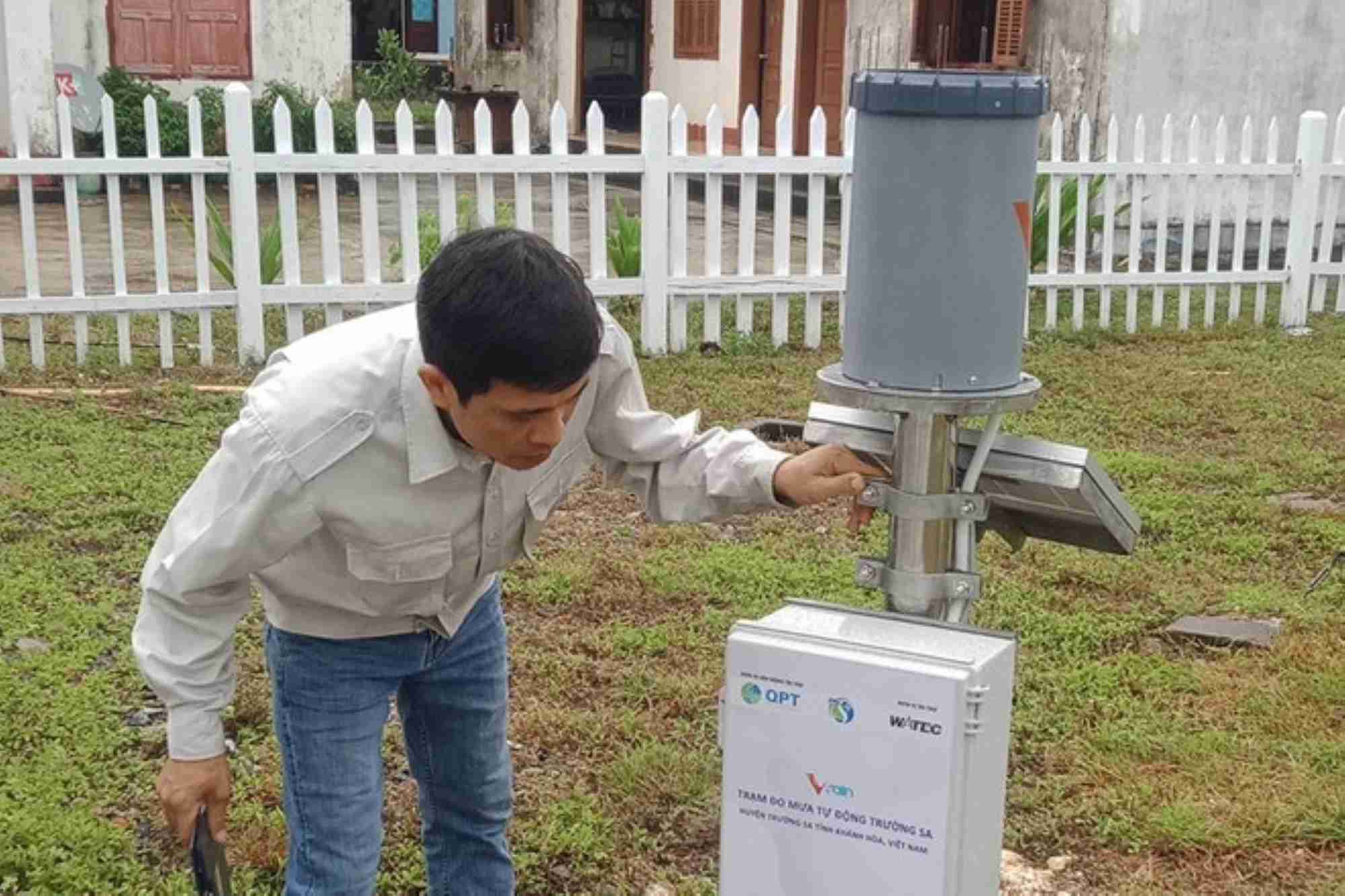
During the recent historic flood, many areas in Dien Khanh and Nha Trang were deeply flooded, greatly affecting people's lives. Not only due to record-breaking rainfall, but flood discharge activities of some reservoirs also contributed to creating more drainage pressure downstream.
Khanh Hoa currently has 64 reservoirs, of which 20 are located in the old Khanh Hoa province (now Bac Khanh Hoa). Of these, only one hydroelectric reservoir is Eakrong Rou Lake, located in the west of Ninh Hoa, with a capacity of 35.91 million cubic meters of water. The remaining 19 irrigation lakes are directly managed and operated by Khanh Hoa Irrigation Works Exploitation Company Limited.
During the peak of flood season in November 2025, Suoi Dau lake (residing in 32.78 million cubic meters, Cam Lam) and Am Chua lake (residing in 4.69 million cubic meters, in the old Dien Khanh district) had to release floodwaters to ensure the safety of the dam.
Although managing 19 reservoirs, so far only Hoa Son Lake (old Van Ninh) has been installed with a flood warning tower to ring the whistle to warn people in Tu Bong area when releasing water. Without a direct warning system, information to people in downstream areas still depends heavily on loudspeakers of communes, wards or through on-site forces.
Khanh Hoa Irrigation Company said that in 2026, the unit plans to install a flood warning tower at Suoi Dau Lake, in order to increase early warnings for people in affected areas.
The company is also studying the placement of flood warning towers in residential areas downstream that have been flooded. The management unit will calculate to warn using both the flood warning horn system and speakers, local radio stations.
In response to the extreme weather developments in recent times, Khanh Hoa Irrigation Works Exploitation Company Limited said that it will continue to coordinate with local authorities to standardize information processes, ensuring that people receive the fastest warnings in emergency situations.
The addition of flood warning towers is expected to help be more proactive in evacuation work, reducing pressure on the loudspeaker system - which is easily affected by heavy rain, power outages or poor signals. Group of reporters
Dak Lak continues to complete monitoring work
Dak Lak is synchronously implementing natural disaster monitoring, forecasting and warning work, combined with risk maps and mobilizing on-site forces, to minimize damage to people, property and infrastructure after floods.
The Dak Lak Provincial Hydrometeorological Station said that the unit plays an important role in providing information, forecasts and warnings about hydrometeorology, serving State management, natural disaster prevention and socio-economic development.
In recent times, the Station has deployed monitoring, weather monitoring and forecasting, warning of extreme phenomena, providing data to sectors and localities, thereby minimizing the consequences of natural disasters in remote and vulnerable areas.
Mr. Nguyen Thien Van - Vice Chairman of the Provincial People's Committee - commented: "The natural disasters in the area are becoming more complicated and unpredictable than in previous years. Early warnings and forecasts are not only technical solutions but also "soft shields" to help localities proactively protect lives and property, stabilize production and develop sustainably".
Dak Lak has deployed a map of natural disaster risks in areas that are frequently affected, integrating data on river basins, residential areas, key works, areas prone to landslides, flooding, droughts and hydrometeorological monitoring data.
Mr. Van said that the application of risk maps has initially shown its effectiveness and needs to continue to be improved and expanded to minimize damage and adapt to climate change. Huu Long
Real-time disaster monitoring requires a common data portal
According to Mr. Bui Quang Huy, Deputy Director of the Center for Policy and Technology for Natural Disaster Prevention and Control (Dical and Natural Disaster Prevention and Control Management Department - Ministry of Agriculture and Environment), the Center for Policy and Technology for Natural Disaster Prevention and Control is currently developing a provincial-level natural disaster monitoring system and piloting it in Ha Tinh. This system connects data between the Central - Provincial - Commune and the community with two interfaces: One for people to monitor developments, receive instructions on response and feedback information; one for direction and operation, integrate real-time data, monitor the progress of evacuation of people and manage safety points on digital maps, thereby giving appropriate instructions.
"I propose to replicate the model like in Ha Tinh, with a data portal to unify resources, helping each province have its own system but still providing an overview nationwide" - Mr. Bui Quang Huy proposed.
Meanwhile, Ms. Nguyen Hong Hanh - Director of the Institute for Construction and Urban Economics (ICUE), Vietnam Construction Trade Union - said that the Community Fund for Natural Disaster Prevention and Control and related organizations can coordinate with the Construction Trade Union to share data related to forecasts and assessments of the time series of storms, floods and major natural disaster events.
According to Prof. Dr. Do Duc Minh - University of Natural Sciences, VNU, in fact, specialized monitoring systems certainly require a huge investment and no country in the world has the conditions to invest in large-scale specialized monitoring stations.
"In the current actual conditions of Vietnam, we recommend that the number of specialized monitoring stations should be located in areas with typical geological conditions. Then, we use the results, thereby, combining with rain monitoring stations and quantum calculations in the laboratory, as well as analyzing experiences based on actual developments", Prof. Dr. Do Duc Minh proposed. Thuy Linh


