
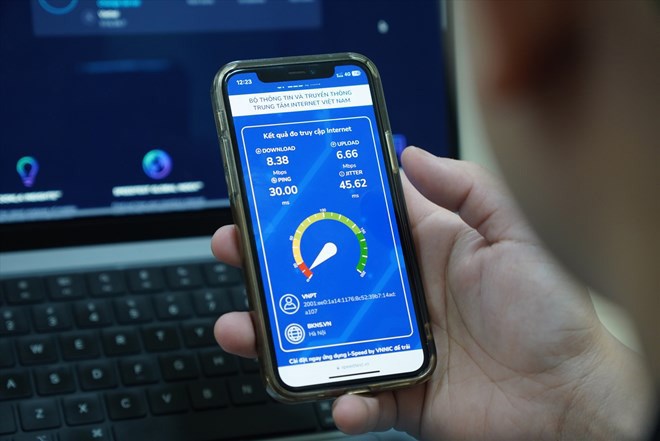
IPv6 is no longer a story of connectivity infrastructure
After many years of Internet presence in Vietnam, the role of the Internet has changed dramatically. If Internet used to mainly serve connection and information exchange, now many management, production, business, transaction and social interaction activities are carried out in a digital environment.
The rapid development of data, artificial intelligence (AI), cloud computing, the Internet of Things (IoT) or smart systems is posing increasing demands for the Internet infrastructure. Meanwhile, the IPv4 address source has gradually run out and no longer meets the increasing connection needs.
Speaking at the Conference summarizing the Program to promote and support IPv6 conversion for state agencies in the period 2021-2025 and implementing the IPv6-Only Program in the period 2026-2030, Deputy Minister of Science and Technology Pham Duc Long said that the Internet is no longer simply a technical infrastructure or connectivity infrastructure but has become an infrastructure for growth and socio-economic development.
According to the Deputy Minister, as the activities of the economy are increasingly carried out in a digital environment, connectivity capacity will determine the ability to expand the country's development space. In that context, the transition from IPv4 to IPv6 is an inevitable requirement.
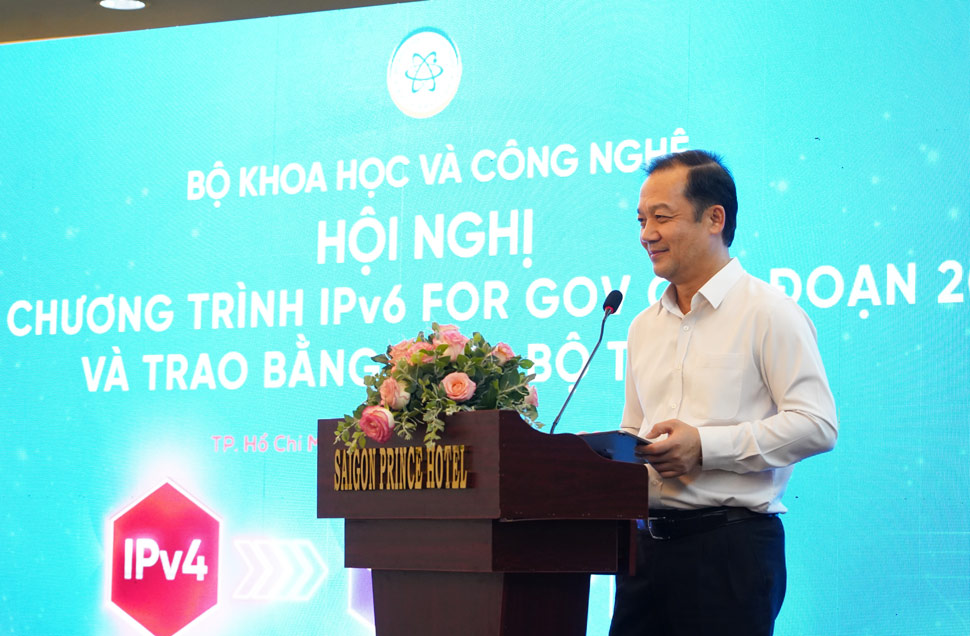
IPv6 not only solves the increasing demand for Internet addresses, but more importantly, creates an expandable connection environment, meeting the connection needs of people, data, devices and smart systems," Deputy Minister Pham Duc Long emphasized.
Leaders of the Ministry of Science and Technology believe that IPv6 is the foundation for forming a new development space for Vietnam in the digital environment. This vast connectivity space will create conditions for the emergence of new business models, new industries and new growth drivers for the economy.
From IPv6 conversion to IPv6-Only target
According to the Vietnam Internet Network Information Center (VNNIC), the Program to promote and support IPv6 conversion for state agencies has contributed to making Vietnam one of the world's leading countries in IPv6 deployment.
Currently, Vietnam's IPv6 usage rate is about 70%, ranking 7th in the world and 2nd in ASEAN, significantly higher than the global average. About 95 million broadband Internet subscribers are operating on the IPv6 platform.
In the state agency sector, 86% of ministries, branches, and localities have completed IPv6 conversion for electronic information portals, public service portals, and Internet-connected information systems. About 73% of units have implemented network planning using IP addresses and independent network numbers.
Mr. Nguyen Truong Giang - Acting Director of VNNIC - said that IPv6 today is not just a network technology but has become an essential platform for developing national digital infrastructure, serving digital transformation, digital government, digital economy and digital society.
According to Mr. Giang, the deployment of IPv6 also creates conditions for the development of new technologies such as cloud computing, IoT, AI, 5G, 6G, smart cities and new generation digital services.
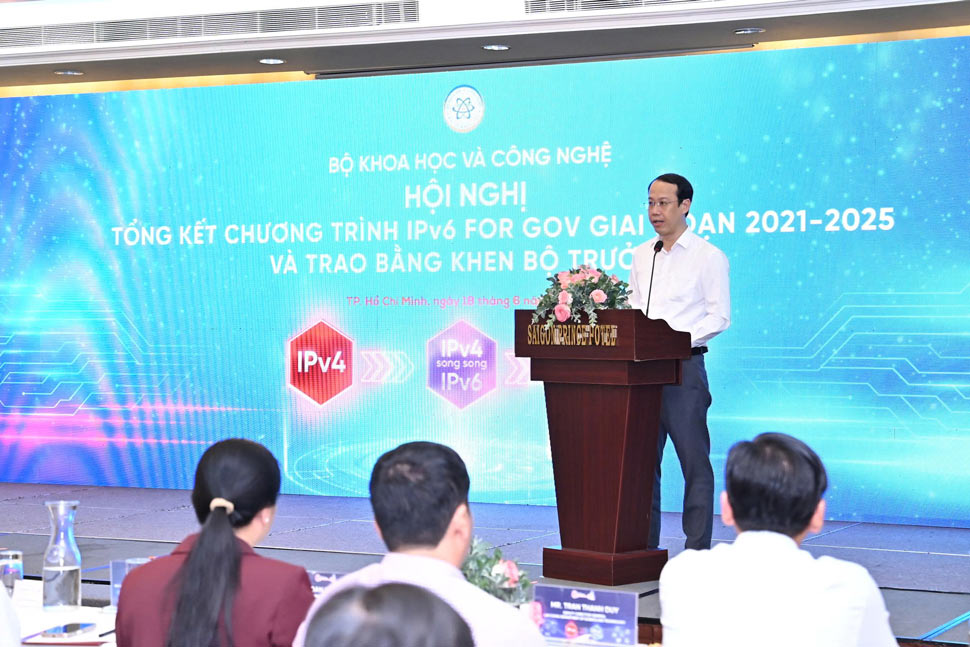
Notably, Vietnam is currently assessed as one of the pioneering countries in the world in building a comprehensive program towards the goal of IPv6-Only on a national scale.
Global trends are strongly shifting to IPv6-Only and gradually stopping the use of IPv4. Vietnam is not only keeping up with the trend but also proactively taking the lead in many deployment contents," Mr. Nguyen Truong Giang said.
According to the orientation for the next phase, the Internet infrastructure needs to ensure safety, reliability, scalability and be ready to meet the requirements of data development, AI, innovation and strategic technologies.
Deputy Minister Pham Duc Long said that the ultimate goal is not to increase the IPv6 usage rate by a few percent, but to build a strong enough digital infrastructure for the country to develop faster, more creatively and more autonomously.
IPv6 should be considered a default requirement right from the start of investment, upgrading infrastructure, platforms and digital services," Deputy Minister Pham Duc Long emphasized.
The deployment of the IPv6-Only program is expected to create a platform for the transition from the IPv4/IPv6 parallel operating model to an operating environment mainly based on IPv6, serving the connection of all data, all devices and smart systems in the future.


