
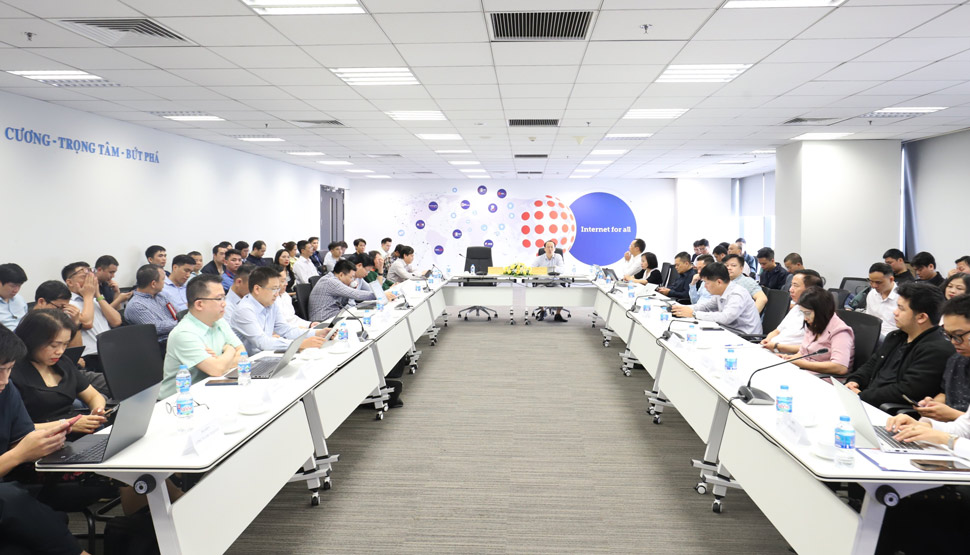
At the IPv6 work deployment conference on March 24, the Vietnam Internet Network Information Center (VNNIC) said that 2025 recorded clear progress in IPv6 transformation, contributing to promoting the development of national digital infrastructure towards modernity and sustainability.
According to the summary report, the IPv6 usage rate in Vietnam reached about 65 to 67%, ranking 7th globally and increasing 2 places compared to 2023. This level is higher than many developed countries such as the US, Japan or South Korea, showing rapid and effective conversion speed.
Technical infrastructure continues to be completed. 100% of national VNIX and DNS systems have IPv6 support. The IPv6 rate on broadband fixed networks reaches about 80%, while mobile networks reach 88%. Notably, 86% of ministries, branches and localities have completed IPv6 conversion for electronic information portals and online public services.

In the business sector, many large units have deployed IPv6 with a high rate. MobiFone reached more than 76%, FPT nearly 67%, Viettel over 65% and VNPT more than 53%. Some state agencies also achieved significant conversion rates, of which VNNIC reached 100%.
Along with infrastructure, the service ecosystem on IPv6 has also been expanded. Many large content platforms such as online newspapers, social networks and online services have switched to IPv6. Training activities have been promoted with nearly 6,000 officials being trained, creating human resources to serve the transformation.
2025 also recorded an important test step with the IPv6 only model. Some systems have been piloted and deployed, while building a DNS64 platform and organizing in-depth training courses on IPv6 only. This is considered a premise for a comprehensive transformation roadmap in the coming period.
From practical implementation, VNNIC believes that IPv6 only is no longer a distant goal but has become an inevitable trend. Vietnam is in the group of pioneering countries in the region in this orientation. Slow IPv6 conversion will cause organizations and businesses to lag behind in the digital flow, as IPv6 gradually becomes a basic condition for development.
Despite achieving many positive results, the implementation process still has some limitations such as monitoring, turning off IPv4 and the equipment replacement roadmap. Perception in some units is not uniform, and needs to be further improved in the coming period.
According to VNNIC, infrastructure platforms, businesses and state agencies are ready to enter a new phase. 2026 is identified as an important starting point for the IPv6 only roadmap to 2030.


