
From infrastructure expansion to governance and trust
After nearly 30 years of development, the Vietnamese Internet is entering a new phase of transition. The focus is no longer on expanding coverage or speeding up, but on responsible data governance, exploitation and construction of a safe and reliable digital space for socio-economic development.
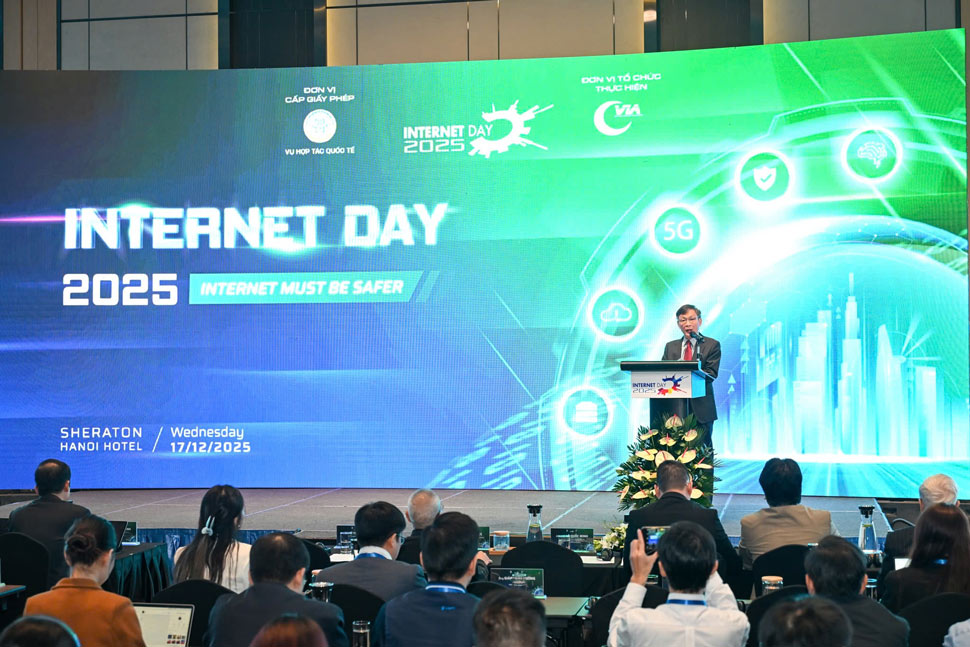
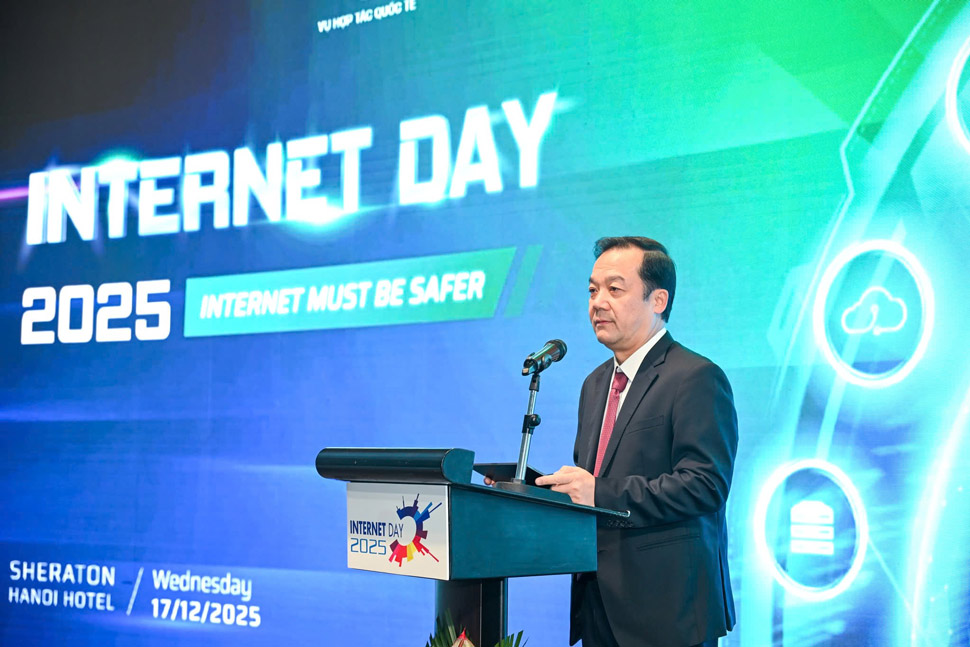
This message was emphasized at the Vietnam Internet Day event - Internet Day 2025, which opened on December 17 in Hanoi. Speaking at the event, Deputy Minister of Science and Technology Pham Duc Long affirmed: "The Internet has become an inseparable part of socio-economic life, with increasingly modern infrastructure, significantly improved quality and increasingly deepening society's participation in the digital environment".
According to the Deputy Minister, when the Internet reaches a certain level, the biggest challenge is no longer expanding scale or speed, but proactively orienting the development of the Vietnamese Internet in what direction. practice shows that Vietnam's Internet is shifting along many trends closely linked to the requirements of sustainable development.
First of all, it is necessary to change the way of governance. The Internet is no longer developed mainly based on self-regulation by entities in the ecosystem, but has shifted to governance by institutions, laws and clearer standards. This approach has been institutionalized in the Law on Digital Transformation.
The Internet has also shifted from a space for information transmission to a space that shapes behavior and social decisions. Algorithms, digital platforms and artificial intelligence are increasingly influencing human choice. The promulgation of the Law on Artificial Intelligence shows Vietnam's orientation to promote innovation, while controlling risks, developing AI in the direction of ethics, transparency and focusing on people.
Another important shift is from exploiting dispersed data to the approach of considering data as a key development resource that needs to be managed and used responsibly. Digital platforms and services are oriented to develop harmoniously between data exploitation and the protection of the legitimate rights and interests of the people and the country.
Vietnam's Internet is also repositioning from simple connecting infrastructure to digital infrastructure for the digital economy. According to Deputy Minister Pham Duc Long, the Internet is not only a transmission line, but must become an integrated infrastructure, including connection, computing capacity, data, platform and safety, thereby improving productivity, competitiveness and autonomy of the digital economy.
At the same time, development goals are shifted from rapid growth to more sustainable and inclusive development, focusing on narrowing the digital gap between regions and population groups. The approach to Internet governance has therefore also changed from incident handling to scale-based management and proactive risk prevention.
The Internet of the new period is not only measured by technology, but also by the trust of society, the economic value created and the contributions to the development of the country, the Deputy Minister emphasized.
The Internet must be safer
At Internet Day 2025, safety and trust were the most mentioned keywords. The theme Online must be safer was chosen as the consistent message of this years event.
According to Mr. Vu Hoang Lien - Chairman of the Vietnam Internet Association, after nearly 30 years, the Internet is no longer just a tool but has become the "second living space" of Vietnamese people. Currently, the country has nearly 80 million Internet users, each person spends an average of 7 hours a day online to study, work and interact.
However, the biggest challenge of the Vietnamese Internet today is no longer the speed or coverage, but the creation of a reliable digital space. The explosion of technology, especially AI and deepfake, has made the line between real and fake increasingly fragile.
Many online scammers used to believe that it would not happen to them, but were hit at the deadliest point, which was confidence, said Mr. Vu Hoang Lien.
When trust is damaged, users are shy at each click. Businesses are sluggish in digital transformation due to concerns about data insecurity. Therefore, according to the Chairman of the Vietnam Internet Association, the Internet must be safer and this is not the responsibility of anyone, but requires the cooperation of the whole society.
From a technical perspective, Acting Director of the Vietnam Internet Center Nguyen Truong Giang said that Internet safety risks exist at all levels of the network. In physical infrastructure, there is a risk of cable breaks, power outages, and equipment errors. In connection infrastructure, there are forms of cyber attacks such as DDoS, phishing and dependence on international networks. With core infrastructure, the biggest risk lies in tuyenal safety, the root factor of the Internet.
After identifying the risk, VNNIC has coordinated with businesses to deploy early routing security solutions since 2020. To date, the protection rate of Vietnam's Internet address areas has reached 97%. About 14,000 domain names have been protected, contributing to ensuring digital identity security.
From a regional perspective, Mr. Filip Graovac - Deputy Director of the Asian Fund for the Year Office in Vietnam, said that digital trust is the foundation of the digital economy. In Southeast Asia, the region has about 460 million Internet users, 3 out of 5 people shop online and more than 60% of transactions are done via digital payments. About 80% of micro, small and medium enterprises consider online platforms essential to reach customers.
According to Mr. Filip Graovac, digital economic growth can only be created when people and businesses truly believe in the digital environment. Digital trust is no longer an option, but a prerequisite for businesses to develop and improve risk resilience.
The current picture of Vietnam's Internet infrastructure shows many favorable foundations for a new development stage. According to international rankings, by October, Vietnam's fixed broadband Internet speed ranked 10th in the world, mobile broadband Internet ranked 15th.
Digital infrastructure ranked 67th out of 193 countries, up 7 places compared to 2022. Vietnam has 7 marine fiber optic cables, 45 data centers, and 85% of households use fiber optic Internet. The 5G network has been commercialized since October 2024, after more than a year it has covered about 59% of the population, creating an important foundation for the development of the digital economy, digital government and digital society.
In that context, the requirement to build a safe and reliable Internet is considered a prerequisite for Vietnam's Internet to enter a new, more sustainable and inclusive stage of development.


