
On December 26, 2025, the Ministry of Education and Training (MOET) issued Decision No. 3588/QD-BGDDT on the set of textbooks (SGK) for general education used uniformly nationwide.
Accordingly, the set of textbooks "Connecting Knowledge with Life" of Vietnam Education Publishing House has been selected as a set of textbooks for general education used uniformly nationwide from the 2026-2027 school year.
The Ministry of Education and Training said that the selection of a unified set of textbooks nationwide must ensure the following principles: Meeting the requirements of the 2018 General Education Program; ensuring scientific - pedagogical - legal nature; inheritance; reducing the burden of innovation; saving budget; limiting impact on teachers, students and society in the spirit of Resolution 71-NQ/TW and Resolution 281/NQ-CP.
Advantages of the "Connecting Knowledge with Life" textbook set
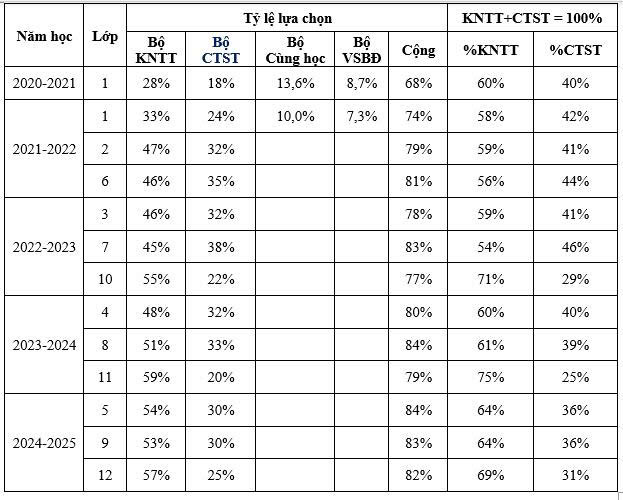
Based on researching the current textbook sets and comparing them with the selection criteria, the Ministry of Education and Training determined: The textbook set "Connecting Knowledge with Life" meets the most fully and outstandingly, specifically as follows: Ensuring full and synchronous coverage of all subjects and educational activities at all 3 levels of education; scientific and pedagogical quality affirmed through practice, widely used in all 34 provinces/cities, with the largest student scale among the current textbook sets; stability, editing ability and highest level of readiness (Vietnam Education Publishing House has sufficient technical capacity, warehousing, distribution, ensuring nationwide supply); minimizing impact on teachers - students - parents because this is the textbook set being used most stably and widely, teachers are familiar with the method and structure of lessons.
Expected impact on teachers, students and society
According to the Ministry of Education and Training, the use of a unified set of textbooks nationwide will help reduce fragmentation of learning materials, creating conditions for teaching to be carried out smoothly. Teachers will have access to the curriculum content according to the same pedagogical design, uniform in the structure of lessons, terms, knowledge - skills standards, thereby reducing the pressure of choosing materials, avoiding the situation of differences in the approach to lessons between localities.
Teacher training and fostering are carried out synchronously, saving costs, and more effectively thanks to the content focusing on a single set of textbooks. In addition, teachers have the conditions to invest more time in innovating methods, applying technology, organizing testing and evaluation, and developing accompanying materials.
For students, a unified set of textbooks will contribute to ensuring that students from all regions have equal access to knowledge, limiting differences in learning content between localities.
Students are taught according to a continuous knowledge flow from grades 1 to 12, creating a foundation for articulation and synchronization in capacity development, reducing the risk of knowledge breakage when transferring schools in the middle of the school year, especially for students in difficult areas and children of migrant workers.
The roadmap towards free textbooks by 2030 brings direct benefits to students and families, reducing regular learning costs. When textbooks are digitized, students can access open learning resources, exercises, videos, and simulations, contributing to improving interest, self-learning ability and lifelong learning ability.
For society, the unification of textbooks helps stabilize national learning materials policies, creating trust and social consensus in general education. Social costs for buying and replacing books annually are significantly reduced; people, especially in difficult areas, benefit from support and free textbook policies.
Localities are more favorable in budget allocation, organizing bidding – book supply, reducing communication pressure and implementation guidance. The unification of textbooks is also a foundation for promoting digital learning, developing digital libraries and open resources, in line with international trends and national digital transformation strategies.
The Ministry of Education and Training affirmed that it will closely coordinate with localities, educational institutions, teachers and the whole society to effectively implement the national unified textbook set.
The Ministry of Education and Training will continue to listen to and absorb the opinions of the people, experts, and teachers to constantly improve learning materials, improve the quality of teaching and learning, contributing to the successful implementation of breakthroughs in education and training development in the spirit of Resolution 71-NQ/TW.


