
Politburo member, Deputy Prime Minister Le Tien Chau just had a working session with the Ministry of Education and Training (MOET) on the implementation of key tasks of the Education sector on June 26.
Teachers are overloaded
At the working session, many issues were reported and discussed by Minister Hoang Minh Son, from the story of teacher shortage, arranging the school network, reducing study and exam pressure to preparing for the new school year or building safe schools.
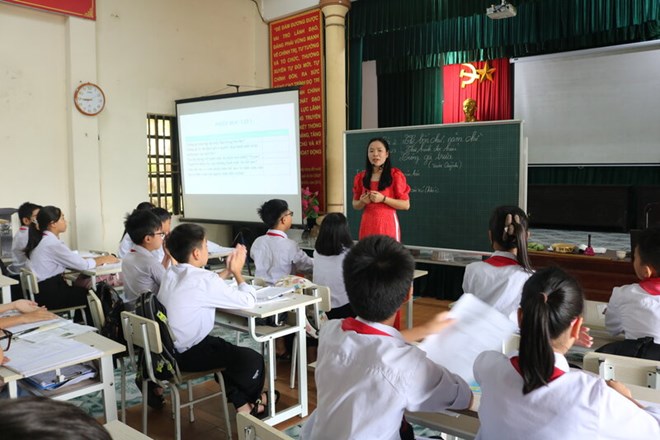
Regarding the issue of the teaching staff, the Minister said that the priority policies for the pedagogical sector in the past time have been effective, and the input quality of teacher training schools is increasingly improved.
Many young teachers are well-trained, have good professional competence, and quickly adapt to digital transformation and AI applications in teaching. Teacher training and fostering work continues to be innovated, contributing to preparing human resources to meet the requirements of education development in the new period.
But from an overall perspective, the Minister acknowledged that the Education sector is lacking teachers, and at the same time there is still a situation of surplus and local shortage. However, if only looking at the number of staff that is still lacking, it does not fully reflect the nature of the problem.
It's not that there are no teachers, but teachers are overloaded" - the Minister emphasized.
The Minister pointed out the reality that the student-to-teacher ratio in Vietnam is currently about 22-23 students/teacher, while in many developed countries, this number is only about 15-16 or lower. When a teacher has to be in charge of too many students, caring for each student, innovating teaching methods or organizing experiential activities will be limited.
Regarding solutions, the minister said that arranging the school network will help the Education sector have about 55,000 more teacher staff due to the reduction in the number of management staff and school staff. In addition, it is necessary to study adjusting teacher norms appropriately according to each development stage.
However, in the long term, it is still necessary to ensure sufficient teachers according to norms because this is an indicator of assessing the quality of education of a country.
At the working session, one of the contents that the minister paid special attention to was contract teachers. The Minister expressed concern about the reality that many teachers have been teaching for decades but have not yet been recruited as public employees, while still performing their full professional duties as teachers in the payroll.
I myself am very concerned about this issue. Why is there still inequality between contract teachers and civil servant teachers? How can teachers who have contributed for many years have the opportunity to be recruited?" - the minister shared.
The Head of the Education sector believes that this is an issue that needs to be further studied and resolved by competent authorities to ensure fairness for teachers who have contributed for many years.
Reducing study and exam pressure: Key causes must be addressed
The issue of reducing pressure on studying and exams is also the content mentioned by Minister Hoang Minh Son. The Minister acknowledged that the cause of pressure does not lie in the form of exams or admission methods, but stems from the imbalance of "supply - demand".
Citing evidence from higher education, the minister said that in the past, getting into university was very stressful, but when the training scale was expanded and the targets met the needs of learners, the enrollment pressure has decreased significantly.
If the shortage of schools, classes, and targets cannot be solved, the exam pressure cannot be solved" - the minister emphasized and said that the fundamental solution is still to ensure enough schools, classes, and teachers.
Regarding the issue of enrollment, the minister said that it is necessary to change the approach. According to him, when it is called "enrollment", there will naturally be "enrollment", there will be "selection". If learning is identified as the right of each student, it is necessary to re-examine it from the perspective of ensuring learning opportunities for learners, instead of just approaching it from the perspective of selection.


