
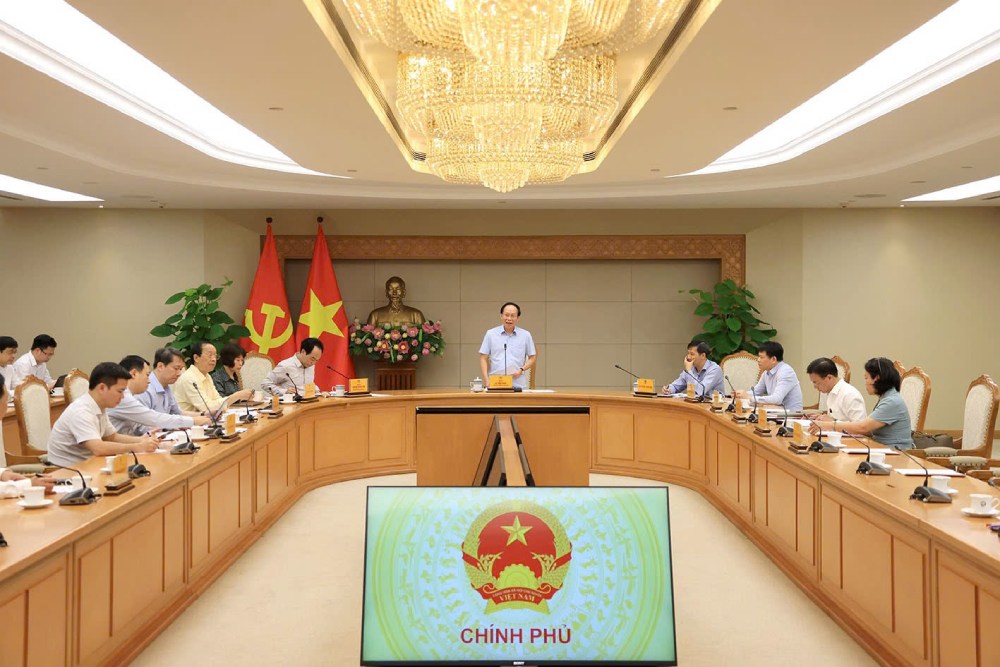
On June 26, at the Government Headquarters, Member of the Party Central Committee, Deputy Prime Minister Le Tien Chau chaired a meeting to deploy the results of the working session of General Secretary and President To Lam with the education and training sector (GDĐT).
According to the report at the meeting, regarding teacher staffing, by the end of the 2025-2026 school year, the total number of preschool and general education teachers is 1,277,297 teachers and 98,477 managers of preschool and general education institutions.
The whole country currently lacks 110,930 teachers of preschool and general education levels in the payroll compared to the prescribed norms.
To prepare for the 2026-2027 school year, the Ministry of Education and Training is implementing many tasks such as: Controlling tutoring and extra classes; reducing exam and study pressure; rectifying the problem of overcharging at the beginning of the school year.
At the meeting, the Deputy Prime Minister requested the Ministry of Education and Training to preside over and coordinate with the Ministry of Home Affairs, the Central Organization Committee and localities to report in detail the data on teacher surplus and shortage after localities implement the 2026 payroll allocation. On that basis, propose solutions for the 2026-2027 school year; report to the Prime Minister before July 10.
In the long term, the Ministry of Education and Training will preside over and coordinate with the Ministry of Home Affairs and the Central Organization Committee to study a plan to innovate the teacher payroll management mechanism.
In which, it is necessary to comprehensively calculate in relation to the arrangement of educational institutions; review regulations on the working regime of teachers and norms for the number of people working in public educational institutions.
Regarding the issue of overcharging, the Deputy Prime Minister directed the Ministry of Education and Training to study and issue a public and unified model nationwide on fees at the beginning of the school year, clearly distinguishing between compulsory fees, service fees and voluntary contributions. This must be unified nationwide.
The Ministry of Education and Training should study establishing a hotline to receive feedback on overcharging, forcing extra classes, and disguised tutoring; and at the same time, publicize the process and deadlines for handling feedback.
Regarding the issue of reducing learning and exam pressure for students, the Deputy Prime Minister assigned the Ministry of Education and Training to comprehensively review the curriculum, teaching content, testing, and assessment in the spirit of minimizing unnecessary requirements, procedures, and records; even study reducing subjects that are no longer suitable when artificial intelligence is actively supporting teaching and learning.
Regarding exams, it is necessary to proactively choose an organizational plan, both reducing pressure on students and ensuring quality and fairness.
Regarding school safety, the Deputy Prime Minister noted that it is necessary to strictly handle acts of school violence; buying and selling, using e-cigarettes in and around schools; strengthen inspection and handling of food safety and hygiene issues at eateries in front of school gates and right in schools.
Government leaders agreed with the proposal to study a plan to manage the use of social networks in a controlled manner.
The Ministry of Home Affairs shall preside over and coordinate with the Ministry of Education and Training to immediately review the current situation of the team of civil servants in charge of education at the commune level; clarify where there is no person in charge, where officials have to concurrently hold too many fields, and where there is still a lack of expertise to have professional training and support plans before the new school year.


