
From the 2026-2027 school year, in Hanoi, the People's Committees of communes and wards are the main units to establish councils to select, sign contracts and assign suppliers of semi-boarding meals for schools in the area. The selected units must meet the capacity profile according to regulations. However, the inadequacies in semi-boarding meals appearing in the early days of the school year raise the practical issue of the gap between management profiles and actual operating capacity.
Ms. Le Thi Thu Chung - Vice Principal of Ly Thuong Kiet Primary and Secondary School (Van Mieu ward - Quoc Tu Giam, Hanoi) said that the selection of suppliers at the new ward level is part of the process. When meals are organized at school, the school is responsible for monitoring the reality from input food, processing process to when meals are delivered to students.
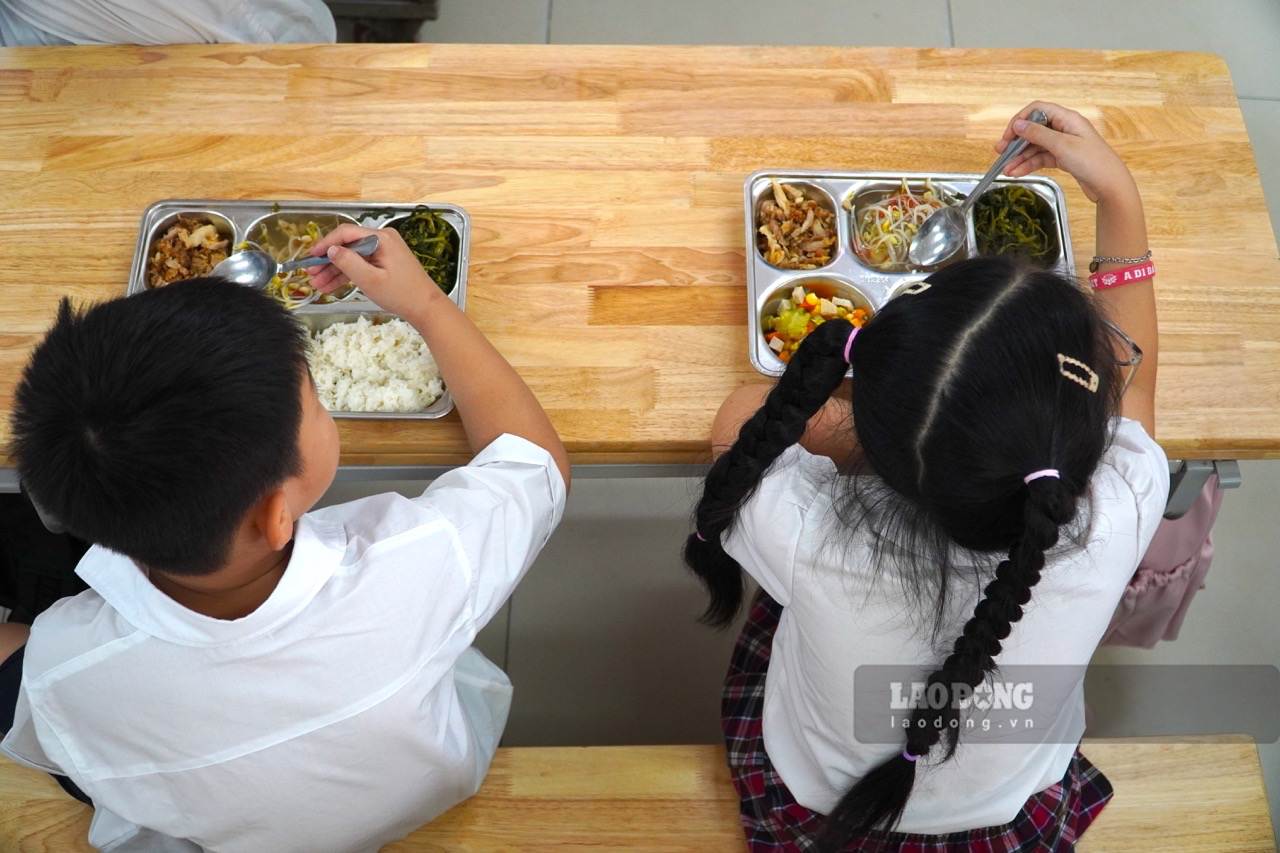
Need to shift from the thinking of "sufficient dossiers" to "sufficient operating capacity
From an expert perspective, Dr. Vu Viet Anh - General Director of Thanh Cong Academy said that businesses with full licenses, certificates and capacity profiles are still not enough to ensure the ability to serve thousands of meals on time, at the right temperature, and in the right quantity.
Therefore, it is necessary to shift from the thinking of "sufficient dossiers" to "sufficient operating capacity". When selecting suppliers, in addition to legal capacity, it is necessary to appraise "load capacity", including the number of schools serving, transport radius, number of specialized vehicles, kitchen capacity and handling plans when vehicles break down, traffic jams, power outages or lack of personnel.
The assessment also needs to be based on data such as on-time delivery rates, quantitative errors, number of menu changes, results of unexpected checks, parents' feedback, leftover food rates and error correction time.
A good meal is not only a meal that does not cause poisoning but also must be on time, on the right menu, with enough servings, balanced nutrition and in accordance with the supplier's commitments" - he assessed.
The next solution is to establish a "verification checkpoint" at the end point before meals reach students. The control needs to be simple enough to be carried out daily but tight enough to detect abnormalities, from the delivery time, vehicle status, sealing, sensory quality to menu comparison, random weighing of samples, storage of delivery records and samples according to regulations.
Building a scientific and effective school meal management mechanism
Hanoi has issued a 10-step process for organizing semi-boarding meals, showing that the locality is shifting from general management to standardizing the process. In addition, HanoiCheck - a database system on nutrition and school food safety of Hanoi - has been put into operation, receiving supplier dossiers and supporting evaluation and selection in a more public direction.
However, Mr. Viet Anh said that digitizing a process that is not good does not mean that the process will be better. QR codes are only meaningful when data matches the actual goods; cameras are only useful when there is someone responsible for monitoring and processing. A beautiful picture of a tray of rice does not prove that thousands of meals are guaranteed equally.
Therefore, data needs to be used to form an early warning system. The fact that one unit continuously delivers late, the number of complaints increases, the rate of abnormal leftovers, one dish being discarded a lot by students, the quantity of samples decreases or the supply changes frequently are all signals that need to be checked.
The management process, according to Mr. Viet Anh, should follow 4 steps: "Signal - Verification - Conclusion - Action". Signals are not evidence of violations, but it is impossible to wait until an intoxication or communication crisis occurs to start collecting data.
Along with technology, there needs to be a clear responsibility map, identifying at each link who implements, who checks, who has the right to refuse and who is responsible when errors occur.
The head cannot directly stand at every kitchen, but must ensure that no stage is left unresponsible" - Dr. Vu Viet Anh said.
In addition, he believes that parents also need to participate as a social supervisory class. They have the right to know what their children eat, how much, where the food comes from, and when there is feedback, who will resolve it, and how long will it take to get an answer.
The most necessary thing is not to add another layer of dossiers, but to build a unified school meal management architecture nationwide, in which localities can choose appropriate models but must ensure minimum standards on nutrition, supplier capacity, delivery time, verification at the end point, data retrieval, early warning and specific responsibilities" - Dr. Vu Viet Anh stated his point of view.


