
Wings for ideas to step out of paper
Launched in December 2025, the Innovation Contest for the Community - FIPAD Innovation Contest 2026 aims to find and support student initiatives to solve community problems through innovative solutions. The contest attracts proposals from student groups from many universities and academies in Hanoi such as the Diplomatic Academy, National Economics University, Hanoi University, Foreign Trade University, University of Social Sciences & Humanities...
Not stopping at selecting potential ideas, FIPAD Innovation Contest continues to accompany teams in the initiative implementation phase. After the selection and project defense rounds, the three most outstanding projects are selected to enter the implementation phase, receiving funding support of 17 million VND for each initiative and the companionship of experts to directly organize activities in the community.
It is the practical implementation requirement that has created the difference of the competition. Instead of just convincing the Judging Council with the novelty of the idea, the teams must find their own solutions to the problems arising during the implementation process: what the target community really needs, which approach is appropriate, how resources are mobilized, and how project effectiveness will be evaluated.
From practical observations, the three initiatives selected to enter the implementation phase have approached social issues in different aspects, including sex education for children with disabilities, preventing gender-based violence in cyberspace and enhancing youth participation in global climate processes. The differences in the themes of the three projects partly reflect a diverse picture of students' concerns today.
Lessons from practical implementation
Reality is always different from the initial plan," that is what Ha Thi Hien, a student at the University of Social Sciences & Humanities (VNUHN), a member of the Glass Shield team, concluded after 3 months of implementing the SafeHer project - an initiative that won the Second Prize at the FIPAD Innovation Contest.
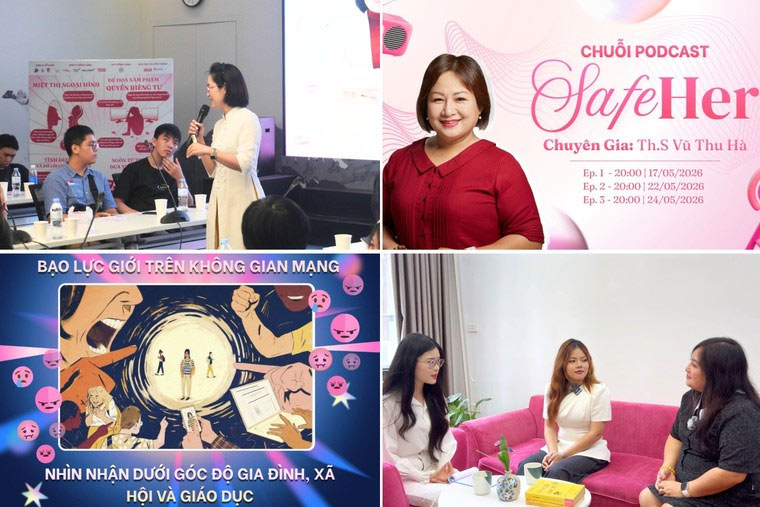
Stemming from the desire to contribute a voice in raising awareness of young people about gender-based violence in the digital environment, Glass Shield built a project with a series of activities including professional articles, podcasts, sharing workshops and video creation contests. Through familiar media forms to students, the group hopes to attract the participation of the community to join hands in creating a safer and more respectful cyberspace.
Glass Shield's SafeHer initiative brings a series of online and live activities on the topic of preventing and combating gender-based violence in cyberspace
However, when starting to deploy, members quickly realized that communication on a sensitive topic requires more creative ideas. Each content related to gender-based violence must go through many rounds of exchange and editing with experts to ensure accuracy, avoiding unintentionally creating secondary harm to the recipient.
Meanwhile, the video production contest, an activity expected to attract a large number of young people to participate, did not receive the expected number of entries, forcing the group to shift the focus from quantity to quality of messages and the level of change in participants' awareness.
The project implementation process helps us realize that a social project is not always implemented according to a fixed roadmap, but requires flexibility, the ability to listen to the target community and readiness to adjust to create a more appropriate and sustainable impact," Hien shared.
Meanwhile, choosing a simulated conference model to approach the topic of global climate processes, COP to the Future - the team that won the Third Prize overall with the TriCop but Cooler initiative - faces the problem of balancing professional depth and the accessibility of young people.
The biggest challenge is balancing academicity and accessibility. The contents on climate diplomacy and the three Rio Conventions are relatively complex for many delegates, so the group had to spend a lot of time simplifying documents and providing professional support throughout the conference," said Tran Thi Khanh Linh, a student at the Diplomatic Academy, a member of COP to the Future.
MSc. Nguyen Thuy Van, Executive Director of the Paris Institute for Action Excellence in Vietnam, former Deputy Head of the News Department of Voice of Vietnam (VOV1), member of the Judging Council of the Final Round of FIPAD Innovation Contest 2026, highly appreciated the spirit of daring to take on the challenges of the teams that entered the Final Round. She also said that the collisions in the implementation process are a necessary experience for young people.
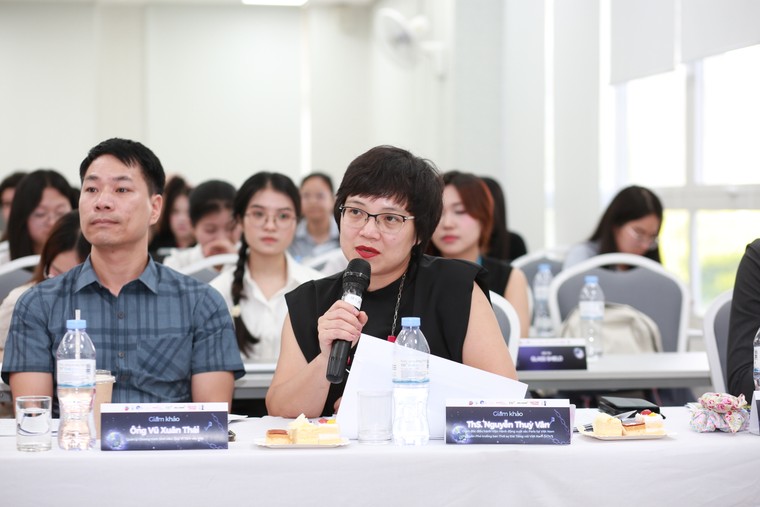
“Community ideas are always very beautiful, but when implemented in practice, there will be many problems arising that young people can hardly foresee, from time, funding, personnel to coordination with partners. However, if you do not start working, you will never be successful. The important thing is what you learn from those experiences to move forward,” she said.
From student playgrounds to impacts for the community
Overcoming initial difficulties, the projects have gradually gone into practice and begun to receive the first feedback from the community they are aiming for.
Nguyen Nhat Minh, a student at Hanoi University of Culture, participating in the program as a representative of the Saudi Arabia delegation, commented: "The program has brought a completely new breeze, not being stained by old clichés. The combination of expertise and free creative space is what makes the difference.
As an organizer, I feel very happy to see topics that are considered'dry' can evoke such interest. That moment made me believe that young people are really interested in global issues; what they need is sometimes just a suitable space to learn and contribute," Khanh Linh said.
With Hearts to Hearts, the team won the First Prize overall with the initiative on sex education and child protection for children with disabilities, the positive changes from young children at Thuy An Center for Rehabilitation of People with Disabilities are the clearest result after the project implementation process.
To help children with disabilities access knowledge about sex education, the group built the Escape Room model with role-playing situations specifically designed according to the cognitive abilities of each target group. The learning space is transformed into an experiential journey, where children solve challenges about the 5-finger rule, identify dangerous behaviors and practice self-defense skills.
Le Thi Kim Khanh, a student at the Diplomatic Academy, a member of Hearts to Hearts, said that the children, who were still shy when entering the experience room, gradually actively interacted and coordinated with each other and with their siblings to overcome each challenge.
After the program, the group still received messages from children and teachers at Thuy An Center wishing the project to return soon.
Opportunity for young people to continue to go far
Initiatives implemented within the framework of the FIPAD Innovation Contest may have only created modest impacts if placed in the context of broad social issues. However, these first experiments have given students the opportunity to test their ideas in practice, listen to feedback from the community and continue to improve the project after the competition.
In the coming time, the Hearts to Hearts Team said it wishes to continue developing the "Touch" project, perfecting the Escape Room model and expanding operations to more specialized educational institutions. Meanwhile, COP to the Future aims to develop TriCOPbutCOOLER into an annual program for young people interested in climate and sustainable development, and hopes that policy recommendations built from the simulation conference will have the opportunity to connect with policy dialogue forums in the future.
For young people's ideas to have the opportunity to develop into practical initiatives, besides the enthusiasm of students, suitable nurturing environments are also needed, where you can access resources, receive companionship from experts and have the opportunity to learn from the project implementation process itself. This is also one of the goals that FIPAD Innovation Contest aims for in the process of accompanying students.
“Through the FIPAD Innovation Contest in particular and the DynaGen Initiative Student Development Initiative in general, we want to empower a generation of students who not only have professional competence, but also have a sense of responsibility to the community and are ready to act against social problems. Playgrounds like FIPAD are opportunities for you to try your hand, to accompany and gradually turn positive ideas into practical values,” shared Mr. Vu Xuan Thai, Student Program Manager, For Vietnamese Stature Fund.
The activity is within the framework of the DynaGen Initiative Student Development Initiative Course 6, implemented by the For Vietnamese Stature Fund (VSF) in coordination with the Diplomatic Academy of Vietnam, with the companionship of TH Group, Bac A Commercial Joint Stock Bank (BAC A BANK) and Education & Times Newspaper.


