
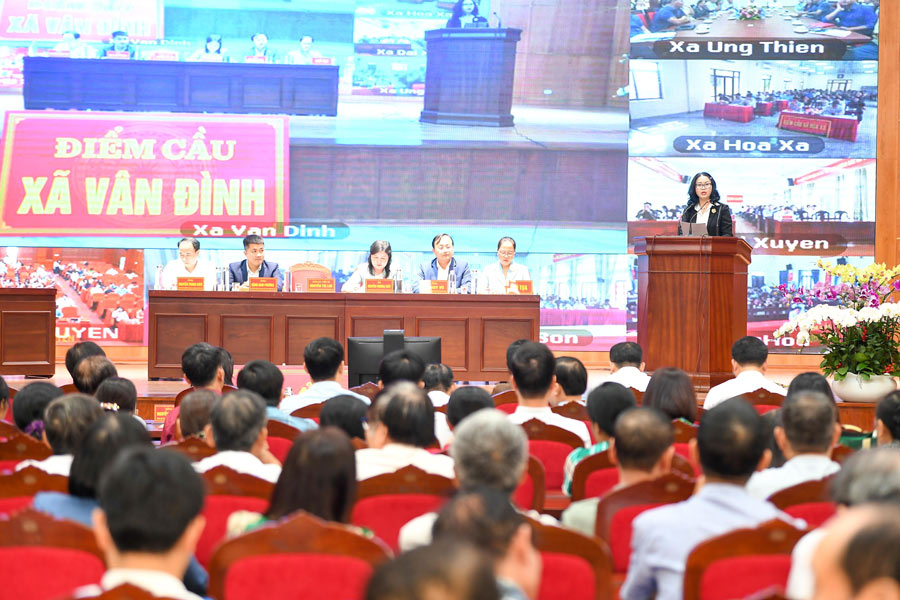
At the large hall of Van Dinh Commune People's Committee (Hanoi), the Standing Committee of the Fatherland Front Committee of Van Dinh commune organized a direct combined online meeting with voters for candidates to campaign for elections in communes under Election Unit No. 8, National Assembly Deputies of the 16th term.
Constituent unit No. 8 includes 12 communes in the South of the city: Van Dinh, Phu Xuyen, Phuong Duc, Chuyen My, Dai Xuyen, My Duc, Hong Son, Phuc Son, Huong Son, Ung Thien, Ung Hoa and Hoa Xa, where there are strengths in agricultural production, craft villages and ecotourism.
At the conference, Prof. Dr. Nguyen Thi Lan - Director of the Vietnam National University of Agriculture - presented an action program if voters trust her to be elected as a National Assembly Deputy of the 16th term. She said that this is the area where she used to work as a National Assembly Deputy in the previous term and affirmed that she clearly understands the honor and responsibility of a people's representative: "Delegates must speak the voice of the people and protect the legitimate rights of the people".
According to Ms. Nguyen Thi Lan, 12 communes belonging to three districts Phu Xuyen, My Duc, Ung Hoa (old) are land rich in traditions of the Red River Delta, known as a place of "talented people", rich in culture, studiousness and revolutionary heroism. This is the homeland of many famous people, successful graduates, artisans; with many relics, scenic spots and famous craft villages. This is both a source of pride and a foundation for the development of a new stage.
Small-scale production, low added value needs to be removed
Besides the results achieved after the merger and maintaining socio-economic development, agricultural production in the area is still mainly small-scale, the added value is not high, and market linkage is unsustainable. The situation of "bumper crop, price drop" still occurs; environmental pollution in some production areas and craft villages has not been thoroughly handled; limitations in vocational training and rural clean water are issues that need to be prioritized for resolution.
Through actual surveys in 12 communes, Ms. Nguyen Thi Lan found that each commune has different advantages and development requirements: some are strong in aquaculture, some have traditional craft villages, some have ecotourism potential; some localities need to promote specialties associated with tourism, some need to promote high-tech agriculture and stabilize outputs, and some raise the issue of environmental treatment. "Policies must be flexible, focused, and cannot be spread out" - she emphasized.
Stemming from the actual needs of the people of the communes and the strengths of the Vietnam Academy of Agriculture, if trusted, she is committed to focusing on participating in building and supervising policies on agriculture, rural areas and farmers in a specific, practical and appropriate direction for each locality. The focus is on perfecting the land mechanism, environmental protection; developing ecological, circular, high-tech agriculture; reorganizing production according to the value chain; promoting digital transformation; and ensuring livelihoods, expanding access to credit and insurance so that farmers can feel secure in investing in production.
Agriculture must shift from small-scale production to high-value production, taking science and technology and innovation as motivation" - Ms. Nguyen Thi Lan affirmed.
Connecting scientific resources, developing ecological agriculture and digital transformation
Answering voters, Ms. Nguyen Thi Lan said - her biggest advantage is the ability to connect scientific and technological resources of the Academy with local practical needs. If she becomes a National Assembly deputy, she will promote the completion of policies to strengthen the transfer of technical advances into production; and directly coordinate with communes to build commodity, organic, and high-tech agricultural models.
She also committed to supporting vocational training for farmers, improving cooperative capacity, developing OCOP products, building local brands and researching environmental treatment solutions in animal husbandry and production. Places with conditions will link production with ecotourism and craft villages to increase livelihoods.
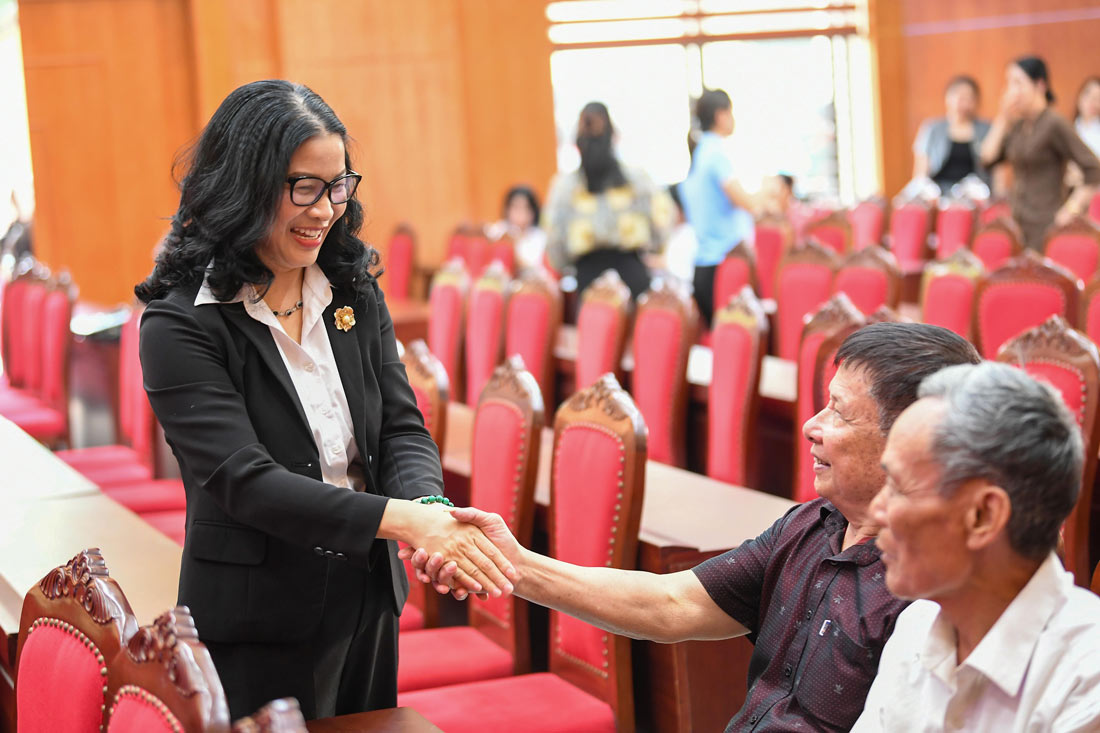
The Director of the Vietnam Academy of Agriculture affirmed that she will regularly contact, listen, synthesize and truthfully reflect voters' opinions; monitor and urge the settlement to the end; maintain direct and online, public information channels for voters to conveniently exchange. According to her, voter satisfaction is a measure of the responsibility of a people's representative.
I was born in an agricultural area, trained and worked in this field. If I continue to be trusted, I want to bring my knowledge and experience to contribute to improving the lives of rural people in Hanoi" - Ms. Nguyen Thi Lan expressed.
During her work, Prof. Dr. Nguyen Thi Lan - Director of the Vietnam National University of Agriculture achieved many achievements and was awarded many forms of commendation.
01 Certificate of Merit from the 15th National Assembly Standing Committee, 01 Certificate of Merit from the Prime Minister, 03 Certificates of Merit from the Minister of Agriculture and Rural Development, 01 Certificate of Merit from the Minister of Education and Training, 02 Certificates of Merit from the Executive Committee of the Vietnam Agriculture and Rural Development Trade Union, 02 Certificates of Merit from the Central Vietnam Women's Union, 01 Certificate of Merit from the Director of the National Academy of Public Administration, 01 Certificate of Merit from the Central Propaganda Department, 07 Certificates of Merit from the Hanoi Party Committee.
Meritorious Teacher; Kovalevskaia Award; Typical Science and Technology Intellectual.


