
Reducing focal points, reducing management staff
In the context of innovating the organization of two-level local government and implementing the Central Resolution on the arrangement of the system of agencies and units, the Ministry of Education and Training (MOET) is stepping up the arrangement and merger of preschool, general education and continuing education institutions nationwide with a determined but cautious spirit.
Accordingly, the management apparatus will be streamlined and efficient, in parallel with the goal of ensuring the learning rights of students and stabilizing jobs and livelihoods of teachers and managers.
According to the report of the Ministry of Education and Training, many provinces and cities have so far completed the plan to reorganize the network of educational institutions. The merger has contributed to streamlining the management of the educational institution system, especially in the administrative apparatus such as principals, accountants, treasurers and administrative staff, thereby reducing management costs and focusing resources on professional activities.
Synthesizing reports from 23/34 provinces and cities sent to the Ministry of Education and Training up to this point, most localities will keep kindergartens, primary schools, secondary schools, and high schools unchanged in 2025 and develop a roadmap for arrangement after the end of the 2025-2026 school year.
For preschool education, 6/23 provinces will maintain the status quo, 15/23 provinces will gradually decrease from 1.76% to less than 10%, 1 province has completed the merger, reducing 45.83% of educational institutions.
In general education, 7/23 provinces remained unchanged, 15/23 provinces decreased from 0.2% to less than 10%, 1 province decreased 42.57%. Continuing education has a strong merger rate, many localities have reduced it by over 30%.
The Ministry of Education and Training assessed that the initial arrangement has contributed to streamlining focal points, reducing management staff, rearranging the team of teachers and staff, and overcoming local shortages and excesses.
During the implementation process, some localities have significantly reduced the number of schools, some places have nearly 50% of the number of facilities after the merger, contributing to solving the "manhole" situation and distributing resources.
Personnel adjustments after the arrangement have also been carried out: Many principals have been arranged as deputy principals or returned to teaching classes, and some cases of teachers who have reached the early retirement age have also been considered according to regulations.
However, the arrangement is not uniform in localities. In some cases, there are still shortcomings, such as in some places where schools have up to 9 vice principals - more than 3 times higher than the regulations, showing that the work of streamlining the apparatus has not yet stabilized immediately after the merger.
Continuous policies and instructions of the Ministry of Education and Training
The Ministry of Education and Training identifies the arrangement and merger of schools not only as a reduction in the number of facilities but also as a means of improving the quality of education and meeting the requirements of universal education according to current regulations. This becomes even more urgent in the context of implementing the two-level local government model and the process of arranging administrative units.
The Ministry of Education and Training has repeatedly emphasized that it is not to run a mechanical reduction of focal points but lacks calculation on the quality of teaching and learning; the arrangement must ensure enough schools, enough classes, enough teachers in each area, ensuring the learning rights of students and working conditions of teachers.
The arrangement must comply with standards on schools, facilities, and teaching staff; at the same time, focus on disadvantaged areas, border areas, and islands to avoid preventing students' learning opportunities.
The arrangement needs to be carried out with a roadmap and caution, avoiding disruption in teaching and learning activities, and focusing on small-scale schools and school locations that are no longer suitable.
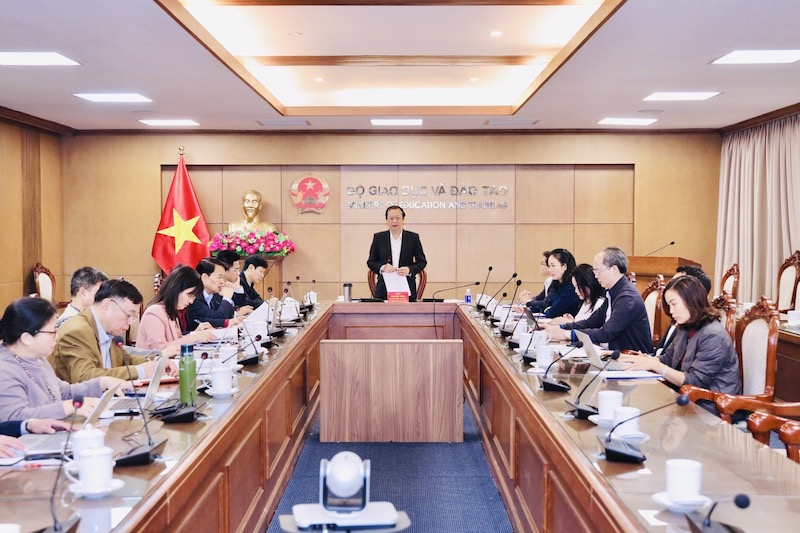
Permanent Deputy Minister of Education and Training Pham Ngoc Thuong has repeatedly emphasized that the arrangement of the school network is not a mechanical cut-off, but must take the quality of education, the rights of students and teachers as the highest goal.
Goal of ensuring the rights of learners and the education team
The Ministry of Education and Training always emphasizes that any arrangement plan must put the interests of students at the center.
This means ensuring: Students in remote areas, vulnerable groups have full access to educational institutions, especially the system of appropriate boarding and boarding schools.
Ensure employment rights and policies for managers, teachers, and staff affected by the arrangement, including transfer, rearrangement, retirement, and staff streamlining according to regulations.
The Ministry of Education and Training also recommends that local departments and branches closely coordinate with relevant sectors to monitor, evaluate the reality as well as promptly report difficulties, thereby adjusting appropriate plans for each region, avoiding excessive disruption to teaching and learning activities.
Localities must complete the arrangement of preschools, general education and continuing education institutions before December 31, 2025.


