
The Ministry of Education and Training (MOET) has Official Dispatch 4054/BGDĐT-GDPT on promoting the arrangement of the network of public preschool, general, and continuing education institutions in accordance with local authorities at two levels. According to this official dispatch, the Ministry requests some localities to pilot 2 large-scale school models from July 1, 2026.
To guide localities to implement, the Ministry of Education and Training has just issued plan 1186/KH-BGDDT on promoting network arrangement and piloting a number of models for public preschool, general education, and continuing education institutions.
The Ministry of Education and Training provides detailed guidance when implementing the two school models after the merger:
Model 1 - Large-scale single-level school (or Continuing Education Center) with branches: The structure includes 01 main school with branches and school points.
The personnel structure includes 01 principal, vice principals, 01 administrative - personnel department (accountant, cashier, clerk) for common use; personnel supporting education according to specialized expertise; professional groups are organized in accordance with branches and school sites to improve the effectiveness of professional activities and teaching organization.
Depending on the actual situation of class size, students, geographical distance to the main school, arrange each branch to have 01 vice principal in charge of the total assigned staff quota to ensure the quality of education.
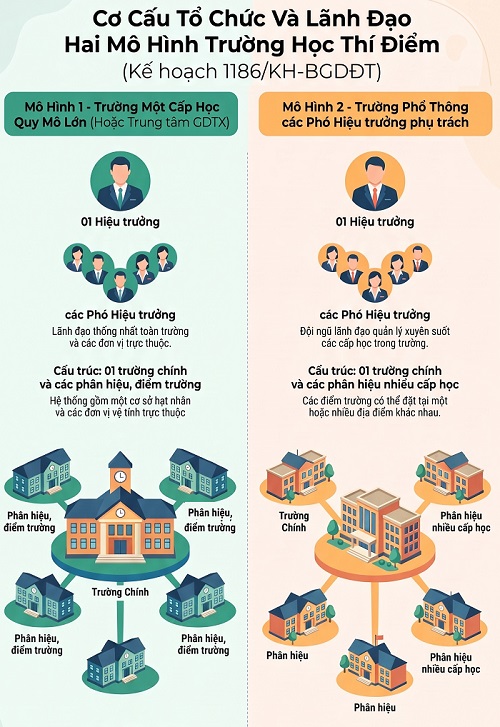
Model 2 - Large-scale multi-level general education school: Implemented at 1 location or different locations; structure includes 01 main school, with branches and school points with many levels of education.
The personnel structure includes 01 principal, vice principals, administrative - personnel department (accountant, treasurer, clerk) for common use; personnel supporting education according to specialized expertise; professional groups are organized in accordance with the school level, branch, school point to improve the effectiveness of professional activities and teaching organization.
Depending on the actual situation of the school level, class size, students, geographical distance to the main school, arrange each branch to have 01 vice principal in charge of the total assigned staff quota to ensure the quality of education.
According to the Ministry of Education and Training, pilot models must operate effectively, shift focus from management to effective governance, strengthen the application of information technology to reduce pressure on administrative procedures, be transparent, smooth and controlled and counted on a centralized digital platform (synchronous management of personnel, finance, assets, professional records); ensure not to affect students' learning rights and the quality of education throughout the system.
The 15 localities selected to pilot the above two models are: Hanoi, Ho Chi Minh City, Hai Phong City, Hue City, Cao Bang, Lang Son, Tuyen Quang, Vinh Long, Bac Ninh, Hung Yen, Ninh Binh, Nghe An, Dak Lak, Lam Dong, Dong Nai.
The Ministry of Education and Training has set out the implementation roadmap as follows:
From July 1, 2026: Pilot the merger of management focal points for educational institutions in the same area to form large-scale school models with branches and school sites; establish a school governance model.
- Before August 30, 2026: Complete the pilot phase, establish a school network suitable for the area and population size; complete the organizational structure and school governance plan to operate right from the beginning of the 2026 - 2027 school year.
- Before December 30, 2026: Comprehensively assess the affected subjects, draw lessons from phase 1 (pilot); form a management model; propose solutions to implement the next phase.
- From March 30, 2027: From the results of phase 1 implementation (pilot), continue to implement the merger and consolidation of educational institutions in the area according to management authority.
- Before April 30, 2027: Complete comprehensively the arrangement and streamlining of administrative management focal points; stabilize governance, finance, and public assets; ensure that the entire system operates synchronously, smoothly and does not cause any impact on professional teaching and learning activities at school sites.


