
The main enrollment method structure for the 2022-2025 period just announced by the Ministry of Education and Training has 7 main admission methods: High school graduation exam results; High school academic results; Direct admission according to the regulations of the Enrollment Regulations; Aptitude test, thinking test and separate entrance exam; Use of aptitude test results, thinking test organized by other units; Cultural exam organized by CSĐT for admission; Combining high school graduation exam results with other methods.
In 2025, about 50.3% of admitted people mainly used the results of the high school graduation exam, down 1.86% compared to last year. Meanwhile, the method of considering high school academic results (considering high school transcripts) increased from 28.2 (in 2024) to 29.2% in 2025.
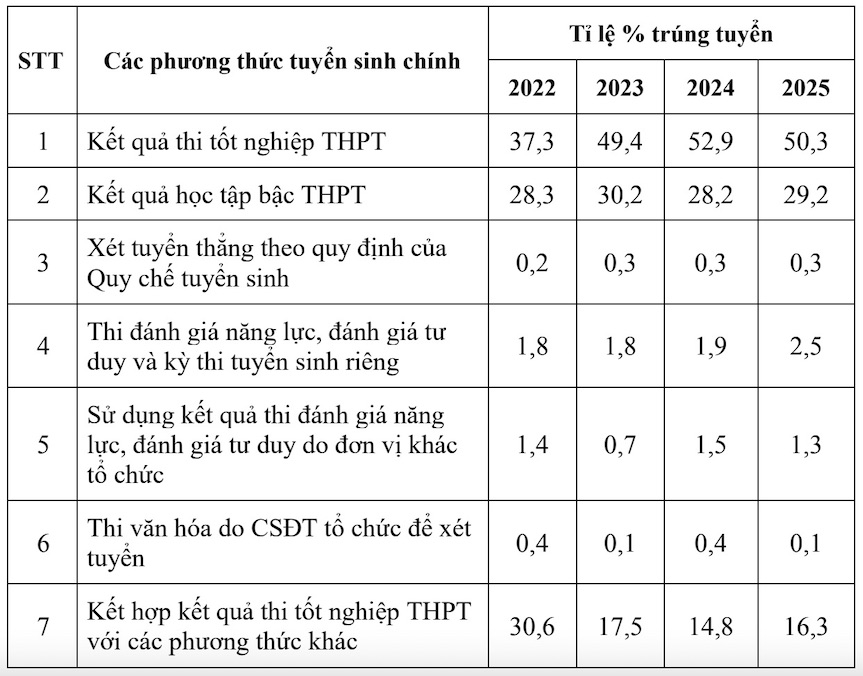
Similarly, the proportion of enrollment through competency assessment, thinking assessment and separate exams also increased, from 1.8% in 2022 to 1.9% in 2024 and 2.5% in 2025.
The Ministry of Education and Training assesses that this structure shows that the results of the high school graduation exam are still a widely used source of enrollment data, while the right to develop and use separate enrollment methods of training institutions is still guaranteed.
In addition, the Ministry of Education and Training also said that the scale of higher education enrollment continues to expand. In the period 2020 - 2025, the number of enrolled people increased from 460,160 to 681,688 people, an increase of 48.1%; the enrollment rate compared to the number of exam takers increased from about 51.1% to 59.0%. The proportion of training institutions with enrollment reaching 80% or more of the target increased from 58.6% in 2022 to 76.0% in 2025.
This shows that the competitive pressure of admissions throughout the system is no longer as concentrated as before; competition mainly takes place in some institutions, majors and programs with high attractiveness" - the Ministry assessed, and at the same time said that the current admission model has the advantage of combining autonomy with accountability, diverse methods with a unified data infrastructure, protecting the priority rights of candidates' aspirations, reducing the risk of being admitted to many places but not enrolling and creating data for management and supervision.
However, the use of multiple admission methods also raises the requirement to continue to improve regulations on equivalent conversion, minimum standards for independent exams, publicize score distribution and evaluate the actual effectiveness of each admission method.
The above figures may change after the 2026 enrollment season. The reason is that the Ministry of Education and Training requires each school to only use a maximum of 5 methods instead of being unlimited as every year. With high school transcript review, candidates must have an average score of 6 semesters (10th, 11th and 12th grade) of at least three subjects, compulsory for Math or Literature, and achieve a graduation exam score of 15/30 or higher. In addition, many universities tend to reduce high school transcript review separately but combine multiple scores. The number of candidates registering to participate in separate exams is all record high.
Notably, the Ministry of Education and Training expects that from 2027, each major and training program will only apply three admission methods, excluding direct admission and group admission. From 2028, schools will only be allowed to use one admission method for one major and program.
In the coming time, the Ministry of Education and Training will continue to maintain the stable multi-modal admission autonomy model on the common data infrastructure; improve regulations on accountability, test standards for independent exams, principles of equivalent conversion and data disclosure; and at the same time build an interconnected database from high school academic results, admission methods to the learning, graduation and employment process to evaluate the effectiveness of each admission method.


