How cold are you girls, we are twice as cold
At 5 am, teacher Pham Duc Thinh - English teacher at Chieng On Primary and Secondary School (Son La province) - got up to set up the stove, warm the pot of water for students to wash their faces before class. The official residence where the teacher stayed was just a wooden room, open walls, thin blankets, he just smiled gently: "You guys are so cold, we are twice as cold. Just need the class to have students and we will feel warm.
At the end of the year, the temperature in Chieng On dropped below 6–7°C for many days, with thick mist, visibility not exceeding a few meters. However, every week teacher Thinh still travels dozens of kilometers to remote school locations to teach combined classes. There was a time when he was assigned to teach at Ca Nang Commune Primary and Secondary School, nearly 80km from the local school to continue supporting the English subject. Many days the wind was bleaching, the teacher had to scout step by step. When he came to class, his limbs were numb because of the cold.
In Y Ty (Lao Cai), one of the coldest areas in the Northwest, many schools are located at an altitude of nearly 3,000m above sea level, the roads to enter are often covered in white ice. Some days teachers have to wait until 9-10 am to be able to enter class because the roads are as slippery as grease. If you are impatient, it is very easy to slip into the stream.
Teacher Nguyen Dinh Hai (Y Ty Ethnic Minority Boarding Primary School) recounted that one morning he had to cling to the forest rope to cross the frozen road to come to class: "I walked one step, slipped half a step. There was a section where I had to crawl into the cliff. But thinking about the students of Ha Nhi and H'Mong ethnic minorities waiting, no matter how hard it was, I tried.
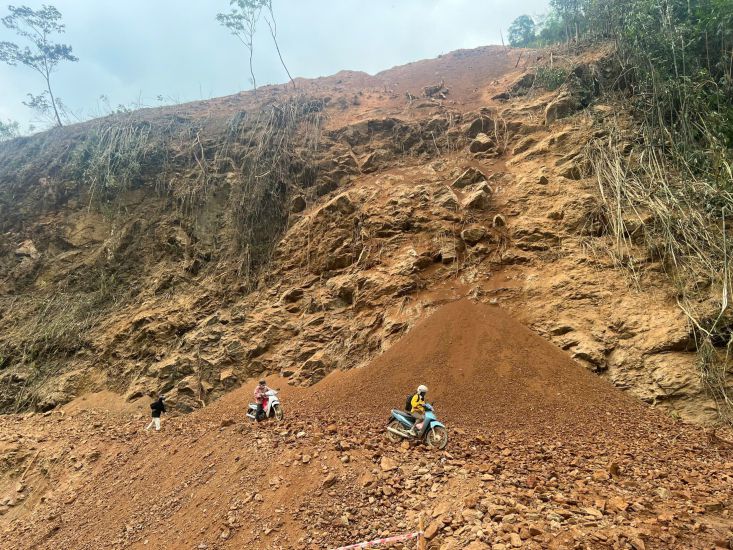
Ms. Nguyen Huong Giang, Suoi Dam school point of An Luong Kindergarten (Lao Cai province) also confided: "The road to my school point is all dirt road, when it rains, dirt often landslides, so traveling is hard. There are many days when I have to leave my car on the road, walk 3-4km to get to the school point. Although wearing boots, it is still very slippery, we fall bruised and have ankle pain is common.
Last year, water from the source flowed down, motorbikes could not pass, we had to leave our motorbikes and walk hand in hand across the stream to get to the school point, in our hearts we were very scared, but because the children were waiting at the school point, we had to try. The children here are still in difficulty, the road is difficult to travel, it rains but the children still come to class normally, seeing the teachers and children are very happy, so we also take that as motivation.
Similarly, the job of "sowing literacy" in the highlands for teacher Hoang Van Hanh has never been easy. Mo Si San school point (Mo Si San Primary and Secondary School) where teacher Hanh works is a few dozen kilometers from the center of Si Lo Lau commune, Lai Chau province. The road is dangerous, especially in the rainy and flood season, he has to park his motorbike and then wade through the stream. Arriving at the place, people are soaked. "Dao students are very miserable, they don't have books, don't have much clothes; in the morning they only eat corn, potatoes, cassava, sometimes they have to drink plain water to fill their stomachs. Many students have to drop out of school midway due to large families and poverty... Thinking about it makes me feel very sorry" - teacher Hanh confided in harmony.
To prevent students from giving up halfway, the teacher struggled to cross slopes, cross streams, into each house to mobilize them to go to school. The teacher remembered that there was a family at the end of the village, the slope was steep, it had to cling to tree roots to climb. But when he saw students smiling and running out to greet them, all hardship seemed to disappear. Facing countless difficulties, teacher Hanh still maintained a simple belief: "If we give up, students will be disadvantaged" - that saying is also the motto of life for the teacher to persevere for the past 16 years.
Students cross streams, cross forests to class
After 5 am, when the fog is still covering the mountainsides, Hoang Thai Thien - an 8th grade student, in Huoi Luong 1 village, Phong Tho commune, Lai Chau province, put on a small briefcase and walked down the slope to school. “Now my parents are working in the fields, no one takes me to school, so I have to go early to be on time for school” - Thien shared.
Thien's house is more than 5km from the school but does not meet the conditions to enjoy semi-boarding. On sunny days, he takes more than 1 hour to walk; on rainy days, the road is slippery, his parents have to take him to school early, before starting the field work.
Students in circumstances like Thien are not uncommon. In Lai Chau - where more than 80% of ethnic minorities, one of the provinces with the highest poverty rate in the country (nearly 20%), their road to school is not only winding hills and mountains, but also a journey through poverty and barriers to realize the dream of "knowing how to read".
In Tua Chua (Dien Bien), a group of 3rd grade students from Ta Sin Chai village had to overcome a rocky slope nearly 700m long, with a 45-degree slope to get to class. On cold days, thin ice covers the rocks, the children hold hands step by step. Teachers instructed: "Don't go alone. If you see your friend fail, you have to keep your shirt on.
Ms. Lo Thi My, a parent with two children studying at Xa Ho Ethnic Minority Boarding Primary and Secondary School - shared: "He told me to go to school so that I wouldn't be as miserable as my parents later. No matter how cold it is, I go. The house only has an old warm coat, torn shoulder, but he still keeps it as a precious thing.
Despite difficulties, the studious spirit of highland students has made the rate of maintaining enrollment have positive changes. In the Northwest provinces such as Lao Cai, Son La, Lai Chau, Dien Bien, the dropout rate in winter has decreased to below 1.2%, significantly lower than 3 years ago.
Mr. Luyen Huu Chung - Director of the Department of Education and Training of Lao Cai province - said that the province is prioritizing investment in more solid classrooms, and at the same time repairing temporary bridges and re-paving slippery roads leading to difficult school sites.
One of the important solutions is to coordinate with the people. When the people are united, the road to class for students will be much less arduous. Some schools also implement the "Welcoming students from the village" model every time there is heavy rain. Teachers are assigned to go all the way to the village, accompanying students to school to ensure safety" - Director of Lao Cai Department of Education and Training shared.
This Northwest season is freezing cold, but amidst the vast cold mist, the sound of reading lessons in corrugated iron classrooms still echoes every morning. Small feet crossing streams, teachers' footsteps printed on slippery mountain roads, all are creating a beautiful picture of learning. And no matter how strong the monsoon blows, the fire to school in the highland villages has never stopped.