
From 2024, Hanoi City piloted a road dedicated to bicycles along the To Lich River. However, after more than a year of implementation, this model has not yet been as effective as expected.
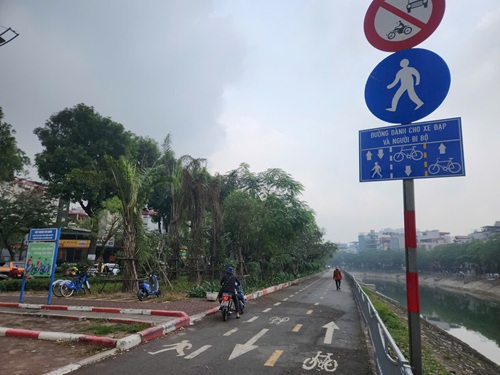
Records on the pedestrian and bicycle road along the To Lich River (parallel to Lang street), about more than 2km long, show that the bicycle lane is often sparse. Although the infrastructure has been completed, the To Lich River is clear and the weather is favorable, the number of users is still very limited.
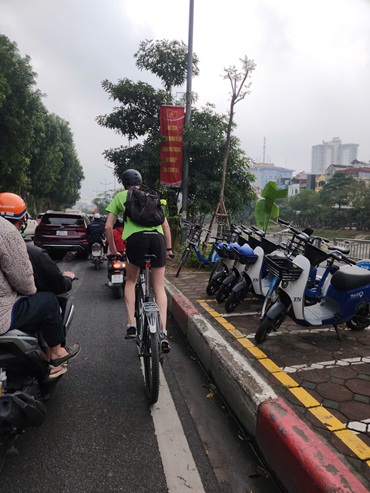
At the same time, along Lang street, many public bicycle rental points are arranged, but the number of vehicles used is insignificant. In fact, pedestrians or cyclists only occasionally appear in the early morning and late afternoon for exercise; there are almost no people using bicycles for daily commuting purposes.
According to Mr. Nguyen Van Nam (Lang ward, Hanoi City), the road is invested in spacious, clean and beautiful but does not attract people because it is only suitable for physical exercise and entertainment activities, and does not meet actual travel needs.
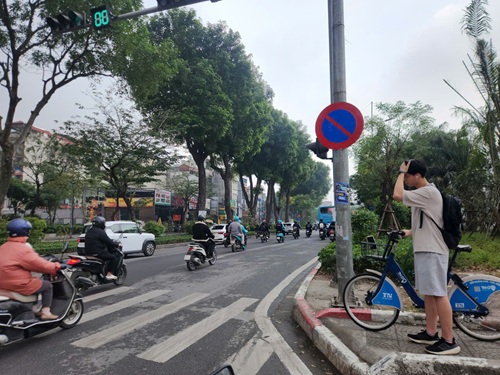
Transport experts believe that opening separate lanes for bicycles is the right direction to build modern, green and sustainable urban transport. However, from infrastructure to effective exploitation is a long process, requiring synchronous connection between routes and types of transport.
According to Dr. Dao Huy Hoang (Institute of Transport Science and Technology), the core reason why the bicycle lane has not been effective lies in the overall plan. Currently, many cities, including Hanoi, do not have clear and separate plans for the bicycle lane network.
Bicycle roads only work when organized into a continuous network. Single sections are not attractive enough and do not meet the actual travel needs of people," Dr. Hoang analyzed.
Traffic experts currently believe that cyclists do not have a safe and convenient network for continuous movement, making it difficult for bicycles to become a regular means of transportation. Meanwhile, current projects are only at the pilot level, lacking a comprehensive program with clear priority and incentive policies. When people see a specific roadmap, they are willing to change their vehicle usage habits.
From the perspective of urban planning, Dr. Nguyen Thanh Tu (University of Transport) believes that green transport development cannot be based on discrete projects. To make bicycles a part of urban life, it is necessary to reorganize the transportation system in a synchronous direction, with a clear and separate network of bicycle lanes.
According to Dr. Tu, it is possible to pilot first in the central area, especially points connected to public transport such as the metro line, and then gradually expand. However, the implementation needs to be based on thorough research on infrastructure and people's acceptance, avoiding waste and inefficiency.
Reality shows that many large cities around the world have spent decades building and adjusting their bicycle networks accordingly. People are only willing to switch to using bicycles when they have safe, friendly and convenient spaces.
The separate road for bicycles not only helps reduce collisions with motor vehicles, but also contributes to improving the quality of living space and building a civilized and sustainable city. However, to achieve that, it cannot just stop at a pilot section.
At the conference summarizing the work of ensuring traffic order and safety in 2025, representatives of the Traffic Police Department said that if lanes are not organized specifically for vulnerable groups such as pedestrians, bicycles, and motorbikes, it will be very difficult to reduce traffic accidents sustainably.
Therefore, large cities need to have long-term planning goals, considering bicycle lanes as a criterion of modern cities, associated with the public transport network. Like buses and trams, bicycles also need to be organized as an effective means of transit.
The development of bicycle lanes will be more feasible if it comes with solutions to limit personal vehicles, manage roadway and sidewalk encroachment, and regularly monitor and adjust during the pilot process.
It can be affirmed that a separate lane for bicycles is the right policy. However, for this model to go into life, a comprehensive and synchronous approach between planning, traffic organization and urban management is needed, instead of being implemented fragmentedly and without connection.


