
After the success of the 14th Party Congress, the atmosphere in the business community is undergoing changes, with increased confidence and expectations for a period of strong reform, a more open business environment and a more sustainable growth engine.
The 14th Party Congress established a new growth model, "taking science and technology, innovation, and national digital transformation as the main driving force and private economic development as the most important driving force". The focus is not only on "encouraging" the private sector, but also on creating a more favorable and safe environment for businesses to access equally and effectively use resources for production expansion, market diversification, brand building and investment in research and application of technology.
An important highlight is the mindset of nurturing "leading" businesses, when it is required to build support policies to form a number of strong, large-scale private economic groups, capable of leading the domestic value chain and expanding to the global market. Along with that is the mechanism of assigning and ordering the private sector to participate in key scientific research tasks, projects, works and important national tasks - a new approach to bring private enterprises into the center of the development process.
For the business community, these messages are creating a different mindset: Instead of just waiting for short-term incentives, many businesses are starting to see a longer "iceberg" for investment, innovation and expansion. Expectations are not only in the speed of reform, but in the quality of reform - where institutions truly become a platform for the private sector's aspiration to break through in the new development phase.
Removing bottlenecks for private businesses to enter the "large playground
Nurturing ambitions to expand to the international market before 2028, AirCity Co., Ltd. - a technology startup in the field of urban operation - is facing difficult problems such as lack of capital, market barriers and automation pressure to reduce dependence on people.
Mr. Le Xuan Vu - CRO cum co-founder of AirCity - shared: "In the process of operating and expanding business, we realize that innovation and digital transformation in Vietnam are still facing many obstacles, especially in the market stage. New solutions are often seen with a cautious eye because of high risks, while there is a lack of acceleration programs strong enough to be a "backbone" for startups. The consequence is that many creative ideas, even with potential, still find it difficult to find opportunities to enter the market.
With AirCity, the biggest bottleneck today is still capital sources. According to Mr. Le Xuan Vu, "lacking prey capital is the first and biggest challenge that startups face". Accessing capital from venture capital funds faces many difficulties due to strict criteria on revenue scale, creating the "chicken - egg" problem: Without capital, it is difficult to expand the market, but without expanding the market, there are not enough conditions to raise capital.
“To be able to expand to new markets, AirCity is forced to solve the problem of reducing dependence on people in highly repetitive tasks such as security, reception, hygiene, through the application of IoT technology and automation. If we achieve an automation rate of over 50%, we are confident that we can develop to any market,” Mr. Vu said.
AirCity's concerns are not an isolated story. Many private enterprises, especially in the technology sector, are facing the same paradox: huge aspirations for development and expansion, still a lot of market space, but the growth journey faces barriers due to lack of long-term capital, market hesitation and a thin innovation ecosystem...
Precisely from that practical requirement, the new spirit after the 14th Party Congress is receiving special attention from the business community as an expectation for a deeper, more open and more synchronized reform phase with the private economic sector.
Businesses must shift from "adaptation" to "development leadership
Prof. Dr. Mac Quoc Anh - Vice Chairman of the Hanoi Small and Medium Enterprises Association, Director of the Institute of Economics and Enterprise Development - said that for the private economy to truly enter the "large playground", businesses must first switch from "adaptive" thinking to "development-led" thinking.
In the previous period, many businesses mainly developed based on short-term market opportunities, exploiting low-cost advantages or available resources; in the next period, businesses need to clearly define which value chains they participate in, in which segments and what are the sustainable competitive advantages. Rapid growth must be linked to productivity, efficiency and scale expansion.
Along with strategy, management capacity is considered a key condition. Prof. Dr. Mac Quoc Anh believes that to achieve sustainable double-digit growth, private enterprises cannot continue to manage according to family models, personal experience or the "doing and fixing" style, but need to standardize financial management, risk management, human resource management and strategic management according to modern standards. This is the foundation for businesses to access medium and long-term capital and cooperate with large domestic and foreign partners.
Another pillar is innovation and digital transformation. According to Prof. Dr. Mac Quoc Anh, businesses must consider innovation and digital transformation as an endogenous driving force, not cost. Innovation is not only in technology, but also in business models, production organization, market approach and data management. Businesses need to boldly invest in digital technology, automation, artificial intelligence, but more importantly, change management thinking so that technology truly creates added value.
In addition, rapid growth needs to go hand in hand with linkage and cooperation. Vietnam's private economy is currently fragmented, lacking large enough business chains to lead the industry. Businesses need to actively participate in industry alliances, linkage clusters, domestic and international supply chains instead of developing individually; linkage does not lose the corporate identity but helps increase overall competitiveness.
Finally, according to Prof. Dr. Mac Quoc Anh, private enterprises need to proactively accompany the State in implementing development goals. When enterprises are strong enough in internal strength, growth targets will no longer be pressure but become a driving force for development.
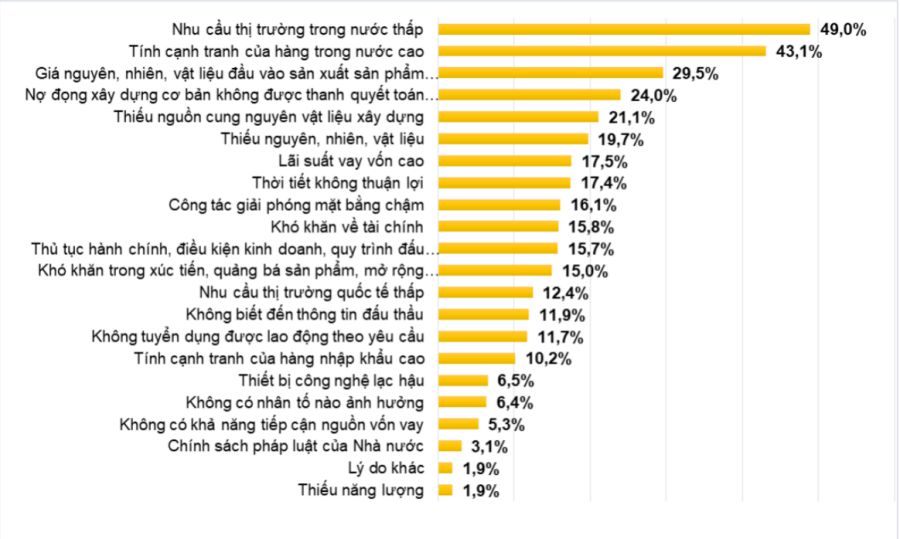
3 driving forces to help private businesses accelerate
Regarding the driving force for the private economic sector to accelerate, Prof. Dr. Mac Quoc Anh acknowledged that this is not a single factor, but a convergence of three structural driving forces.
First of all, competitive pressure is increasingly fierce as geopolitical fluctuations, global supply chain restructuring, increased production costs and increasing demand from customers force businesses to change; in that context, digital transformation is no longer a "must or should not" story but becomes a vital condition, businesses without transformation will quickly lose competitive advantage, and even be eliminated from the market.
The second driving force comes from the policy environment that is shifting positively, when the State increasingly considers the private economy as an important driving force for growth, while placing digital transformation and innovation at the center of the development strategy. Promoting digitalization of public services, administrative procedure reform and digital infrastructure development creates a "pulling force" that both binds and supports businesses to participate more deeply in the digital economic space.
The third driving force is the popularity of platform technologies such as cloud computing, artificial intelligence, big data, e-commerce, thereby significantly reducing cost barriers. Thanks to this, even small and medium-sized enterprises can access management and business tools that were previously mainly for large enterprises. These three factors combine to create a new context, in which digital transformation not only helps businesses "withstand" fluctuations but also opens up opportunities for breakthroughs in productivity and business models.


