
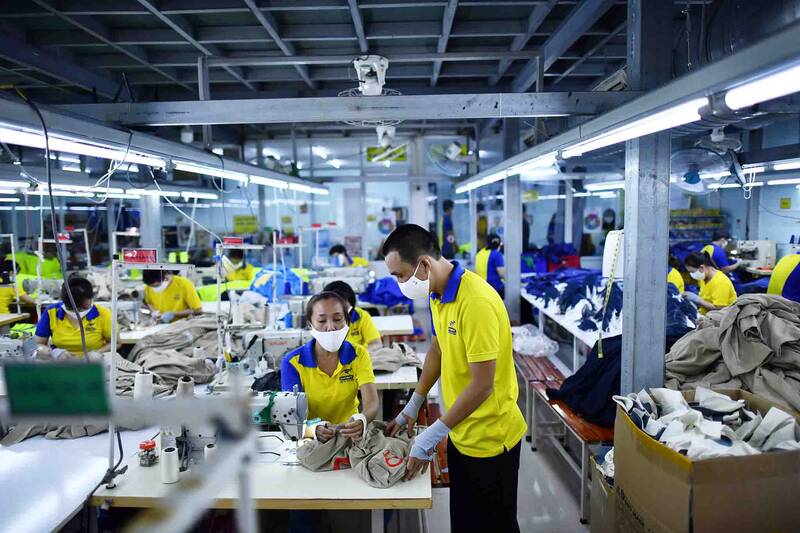
These days, at the production workshop of Dony Garment Company, the atmosphere is still bustling as usual. However, behind the steady pace is the close monitoring of each shipment exported to Jordan - a market accounting for nearly 20% of the enterprise's export turnover and has been maintained stably from 2017 to now.
Mr. Pham Quang Anh - General Director of Dony Garment Company, said that Jordan is an important market, but also potentially volatile due to the specific nature of the transport route. Garments from Vietnam to Jordan mainly transit through the Red Sea - an area directly affected if tensions escalate.
In previous periods of instability, the shipping time was once extended from one month to 3-4 months, which is 3-4 times longer than normal. 40-foot container fares also increased sharply, from about 1,500 USD to 5,000 USD. Not to mention, war insurance premiums and limited shipments make the risk of delayed delivery a constant pressure for businesses.
Just 15-20 days late can miss the sales season, and if it lasts 3-4 months, it is considered over the season. For the textile and garment industry, where the product life cycle is short and the seasonality is high, the biggest risk is not increasing freight rates by a few thousand dollars, but the risk of breaking the business cycle of customers.
However, according to Mr. Quang Anh, the market has now adapted more to fluctuations. If customers used to temporarily stop ordering to listen to the situation, now the trend is to still maintain orders, only adjusting output or delivery progress.
Currently, Dony is preparing to export a 40-foot container to Jordan in the next two weeks, and is working closely with logistics partners to update on the latest developments. "The most worrying factor is still logistics. Regarding market demand, we expect the conflict not to escalate into widespread war" - Mr. Quang Anh said.
Concerns about the transport route through the Red Sea are the focus of concern for many export businesses. Mr. Pham Van Xo - Chairman of the Ho Chi Minh City Import-Export Association (HIEA), said that the risk of the Red Sea crisis may return, forcing many shipping lines to avoid the sea route through the Suez Canal. This will push transportation costs up sharply, leading to the risk of delivery delays and supply chain breakdowns.
In the context of the world economy still facing many fluctuations, the Ho Chi Minh City Department of Industry and Trade has proactively implemented synchronous and flexible solutions right from the beginning of 2026 to stabilize the market, maintain production and create momentum for growth. Solutions are implemented in both the industrial and commercial sectors, with a focus on maintaining market stability, supporting businesses to recover and expand production.
Regarding exports, the turnover in February reached 6.6 billion USD, an increase of 3.88%. Accumulated in the first two months of the year reached 14.72 billion USD, an increase of 10.58% compared to the same period. In the opposite direction, import turnover in February reached 7.86 billion USD; the total for the two months reached 16.59 billion USD, an increase of 13.78%. This development shows that the demand for importing raw materials and machinery for production is increasing.


