
Gold and silver prices entered a new trading week in a sensitive state, after the global market experienced strong fluctuations related to US-Iran tensions last weekend. However, according to Wall Street experts, geopolitical factors are only a part, a broader picture is dominating the trend of precious metals.
Mr. Adam Button - Currency Strategy Director at Forexlive. com commented that short-term gold prices are in a state of stalemate - "We will follow the direction that US bombings lead". This assessment reflects the current market sentiment: Prices fluctuate according to news flows, but a solid scenario has not yet formed.
Mr. Sean Lusk - Co-Director in charge of trade risk prevention at Walsh Trading, said he closely monitored the impact of the US government's statements on Iran on the commodity market in Friday's trading session last week.
There are a lot of rumors and information chaos," he said. "But that's the expectation factor. So energy increased, metals increased, wheat increased, corn increased, while livestock decreased and the stock market lost 500 points on the Dow Index.
According to Mr. Lusk, traders are forced to proactively position themselves before the weekend holiday, before information related to airstrikes. "You don't want to be in a short selling position. That's the problem," he said.
He also said that the increase in gold is not only related to Iran: "There are large deals in the private investment sector, there are bankruptcies, and many other geopolitical issues. Instability is present everywhere.
Regarding economic data this week, Mr. Lusk said that the US non-farm payroll report is unlikely to have a major impact unless a sudden increase appears. "Unless we see an "unusual" figure, such as an increase of 300,000 or 400,000 jobs. If so, the USD will be supported and the metal may be sold off. But will such a figure appear? Perhaps not." According to him, at least 250,000 jobs can weaken the upward momentum of gold and silver.
From a more optimistic perspective, Mr. Marc Chandler - Managing Director of Bannockburn Global Forex, believes that the risk of military escalation may continue to support gold prices.
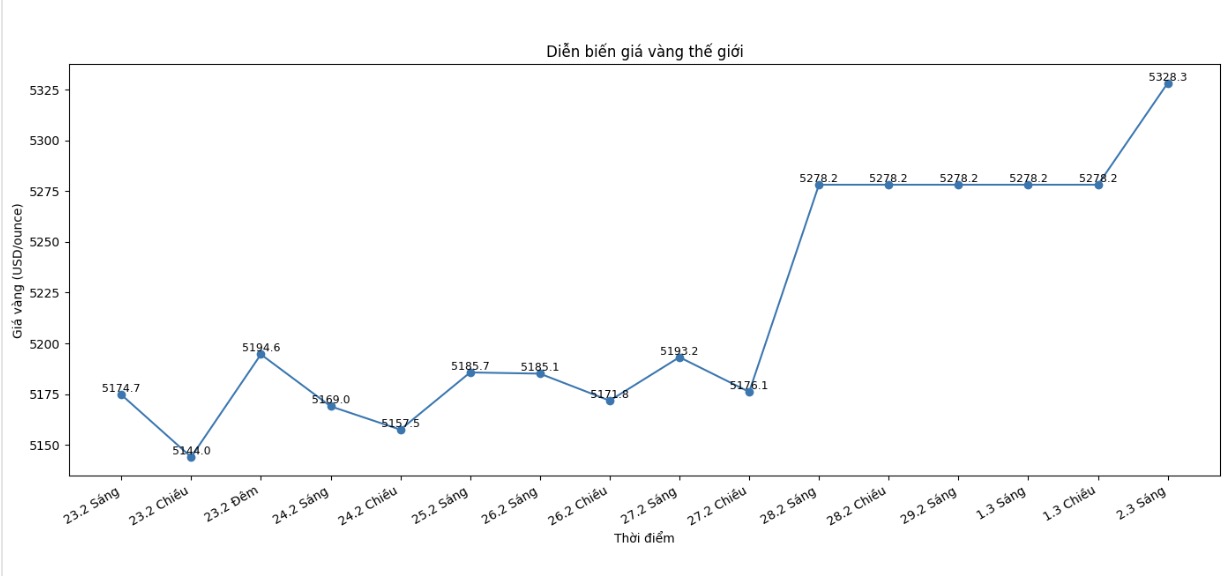
Gold prices are likely to continue to rise" - he said. According to him, if it surpasses the 5,250 USD mark, gold may head to 5,500 USD/ounce. He also noted that the yield of 10-year US government bonds fell below 4%, even when the producer price index is higher than expected, which is a supporting factor for the precious metal.
Meanwhile, Mr. Alex Kuptsikevich - senior market analyst at FxPro, gave a more cautious view. He said gold has increased by about 2% since the beginning of last week and this is the third consecutive week of increase.
Geopolitical tensions once again boosted demand for commodity assets, from gold to oil, as investors increasingly worry about the stability of the situation. Pressure on the stock market, especially large technology groups, also raised the need for risk hedging.
However, Mr. Kuptsikevich believes that in the long term, investors should prepare for the possibility of lower prices. "Although we still believe that gold prices in the next few years may have formed peaks, we see that technically there is still room for prices to recover to 5,300 USD/ounce. However, in the long term, investors should prepare for the possibility of lower prices and increased selling pressure" - he said.
Analysts at CPM Group also issued a gold sell recommendation in Friday's session, with an initial target of 5,100 USD/once in the February 23 - March 6 period and a cut-loss level of 5,275 USD/once. A week earlier, when gold traded at 5,082.6 USD/ounce, this group had recommended buying with a target of 5,225 USD/ounce and expanded to 5,400 USD/ounce. Last week, the price touched 5,266 USD/ounce and at one point reached 5,259.3 USD/ounce in the February 27 session.
According to CPM, although still expecting gold prices to increase in the next month, the possibility of adjustment in the first week of March is real. This group recommends that super-short-term investors should stay out or consider short-term selling positions with a close cut-loss level. If the price exceeds the peak around 5,265 USD/ounce, buying and selling activities may push prices up sharply in the short term.
This week, the market will monitor a series of important data including the ISM manufacturing PMI index released on Monday; the ADP and ISM service PMI payrolls on Wednesday; the number of weekly jobless claims on Thursday; and especially the non-farm payrolls and US retail sales on Friday.


