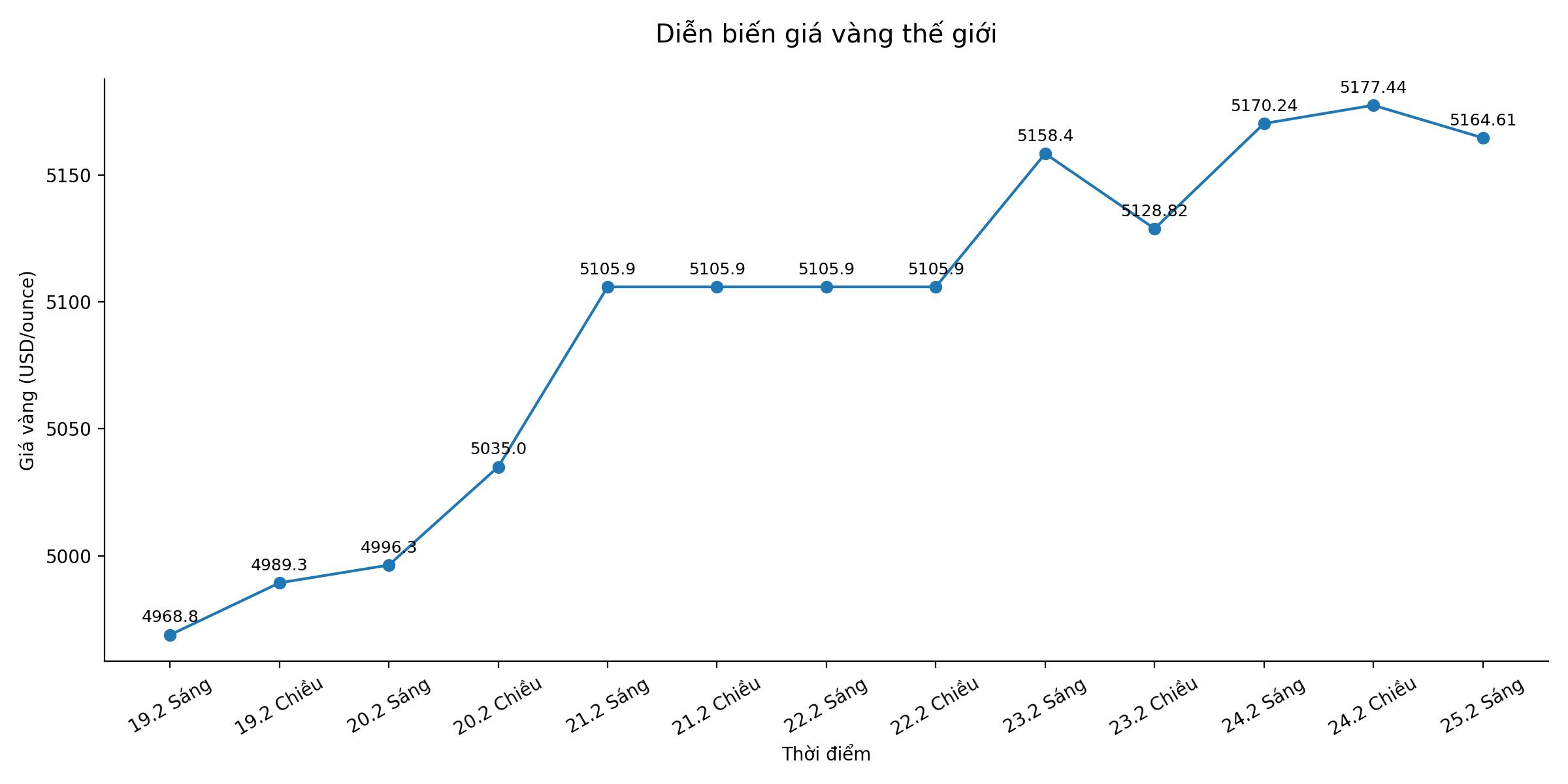
Gold prices turned down after four consecutive increasing sessions, as the upward momentum was driven by instability in US trade policy and escalating tensions in the Middle East.
This precious metal narrowed its decline after falling by 2.5% at one point, thanks to the weakening USD. Previously, gold had increased by more than 7% in the four consecutive sessions, as investors turned to safe assets after the US Supreme Court's ruling derailed President Donald Trump's tariff policy, amid US confrontation with Iran.
Fluctuations within the 2% range are still within the market's normal threshold" - Mr. Song Jiangzhen, a researcher at the Southern Guangdong Gold Market Institute, commented - "In the long term, market sentiment remains positive, as instability around Iran continues and the US faces the risk of being isolated by tariff policies.
The market is in a state of turmoil after Mr. Trump announced that he would raise global import tariffs to 15%, following the Supreme Court's ruling rejecting the "counter-collective" tariffs he proposed. Previously, a directive allowing 10% tariffs officially took effect from Tuesday. However, the timing of implementing higher tariffs has not yet been determined.
Some US trading partners are struggling to reconcile new tariffs with previous agreements, increasing tensions in already fragile relations. The European Union's assessment shows that Mr. Trump's new policy will push tariffs on some of the bloc's exports beyond the current trade agreements.
News related to tariffs continues to maintain a high level of uncertainty, thereby supporting gold at a certain level, but so far it is still not enough to create a clear breakthrough," said Christopher Hamilton, Head of Asia-Pacific Customer Solutions (Outside of Japan) at Invesco Ltd. - "As real interest rates remain relatively high and the USD maintains its strength, gold is likely to move sideways and accumulate rather than form a strong upward trend in the short term.
In the context of investors seeking shelter from risks, gold prices have found a support again above the 5,000 USD/ounce mark after a historic plunge at the beginning of the month. A strong speculative wave pushed the long-term upward momentum to the point of overheating, causing gold prices to rebound sharply from a record high of over 5,595 USD/ounce at the end of January. Since then, the precious metal has recovered more than half of its decline, although trading still takes place with a large and unstable amplitude.
Many banks, including BNP Paribas, Deutsche Bank and Goldman Sachs, forecast that gold prices will continue to recover, as the fundamental factors that once boosted the previous upward momentum remain. These factors include concerns about the independence of the US Federal Reserve, the trend of moving away from government bonds and currencies, and geopolitical risks, especially in the Middle East.
Geopolitical events "can trigger short-term fluctuations, thereby boosting demand for portfolio hedging instruments like gold," said Mark Haefele, Investment Director of UBS Global Wealth Management, in a report released on Tuesday. The bank believes gold prices could reach $6,200/ounce in the coming months, as the core drivers that supported gold's strong rally last year are still working.
The US has now deployed its largest military force in the Middle East since 2003, while negotiations on Iran's nuclear program are expected to resume this week. Despite emphasizing the priority of a diplomatic solution, Mr. Trump also warned that it would be "a very bad day" for Iran if no agreement is reached, and rejected reports that the Pentagon is concerned about the possibility of prolonging a military campaign.
In this morning's trading session, gold prices fell 1.2% to $5,164.61/ounce. Silver prices lost 1.0% to $87.30/ounce. Platinum and palladium also went down simultaneously. The Bloomberg Dollar Spot index, a measure of the strength of the USD, increased slightly by 0.05%.