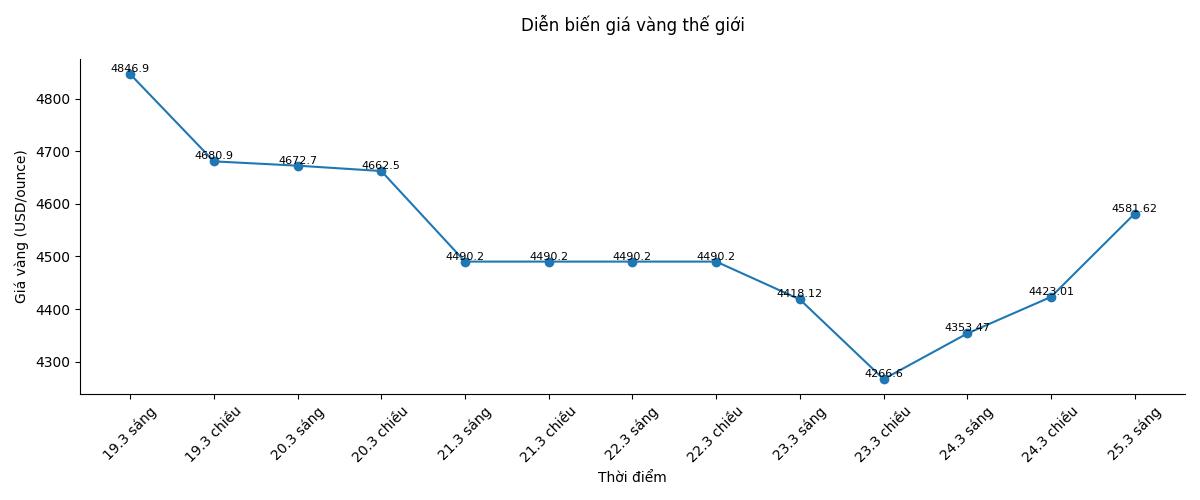
Gold prices rebounded, ending a 9-session consecutive decline after information emerged that the US is seeking the possibility of reaching a month-long ceasefire agreement to facilitate exchanges with Iran.
Precious metals once increased by 1.7% at the end of Tuesday's trading session after Israel's Channel 12 quoted sources as saying that the US is approaching the possibility of conducting exchanges with Iran. The stock market narrowed its decline, while the USD and US Treasury bond yields also reduced their previous increases. According to Ms. Nicky Shiels - Director of Metals Strategy at MKS PAMP SA, information about the possibility of a ceasefire has contributed to improving market sentiment.
Earlier on Tuesday, gold prices fluctuated alternately as investors assessed many different scenarios related to the developments of conflict in the Middle East.
US President Donald Trump said Iran has sent a "signal of goodwill" in the exchange process, related to transportation activities through the Strait of Hormuz. The US and regional intermediaries are discussing the possibility of holding high-level exchanges as early as Thursday, but are still awaiting feedback from Tehran, according to Axios.
On the same day, the Wall Street Journal (WSJ) reported that the US is considering deploying about 3,000 soldiers of the 82nd Airborne Division to the Middle East as the White House considers options to reduce Iran's level of control in the Strait of Hormuz.
In recent times, gold prices have fluctuated sharply as investors continuously adjusted positions in the face of new information related to conflict developments. The downward trend of the global stock and bond markets has also forced some investors to narrow down their gold positions to supplement liquidity.
Mr. Frank Monkam – Multi-asset macro strategy director at Buffalo Bayou Commodities said that the adjustment of monetary policy expectations of the US Federal Reserve (Fed), along with the developments of the USD and bond yields, are factors affecting the recent gold price trend.
According to Mr. Monkam, gold price fluctuations are also affected by the downward leverage of individual investors, along with some emerging economies including central banks adjusting their gold holdings to strengthen foreign exchange reserves in the context of volatile energy markets.
A similar development once appeared after the Russia-Ukraine conflict broke out in early 2022, when gold prices rose sharply in the short term before entering a prolonged correction phase due to investors restructuring their portfolios.
On Tuesday, Bloomberg said that the central bank of Turkey has discussed the possibility of conducting gold-for-foreign currency swap transactions in the London market to support the stability of the domestic currency in the face of fluctuations related to regional conflicts.
Although gold prices have fallen in recent weeks, this precious metal has previously maintained a prolonged upward trend thanks to geopolitical tensions, global trade and increased gold reserves by central banks. However, some energy importing countries are adjusting their resources allocation in the short term.
In this morning's trading session at 09:35 Vietnam time, spot gold prices increased by 4% to 4,583 USD/ounce. Silver prices also increased, platinum increased slightly while palladium decreased. The Bloomberg Dollar Spot Index - a measure of the strength of the USD - increased by 0.3%.