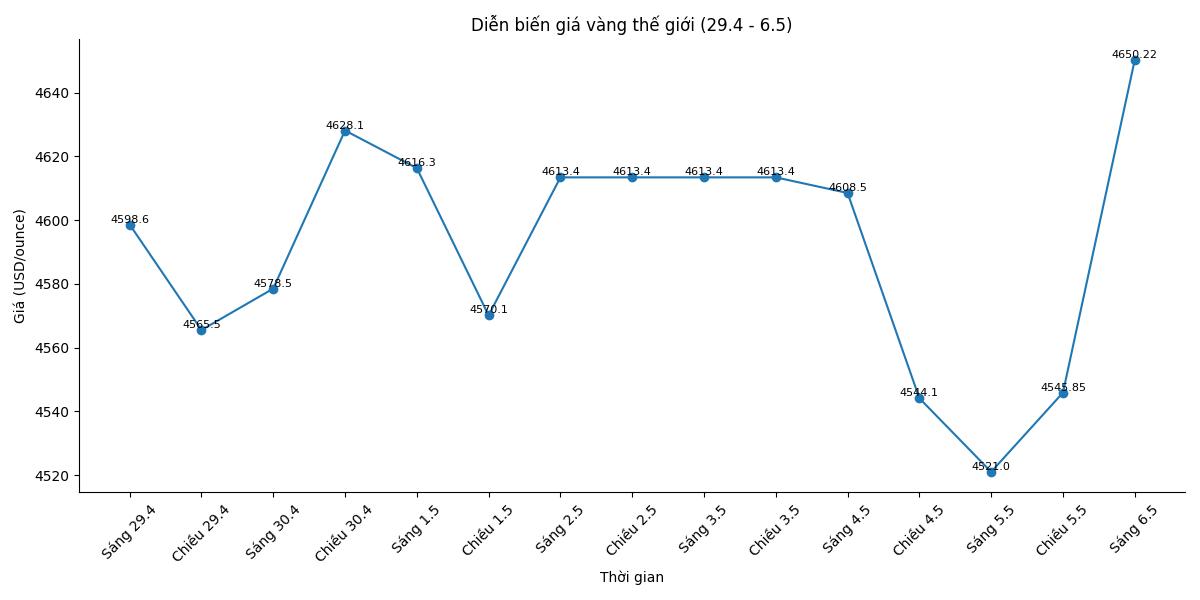
Gold prices rebounded after US President Donald Trump said negotiations with Iran made "great progress", thereby easing inflation concerns and putting downward pressure on the USD.
The precious metal at one point increased by 1.6%, approaching the 4.630 USD/ounce mark, after increasing by 0.8% in the previous session. The USD index fell by about 0.3%, making gold cheaper for investors holding other currencies.
On social media, Donald Trump said he was making "very positive progress" with Iran, and temporarily suspended plans to support ships stranded in the Strait of Hormuz to await the possibility of reaching a final agreement.
US officials also sent signals to cool down tensions. Defense Secretary Pete Hegseth said the ceasefire lasting nearly a month is still maintained, while Foreign Minister Marco Rubio affirmed that the offensive operations have ended and Washington is shifting to protecting the transportation route through the strait. On the Iranian side, Foreign Minister Abbas Araghchi also confirmed that the negotiation process is progressing.
However, geopolitical risks have not completely disappeared. Reports of a cargo ship being attacked just one day after the maritime collisions show that tensions are still simmering, making the prospect of completely reopening the Strait of Hormuz uncertain.
In that context, gold is still under pressure in the short term. Prolonged inflation concerns are causing the market to raise expectations about the possibility that the US Federal Reserve (Fed) may raise interest rates, instead of cutting them as before. This is a disadvantageous factor for gold – a non-interest-generating asset.
Bond traders are currently increasing bets that the next step of the Fed may be to raise interest rates. Since the conflict broke out at the end of February, gold prices have fallen by more than 12%.
The market is currently focusing its attention on the upcoming US jobs report, to assess the health of the labor market. If data shows that the economy remains stable, inflationary pressure may become the main dominant factor, leading to tighter monetary policy.
According to Ms. Nicky Shiels - Head of Metal Strategy at MKS PAMP, the precious metals market is falling into a state of "positional paradox". Investment capital in gold is still large, but the actual level of market participation is not commensurate.
The story of gold's medium-term price increase is still maintained, based on monetary risks, supply chain disruptions and global financial order fluctuations. However, to set new peaks, the market needs large institutional capital to return," she said.
Spot gold prices rose 2.79% to 4,650.22 USD/ounce at 10:20 am Vietnam time. Silver rose sharply 2.9% to 74.98 USD/ounce, while platinum and palladium also simultaneously went up.