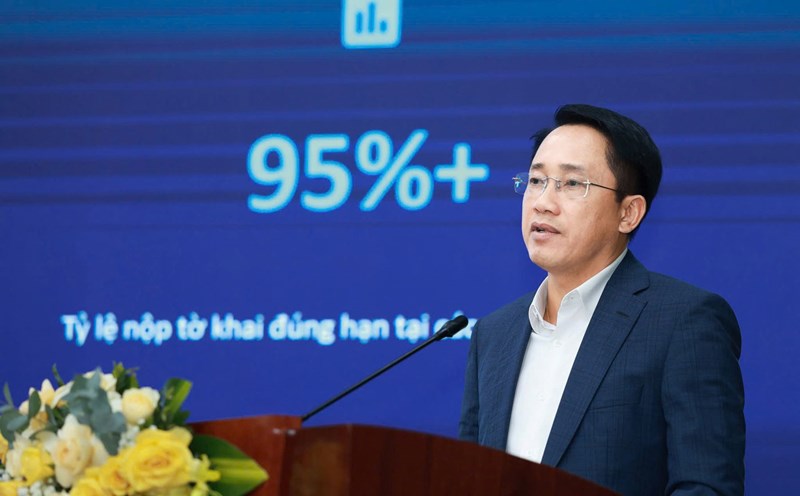
Lao Dong Newspaper would like to introduce the speech of Prof. Dr. Mac Quoc Anh - Member of the Central Committee of the Vietnam Fatherland Front, within the framework of the Workshop "Promoting self-respect and full tax compliance - Building a strong era" co-chaired by Lao Dong Newspaper and the Tax Department - Ministry of Finance, and co-organized by the Vietnam Federation of Commerce and Industry (VCCI) on October 23, 2025.
From compliance costs to hidden costs - the price of uncertainty
When talking about "tax compliance costs", we often think of the number of declaration hours, the number of documents, or the waiting time for tax refunds. However, for the small business community and business households - accounting for more than 98% of the total number of enterprises in Hanoi, that is not the whole picture. What small businesses really have to bear is the "hiding cost" of uncertainty:
Not sure which regulation is in effect;
Not sure if the understanding of the tax authority is consistent;
Most importantly: Not sure if I am doing the right thing or not.
In Hanoi, there are currently more than 400,000 small and medium-sized enterprises, millions of individual business households, accounting for more than 13% of the total number of enterprises nationwide. Most of them operate in trade, services, logistics and supporting industries. They are the "backbone" of the capital's economy but are also the group with the largest administrative risks due to the lack of professional resources in finance, accounting, and law.
Three types of hidden costs that small businesses are having to pay
Mental costs: Fear of mistakes and fear of being fined
According to a survey by the Hanoi Association of Small and Medium Enterprises (SAEs), more than 65% of informal business households said that "there are not enough people or knowledge to declare correctly". 90% of households converting to businesses said that "fear of tax violations" was the biggest barrier.
The business owner in Dong Da shared: "I started a business to expand the scale, but after registering, I was worried about how to pay VAT. I hired an additional outside accountant, 2 million a month, just to "go on the right track".
That is a mental cost, and it is not included in every administrative reform report.
Opportunity cost: Waiting time and losing cash flow
A small manufacturing enterprise in Ha Dong has been suspended from tax refunds for nearly 3 weeks just for data errors when sending electronic invoices. No one intentionally violated, but the consequences were the project stopped, the contract failed, and interest increased. Every waiting day is an "incentive cost" that businesses have to pay for due to a lack of transparency in feedback on errors.
Information costs: Many laws, but confusing instructions
According to WB Doing Business 2020, a small enterprise in Vietnam spends an average of 10-15 million VND/year on tax compliance costs (including consulting, software, accounting services).
The law is not lacking, but detailed and easy-to-understand instructions are rare. Many homeowners said: "Every time I ask for taxes, each place says differently". That inconsistency is causing businesses to pay for uncertainty.
The current situation of Hanoi - a bright spot in digital transformation, but still has "bsure" confidence
In recent times, the Hanoi Tax sector has gone a long way in modernization with known figures: 99.38% of businesses declare taxes electronically; 98.88% pay taxes online and 100% of businesses have used electronic invoices. The taxpayer satisfaction index reached 92 - 95% - among the highest in the country.
However, "technical chess" does not mean "self-conscious chess". Therefore, we need a step from compulsory compliance to smart compliance where taxpayers are accompanied and trusted.
From compulsory compliance to smart compliance
I propose three principles to redesign the system to support small businesses and business households, towards the "smart pilot" model:
Principle 1: easier to understand the guiding laws according to situations, not according to documents Small enterprises do not have legal departments. They need to know "in my case, what should I do", not need to read all the decrees.
For example, send a list of "10 common situations" to business households: converting to businesses, deducting VAT, making invoice errors, temporarily suspending business... If each situation is explained in the language of life, not legal terms, they will proactively do it correctly.
Principle 2: fewer papers than the process of reducing the level of confirmation and certification. Currently, many tax procedures still require businesses to download a series of attachments that other agencies already have.
It is necessary to connect data between Customs Insurance Bank Taxes via the "TaxID Connect" platform, allowing immediate counterfeiting. Businesses should have the right to submit declarations directly via mobile applications and authenticate with a chip-embedded CCCD, without having to sign complex numbers.
Principle 3: Know the results earlier than the risk - be transparent in responding to errors Small businesses are not afraid to pay taxes, they are just afraid of not knowing why they are doing wrong. There needs to be an "immediate error response" mechanism: when the file is suspended, the system immediately sends a message describing the error, suggesting a correction.
Some localities such as Da Nang and Can Tho have deployed electronic tax support lines for individual households, feedback in the past 24 hours is a model that should be replicated.
Illustrative data creates soft reliability The Hanoi Business community has reflected many notable figures, specifically:
Average compliance cost: 10 - 15 million VND/year/small enterprise.
65% of informal business households do not have the capacity to declare correctly.
90% of households converting to enterprises are afraid of violating tax regulations.
Every year, about 2,000 3,000 business households in Hanoi close, mostly due to "lack of specific instructions" (according to Lao Dong newspaper, June 2025).
These are "emotion indexes" that tax policies need to take seriously, in addition to technical indexes.
Hanoi's pioneering role - piloting "smart compliance culture"
Hanoi can become an " institutional laboratory" for the new compliance model:
Establish a SME Tax Support Center - a business household in each district, operating as a "tax doctor" providing quick consultation.
The virtual assistant application guides declaration: business households only need to enter industry codes, the system suggests appropriate forms.
Building a "Hanoi SME Tax Credit Portal", recognizing and ranking complying enterprises as both transparent and a positive communication tool.
If Hanoi can do it, this model can be replicated nationwide, turning "tax self-awareness" into the standard of Vietnamese corporate culture.
Some policies - Putting faith first before sanctions
First, prioritize small enterprises to comply well in tax refunds, bidding, and capital access. "Doing the right thing will benefit".
Second, publicize the unified understanding of tax documents nationwide - avoiding the situation of "each place has its own understanding".
Third, training and fostering "tax skills for startups" - included in vocational and university training programs.
The best policy is the policy that makes businesses want to do the right thing because they see it as beneficial, not doing the right thing for fear of being fined.