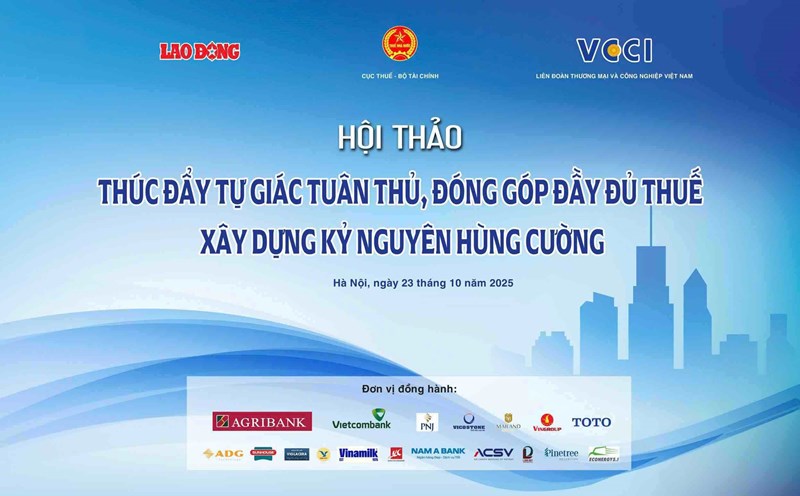
Workshop "Promoting self-respect and full tax contributions - Building a strong era"

Hoàng Anh |

Improving tax compliance is not only a technical task, but a step forward in cultural development and trust between the State and citizens.

4:55 p.m.: Mr. Mai Son - Deputy Director of the Tax Department delivered the concluding speech:

All the comments, shares, and exchanges of the delegates, experts, and businesses in today's program are very valuable suggestions for tax authorities. We would like to help you through the Organizing Committee to receive more questions, feedback, and opinions from readers and business communities across the country, in the spirit of openness, listening, and acceptance.

Fortunately, the contents raised today took place at the right time when the tax sector was amending the Law on Tax Administration and building a new information technology system. This is an opportunity for us to look back, evaluate and perfect the entire professional process, in order to meet the requirements of comprehensive innovation and deep integration of Vietnam in the global context - associated with the standards of the IMF, World Bank and OECD.

Ong Mai Son – Pho Cuc truong Cuc Thue phat bieu ket luan hoi thao. Anh: Hai Nguyen
Mr. Mai Son - Deputy Director of the Tax Department delivered the concluding speech at the workshop. Photo: Hai Nguyen

We are well aware that, despite great efforts, the tax sector still has points that need to be further overcome. Therefore, redesigning a modern tax management model, associated with data infrastructure and digital technology, is an important step to improve management efficiency, while synchronously connecting with national databases, towards sharing big data between state agencies.

The ultimate goal is not only to better serve tax management, but also to create a fair and transparent business environment, nurturing sustainable revenue sources, contributing to the country's major goals such as social security, infrastructure development and national defense reinforcement.

And above all, we understand that the efforts of businesses and taxpayers are the deciding factor. All efforts of tax authorities are only meaningful when associated with the reality and companionship of the business community.

The tax industry is committed to continuing to listen to, absorb and institutionalize today's comments on specific action programs in the coming time.

would like to express my sincere thanks to Lao Dong Newspaper, the Vietnam Federation of Commerce and Industry (VCCI), financial experts, business leaders, press agencies and readers across the country for their interest and support in the program.

16:35: Responding to a reporter's question, Ms. Nguyen Thi Cuc - Chairwoman of the Tax Consulting Association, Arbitrator of VIAC International Referee Center, Former Deputy General Director of the General Department of Taxation - said:

First of all, to make people and businesses better comply with taxes, it is necessary to shift from the mindset of "management and imposition" to "service and companionship". Therefore, tax authorities must continue to build a comprehensive support ecosystem, helping to reduce compliance costs for both taxpayers and society. This is also the reason why the Tax sector has recently implemented many digital transformation solutions and achieved remarkable results, being assessed as an excellent state agency in digital transformation.

Ba Nguyen Thi Cuc - Chu tich Hoi Tu van Thue Viet Nam. Anh: Hai Nguyen
Ms. Nguyen Thi Cuc - President of the Vietnam Tax Consulting Association. Photo: Hai Nguyen

However, there are still some problems that need to be improved.

First, tax payment is now done automatically. She suggested adding an automatic feature to automatic tax payment nhac nhat. Ms. Cuc said that according to the Law on Handling of Administrative Violations, only having to pay a certain number of days late will be fined, even though the amount of tax payable is very small. For example: there are cases where taxpayers only have to pay a few hundred thousand dong, but due to delays, they are still fined a few million dong - this causes hesitation and is not really fair.

Second, business people are subject to both tax and many non-tax costs such as market management fees, food safety costs, operating costs, etc. This puts them under a lot of pressure in business. If there is a policy to help reduce those non-tax costs, they will be more willing to fulfill their tax obligations. Thus, to improve compliance, not only tax policies but also synchronize institutions, reduce costs, and create real convenience for taxpayers.

Third, although tax policies have been reformed, there are still some shortcomings in implementation, which have a negative impact on tax management. Accordingly, it is necessary to continue to improve and reform breakthroughs in perfecting tax policies, aiming to deeply reduce social costs, improve compliance, increase transparency and equality in tax obligations.

Fourth, Ms. Cuc emphasized that businesses and entrepreneurs themselves need to correctly consider compliance with tax obligations and civilized business as their responsibility and obligation to themselves, their families, their businesses to be better, more respected and their brands to be more sustainable.

Finally, taxpayers need to aim to and improve their self-respect and strict compliance with legal policies, fully contribute to tax obligations, do business legitimately, get rich legally, pay taxes fully and a lot to the State budget, which is the Fatherland, contributing to building a strong nation.

16:33: Ms. Bui Thi Trang - Director of Retail Solutions, MISA Joint Stock Company shared some perspectives in the process of accompanying business households, especially in the aspect of improving self-awareness and tax compliance of taxpayers.

The Misa representative said that in order for businesses to be able to voluntarily fulfill their tax obligations, it is important that they clearly understand what they need to do, it must be easy to do, and at the same time know the benefits of doing the right thing and the risks of doing the wrong thing. Technology is a factor that helps businesses easily comply with tax obligations naturally.

During the process of working with business households, MISA has redesigned software solutions, aiming to simplify and integrate the entire process. Previously, operations such as tax declaration, invoice making, and accounting were often disjointed, causing difficulties for users. Now, on our platform, businesses can perform the entire process right on one application: from sales, issuing invoices, to the declaration period, the system will automatically remind and synthesize input - output data to form a tax declaration. After that, the software also suggests recording accounting in accordance with State regulations.

Connecting data and automating these steps helps businesses not to forget, not to miss operations, reduce manual operations, and especially feel tax compliance becomes easier. When its easy, they do it, and when they can do it, theyre self-conscious.

Ba Bui Thi Trang - Giam doc Khoi Giai phap Ban le, Cong ty Co phan MISA. Anh: Hai Nguyen
Ms. Bui Thi Trang - Director of Retail Solutions, MISA Joint Stock Company. Photo: Hai Nguyen

Ms. Trang also sent a proposal to the tax authority: currently, MISA's software has supported users to prepare a complete tax declaration, however, at the tax payment step, if it can be directly connected to the bank's payment gateways for taxpayers to pay right on the software, the entire process will be completed - from tax declaration, payment to file storage. At that time, the slogan "voluntary compliance" will not only be a call, but will truly become a natural behavior, associated with the daily business activities of individual households.

In addition, AI and chatbot are also playing an important role in supporting and advising on tax policies. Right on the software platform, MISA has integrated a smart chatbot, allowing users to easily ask - answer, look up instructions on tax declaration, invoices, and tax payment. If previously tax officials and we had to go to the media and provide direct instructions many times, now users only need to "chat" the system to be able to grasp the process that needs to be done.

Finally, please share more, today MISA officially announced a program to support 3 months of free accounting software and electronic invoices for business households. This solution helps households to start fulfilling their tax obligations immediately, even without a request from the tax authority, contributing to promoting self-awareness and transparency in tax compliance.

16:33: Responding to a question from Dan Viet reporter, Mr. Noguchi Daisuke - Chief Advisor of the JICA Tax Project said: In my presentation, I mentioned the model of compliance in the spirit of cooperation, while voluntary compliance is the requirement for taxpayers to proactively fulfill their tax payment obligations. Meanwhile, the cooperative model not only requires taxpayers to comply but also requires tax authorities to accompany and support taxpayers through technologies to fulfill their obligations well.

Currently, I am a long-term expert of JICA, working at the Tax Department. Yesterday, I had a training course at a tax authority on e-commerce related to taxes and e-commerce policies in Japan to share in Vietnam.

From the perspective of tax managers, Vietnam is also ahead of Japan in managing e-commerce taxes. In particular, in the strong digital transformation process, tax calculation for e-commerce platforms, Vietnam implemented this policy earlier than Japan.

Ong Noguchi Daisuke - Co van truong Du an Thue JICA. Anh: Hai Nguyen
Mr. Noguchi Daisuke - Chief Advisor of the JICA Tax Project. Photo: Hai Nguyen

Sharing 3 points on how to implement taxes in Japan to contribute experience to Vietnam, Mr. Noguchi Daisuke said: "First, it is necessary to increase access to information sources. When promoting the voluntary compliance model, sharing information is very important, tax authorities need to be transparent in information and ensure forecasting capability to taxpayers.

I think that a taxpayer who does not declare may not have violated the law but they do not have enough information to access and be able to declare. The way to create opportunities to access information is Viettel Post's proposal on the declaration system for transportation, we should have instructions through easily seen and easily recognizable standards of information.

Advertisements and opportunities for them to access information, for example, on the transportation application, they will see windows or clips, banners to create opportunities for them to access.

Regarding this activity, I would like to share in Japan that we are taxing foreign enterprises and suppliers, they also have to declare taxes and VAT. In Tokyo, we have a Tokyo game show about fairs and exhibitions. When participating in the program, they will have to answer questions about how to declare taxes and VAT to create opportunities for them to access. This event is very big, with more than 800 participants, creating a great approach.

The second point is to promote compliance with cooperation, build a simple and easy-to-understand system for taxpayers. The Tax Department is actively transforming digitally in eTax Mobile to make it easier for taxpayers to access, hoping to achieve results soon.

Building a tax system that is easy to understand and access, but they do not have knowledge, Japan values providing knowledge through tax agents so that they can access through them. Previously, Japan has implemented and next year Vietnam will also eliminate contract tax, so through tax agents, it will help them understand policies and build a roadmap.

Third, taxpayers who pay in full should have mechanisms, policies, and rewards to further encourage them. Especially for private enterprises, if they are tax-inspected, they will be discouraged, Japan will implement a compliance program for 500 large enterprises. The compliance program is evaluated through the business inspection process, including 7 contents to evaluate the business, according to 3 levels: Good, relatively good, need to improve.

Enterprises in this program that are good, relatively good, will have a long inspection time. This assessment will be conducted by the head of the inspection team and business leaders. The Japanese tax authority focuses on establishing a relationship between tax authorities and taxpayers. In 2022, the program assessed 130 enterprises with good grades, a rate of about 22%, relatively good, the remaining 60% need to improve.

The above compliance assessment program will strengthen the cooperative relationship between the assessment agency and the enterprise, promoting the cooperative compliance model.

16:39: Mr. Vu Hoang Long - Deputy Head of Hanoi Tax Department shares about digital transformation in tax management in Hanoi.

For Hanoi City, a key unit in budget collection and tax management, the current workload is very large. Currently, Hanoi is managing over 240,000 enterprises, 342,000 business households, more than 10 million tax codes, and nearly 2 million taxpayers using agricultural land, while the whole industry only has about 3,400 tax officials.

Therefore, Hanoi Tax City always follows the direction of the Ministry of Finance and the tax sector in applying information technology, both to modernize tax management and facilitate taxpayers. In addition to the general applications of the industry, Hanoi has built additional separate tools, such as the "virtual assistant" chatbot to support people and businesses in answering tax policies, guiding electronic tax declaration and payment. These applications are integrated on the Hanoi Tax Portal, significantly reducing time and costs for taxpayers.

Ong Vu Hong Long - Pho truong Thue Thanh pho Ha Noi. Anh: Hai Nguyen
Mr. Vu Hoang Long - Deputy Head of Hanoi City Tax Department. Photo: Hai Nguyen

At the same time, we also build our own internal management systems to serve the work of monitoring and analyzing data, thereby effectively supporting the tax management process. With effective applications, Hanoi Tax is continuing to expand and deploy throughout the system.

Regarding management methods, Hanoi is strongly shifting from functional management to taxpayer management, with taxpayers as the center. Since the beginning of 2025, we have established specialized business management departments and separate business household management departments. Thanks to that, tax officials can monitor the entire operation of each taxpayer, clearly understand the production and business situation to provide timely support.

The current focus is to increase propaganda and support so that taxpayers clearly understand their rights and obligations, towards voluntary compliance. When taxpayers do it correctly and sufficiently, they will reduce costs and time, and at the same time, the tax authority will also focus resources on risk management instead of having to handle violations.

Hanoi Tax City has developed a risk management criteria system to promptly detect tax evasion, evasion or tax appropriation of the budget, ensuring fairness among taxpayers.

Since March 2025, we have implemented electronic personal income tax refunds. Based on income management data, income payment organizations and tax authorities coordinate to build an automatic database, helping taxpayers to return taxes online, receive the fastest and most timely refunds, directly into their accounts, without having to contact tax authorities. This helps reduce time, costs and increase people's satisfaction.

In the coming time, according to the Law on Tax Administration (amended), electronic value-added tax refunds will also be widely implemented. At that time, businesses can access tax refund capital more quickly, facilitate production and business activities, and contribute to promoting growth.

The application of Big Data, in combination with connecting with other agencies such as customs, treasury, banks, etc., will help tax refunds and tax management become more transparent and accurate, minimizing direct contact, aiming to improve the level of voluntary compliance of taxpayers.

16:10: Responding to a question from Vietnamnet reporter, Associate Professor, Dr. Le Xuan Truong - Head of the Faculty of Taxation and Customs, Academy of Finance said that the story of tax justice has many controversies, in my speech sent to the Workshop I have presented it carefully. However, to choose 2 contents to share, I think that the tax threshold and tax rate are essential issues, an urgent problem for the people".

First, adjust tax rates including the threshold not subject to VAT and the personal income tax threshold for business households. And the family deduction threshold (the deduction threshold for oneself and dependents). Currently, the Ministry of Finance has proposed and in the draft law on income tax, but how to adjust it, what is the basis for making it suitable?

The tax-free level we have adjusted (VAT and personal income tax exemption) before 2013 is to determine that VAT of business households is based on the minimum wage, later we have to change it to the basic salary. The first time we mentioned the threshold of 100 million VND, after 12 years, at the end of 2024, the threshold was raised to 200 million VND. However, this level is reasonable and we do not need to consider further. If the inflation index is not fully reflected, it would be more appropriate than we need to base it on the average GDP/person. In 2013, GDP/person was around 1,300 USD, but in 2024 it will be 4,700 USD, so has the adjustment accurately reflected the living standard and growth of business households? Similarly, we compare the family deduction if we take the CPI as just commodities, the GDP per capita will be wider and deeper.

PGS.TS. Le Xuan Truong - Truong khoa Thue - Hai quan (Hoc vien Tai chinh) tra loi cau hoi tai hoi thao. Anh: Hai Nguyen
Associate Professor, Dr. Le Xuan Truong - Head of the Faculty of Taxation and Customs ( Academy of Finance) answered questions at the workshop. Photo: Hai Nguyen

Second is the tax rate, which places are not suitable, not ensuring the ability to pay more, higher taxes, must be completely reviewed. Adjust some regulations, if choosing that time is suitable for before 2015, but after 10 years, those regulations are no longer suitable.

Before 2015, Law No. 71 of 2014, there were 2 ways to calculate securities transfer tax at a temporary fee of 0.1% and then settle the choice of 0.1% on revenue or 20% on selling price. Then, we decided to calculate to simplify, allowing calculations of transactions on the stock exchange to determine how much profit is, why do we have to maintain 0.1% in case they lose, they also have to pay. Similar to real estate tax, we must review. In which, there is an income tax table, determining the levels corresponding to income from 60-960 million VND/year for a tax table from 5-35%. After more than 10 years, from the average income per capita of 1,300 to nearly 5,000 USD, we still leave it like that, which is no longer appropriate.

15:50: Ms. Nguyen Minh Thu - Financial expert - presented a speech: Public communication to raise awareness and the spirit of voluntary tax compliance of the people

According to Ms. Nguyen Minh Thu, there have been business households that have had to temporarily close due to unverified rumors, such as the tax authority collecting from total personal account transactions.

She emphasized that those stories show a big gap between policies and citizens' emotions. Although the tax system has made many improvements, the general awareness still has barriers: taxes are considered a "burden", the system is "complex", and the communication message is "dried up", one way or another.

According to financial expert Nguyen Minh Thu, it is worth mentioning that we have a huge advantage, which is the people's trust. According to a 2021 survey by YouGov, the rate of Vietnamese people's trust in the Government is much higher than the world average. This is a valuable social capital that the tax sector needs to take advantage of.

The expert gave an example from a friend - a small business owner - who shared that recent tax reforms have really helped him " breathe easier". His business no longer has to be annoyed when partners request different invoices, no longer taking time for details. Especially after the recent tax inspection, seeing that businesses have implemented well, tax officials are also very comfortable with them in the following inspections.

Chuyen gia tai chinh Nguyen Minh Thu. Anh: Hai Nguyen
Financial expert Nguyen Minh Thu. Photo: Hai Nguyen

She added that we cannot build a spirit of sustainable tax compliance just by law and sanctions. The foundation must be trust and understanding. People are willing to contribute when they believe that their money is used for the right purpose and fairly.

Therefore, we need a public communication strategy to shift from "complaining" to "accompanying".

To realize this goal, our communication strategy needs to be built on a completely new philosophy: shifting from "commanding" to "accompanying", from "enforcing" to "encouraging".

She proposed an overall strategy that includes:

The first pillar: Storytelling - Turning taxes into stories with people.

Instead of dry slogans, we must tell real-life stories that touch the heart. Let's show people where a new road is built in their homeland, how a hospital in the highlands that saves people every day is operated thanks to a stable source of income, or how a small business has grown up thanks to a timely tax refund policy.

In particular, people need to have a quick, direct link about the relationship between the tax they pay and the benefits they receive. She gave an example of a gift of 100,000 VND to each person on the occasion of National Day. The quick and effective disbursement to more than 100 million people is the most vivid proof that the budget money is spent in the right place, with the right people. Or the support for people affected by natural disasters and floods also needs to be implemented thoroughly and promptly. At that time, taxpayers will see themselves as the main character in the development process of the country, not an outsider.

The message to the people therefore also needs to arouse self-awareness, pride, and touch the affection of citizens. Instead of " Pay taxes on time", "Tax today - schools for tomorrow" - or any more specific message.

Second pillar: Behavioral Communication - Instead of forcing, "slight down" behavior.

Psychology has proven that a gentle breath is often more effective than a rigid order. We can send personalized notices such as: "85% of people in the same area with you have completed the declaration, you only have 3 days left." The pressure from this social standard is a very strong motivation.

personalized message is something that many applications have done, based on the data of each customer group, each specific scenario is set up. This message helps the message of the tax authority to the people become more friendly, less rigid and easier to feel.

Design a more friendly tax gateway interface, with pre-determined active options such as "agree to receive tax reminders" to reduce decision-making steps for people. Every electronic application needs simplicity to minimize barriers to users.

Third pillar: Applying "Gamification" techniques - Turning obligations into winning experiences.

This is a breakthrough direction to address the psychological barrier of complexity. Create a safe testing space where people can "play" with tax declaration through mini quizs or simulation applications without risks. When they have completed the step, give them badges such as "Smart Taxpayers".

Anh: Hai Nguyen
Photo: Hai Nguyen

She believes that "winning" these games can create a positive spillover effect, when people share their "achievements" through social networks. This not only helps people realize that taxes are not too complicated, but more importantly, "they are truly smart".

Conquering complexity in a safe environment will bring a sense of control and victory, an extremely strong psychological motivation for them to confidently enter the real process.

Final pillar: Combining data and technology as a foundation.

All of the above will not work without technology. Tax authorities need to apply AI and analyze data to classify subjects - from small businesses, freelancers, to business households - to send the most appropriate messages. Build friendly consulting chatbots, operating 24/7 to answer questions immediately, reducing pressure and waiting for people.

According to her, these pillars together create a comprehensive strategy, taking people as the center, to rebuild the social future on the foundation of understanding and trust.

15:40: Mr. Bui Ngoc Tuan, Deputy General Director, Tax Consulting & Legal Services, Deloitte Vietnam shared a paper "Experience from global businesses - Turning tax compliance into a competitive advantage in the age of transparent data".

As a world No. 1 company providing many auditing consulting services for business households, the company hopes to share a perspective on how the world is doing in the digital age and tax transparency requirements.

Ong Bui Ngoc Tuan - Pho Tong Giam doc Dich vu Tu van Thue & Phap ly, Deloitte Viet Nam. Anh: Hai Nguyen
Mr. Bui Ngoc Tuan - Deputy General Director of Tax Consulting & Legal Services, Deloitte Vietnam. Photo: Hai Nguyen

Global context: Tax compliance in the data transparency period.

In the period of tax transparency and the digital age, according to the results of the 2025 Tax Policy Research Report conducted by Deloitte Global based on the results of interviews conducted with more than 1,100 leaders and experts in charge of taxes and finance of leading corporations and companies in 28 countries around the world, it can be seen:

82% of surveyed leaders believe that the requirement to publicize tax information will increase sharply in the coming time.

More than 86% believe that digital transformation and tax automation are their top priorities in the coming time.

More than 50% of leaders emphasized that building sustainable tax governance capacity is an important foundation in sustainable development, contributing to building and protecting corporate brands and values in the digital age.

This shows a global trend, tax compliance is shifting from legal obligations to transparent commitments and corporate social responsibility, especially for reputable and increasingly open enterprises in the market. Global businesses around the world understand that in the era of open data, compliance and transparency of tax obligations is one of the important factors affecting the value and reputation of the company, as well as building the trust of shareholders, investors, the government and the business community.

Through surveys in leading multinational corporations, the tax governance journey is transformed through 3 levels, including:

Level 1 - Comply: Enterprises properly, fully and promptly fulfill tax obligations according to regulations and requirements of tax authorities.

Level 2 - Risk management: At a higher level, businesses have begun to have plans and actions in proactively identifying risks, establishing an internal control framework to contribute to effective and proactive tax risk management.

Level 3 - Strategy: The highest level, demonstrating a modern tax governance model, integrating tax governance for the future into financial strategies and planning, sustainable development, is especially important and necessary for multinational corporations around the world as well as corporations operating in many fields.

If in the past, "tax compliance" was mainly associated with performing obligations correctly and fully according to regulations, now, in the era of transparent data, the scope and meaning of this concept have changed completely. Technology, data and information disclosure requirements are making tax activities more connected, smooth and transparent than ever.

Tax authorities of countries, especially developing countries, including Vietnam, have been investing heavily in digital transformation and real-time tax data analysis. This system allows them to immediately grasp all changes in declaration, invoice processing and transaction activities, and at the same time require taxpayers to report, explain and make timely adjustments.

This shows that "tax compliance" is no longer a passive activity in response to the requirements of tax authorities but has gradually become a proactive activity in a positive direction, with important significance, contributing to improving core competence in governance and competitiveness of enterprises.

At the global level, Deloitte found that multinational corporations have long shifted from compliance with regulations to proactively exploiting tax data to make strategic decisions. Major corporations are implementing:

Integrating tax data into the corporate governance system (ERP, BI dashboard) to estimate tax obligations, forecast cash flow and risks.

Use AI and machine Learning to identify errors, detect abnormalities in transactions and reports.

Toan canh hoi thao. Anh: Hai Nguyen
Overview of the second exchange session at the workshop. Photo: Hai Nguyen

Making tax compliance index a part of the ESG criteria set, demonstrating social responsibility, transparent and sustainable governance. Deloitte itself develops tools to serve large corporations and multi-disciplinary corporations in financial health software to provide pictures of tax obligations in production and business activities. Compared to the business sector, businesses may have a current high or low comparison. From there, there is a scale of activities, planning, handling taxes, and properly and fully implementing tax obligations to tax authorities.

Deloitte's 2025 Tax Technology Transformation Trends Report also recorded that 57% of tax leaders believe that AI and data analysis skills are mandatory for today's tax management team. In addition, 94% believe that cooperation with in-depth consultants will help businesses reduce operating costs and improve compliance quality.

Thus, in the new context, businesses not only need to comply but also know how to manage and take advantage of tax data as a strategic asset. Thereby, helping them make decisions faster, more accurately and creating long-term advantages in the market, thereby helping to increase business value, protect investor confidence.

Vietnam - Opportunities and pressures in the transparency era

In the context of the global digital economy and the need for domestic socio-economic development, the process of extensive reform and digitalization of the tax sector is taking place more strongly than ever. Through the figures from the leaders of the tax department and the Ministry of Finance, the professional departments shared in the first session, showing that the extensive reform of the tax sector is being implemented well. From the implementation of electronic invoices nationwide, changing tax management methods for business households, and managing electronic taxes for e-commerce platforms, to amending, supplementing and replacing a series of tax laws such as the Law on VAT effective from July 1, 2025, the Law on Corporate Income Tax effective from October 1, 2025 and many draft laws that are continuing to be implemented, it can be said that Vietnam is gradually approaching the world's modern tax management model.

Anh: Hai Nguyen
Delegates attending the workshop. Photo: Hai Nguyen

However, digital transformation in tax management is not just a story of State agencies. For businesses, especially large private corporations, listed companies and foreign-invested enterprises, this reality poses a new requirement that needs to shift from compliance thinking to management thinking. With the new requirement, businesses need to:

First, establish a comprehensive tax administration system, including processes, people and technology, ensuring unified, controlled and tracked tax data quickly.

Second, applying data technology to detect errors early, warn of risks and optimize legal tax costs.

Third, connecting tax data with the corporate governance system, helping senior leaders make investment, financial and cash flow management decisions based on real-time information.

With the above changes in thinking, businesses can switch from "responsibility" with compliance requirements, to proactively building internal capacity. Mr. Tuan believes that being proactive in compliance is proactive in risk control, reputational governance, building corporate value and building trust, as well as improving competitiveness in the current volatile world.

Action for Vietnamese enterprises in the new period

Mr. Bui Ngoc Tuan, Deputy General Director, Tax Consulting & Legal Services, Deloitte Vietnam, gave some suggestions to make it possible to truly "compliance" and "moderate tax administration" in Vietnam can be implemented according to 3 strategic pillars:

pillar 1: Building a solid tax governance framework foundation. With pillar 1, businesses need to establish and standardize internal control processes and systems, ensuring that tax data is recorded, stored and reviewed consistently between departments such as: accounting, business, legal, finance, investment. This governance framework not only reduces risks in the future inspection process but also improves the ability to coordinate with tax authorities, demonstrating transparency and professionalism.

pillar 2: Development of technology, digitalization and exploitation of tax data. Businesses should consider tax data as a type of strategic management asset. Through AI tools, businesses can be proactive in detecting deviations, analyzing trends and optimizing tax payment cash flow.

According to Deloitte, 94% of tax leaders of global businesses believe that the application of technology and automation will help them reduce operating costs and increase the ability to control financial and tax obligations data within the next 3 years.

Keyboard 3: People. Wherever, in any field, people are always the core element. And here, people are a valuable asset of every enterprise, this assessment is also very true for tax administration activities. Instead of focusing only on declaration and reporting, the tax team needs to be trained to have a deep understanding of business operations, be able to analyze data, forecast risks and advise leaders. Thereby, making correct and timely decisions, improving the competitiveness of enterprises.

This is a "jump" to help the tax department shift from compliance role to the role of accompanying business leaders in strategic decisions.

With the above suggestions, today's tax data is not only a testament to compliance but a measure of modern corporate governance capacity. Enterprises that are at the forefront of information transparency, risk management and effective data use are trusted, invested and developed sustainably.

On this journey, in the past and in the coming time, Deloitte is committed to accompanying tax authorities, the business community and professional associations, to jointly promote a more transparent, fair and effective tax ecosystem, contributing to the goal of building a rapid and sustainable economic development of Vietnam.

Mr. Tuan himself uses the eTax Mobile application and feels it is effective because since the beginning of the year, he has been able to declare taxes and pay land taxes himself. Mr. Tuan hopes that in the coming time, the tax authority can study more items reflecting the situation of tax evasion on the eTax Mobile application to make compliance more strict. According to his observations, at all stores, QR codes are personal accounts that are constantly changing. Deloitte representative recommended that during the process of propaganda and support, tax authorities should stipulate that the account registered with the business owner, registered for business, matches the person with the tax code to register for business to avoid tax evasion and evasion.

15:25: Mr. Hoang Duy Chinh - Deputy Head of Finance - Accounting Department, Viettel Post Joint Stock Corporation (Viettel Post) presented a speech: " Proposing solutions to promote full tax payment from the perspective of e-commerce and delivery units".

In the digital age, e-commerce is becoming one of the strongest development drivers of the Vietnamese economy. With just a smartphone, an e-commerce platform and a reliable delivery unit, millions of people can access national and international markets, choose diverse products, place orders and transactions conveniently.

As one of the leading logistics and e-commerce enterprises in Vietnam, Viettel Post is not only a freight transport unit but also a bridge between sellers, buyers and management agencies. From the practice of serving millions of online sellers nationwide, we would like to share some outstanding issues in the process of fulfilling tax obligations of this group of subjects, as well as solutions proposed from the perspective of delivery businesses.

Ong Hoang Duy Chinh – Pho Truong Ban Tai chinh - Ke toan, Tong Cong ty co phan Buu chinh Viettel (Viettel Post). Anh: Hai Nguyen
Mr. Hoang Duy Chinh - Deputy Head of the Finance - Accounting Department, Viettel Post Joint Stock Corporation (Viettel Post). Photo: Hai Nguyen

In reality, compliance with tax obligations in the field of e-commerce is still facing many difficulties. First of all, there is a lack of understanding and a fear of taxes. Most small sellers do not clearly understand the threshold of taxable revenue, the type of tax payable and the declaration process. They do not intend to avoid it, but have not been instructed in simple, approachable and easy-to-understand language. In addition, electronic declaration procedures are still complicated, causing many people to fear mistakes and being fined, thereby choosing to avoid them instead of proactively fulfilling their obligations. Another weakness is the lack of a mechanism for "first self-correcting mistakes" for taxpayers. Many small errors, due to not being detected and warned in time, after a period of time are handled administratively, reducing self- motivation - a very important factor in modern tax management.

E-commerce is a non-traditional, multi-platform and cross-border field, making it difficult to determine the business location of sellers and buyers. This is a big challenge in accurately determining the subject and taxable revenue. However, delivery units and e-commerce platforms themselves hold important practical data such as transaction scale, sales frequency, revenue, information about customers and sellers. This is a data source that can become an effective bridge between taxpayers, tax authorities and management units, contributing to the transparency of e-commerce activities.

From the perspective of businesses, we believe that, to arouse the spirit of self-responsibility in tax payment, it is necessary to change the approach from "management" to "assistance". Online sellers, e-commerce platforms and delivery units should not only be considered subjects subject to supervision, but should be considered partners participating in the process of tax obligations. Tax authorities need to promote communication, guidance in easy-to-understand language, increase online support and build friendly tools to help sellers easily declare and pay taxes. In addition, it is advisable to establish a mechanism for coordination with e-commerce platforms and delivery businesses to implement the form of collection and payment on behalf of others, instead of relying only on administrative measures or penalties. At the same time, there should be a form of encouragement and honor for people who fulfill their tax obligations well, such as organizing the program "Reputed seller - Pay taxes fully", thereby spreading the spirit of self-awareness in the online business community.

From actual operations, Viettel Post would like to propose a number of key solutions. First of all, it is necessary to raise awareness of sellers through communication campaigns with the message "Easy to understand Tax - Easy to do - easy to pay". Short, easy-to-understand instructions, along with free online training sessions, can help retailers feel more confident when declaring and paying taxes electronically. It is necessary to study a mechanism to allow the disclosure of transaction data between sellers, tax authorities and e-commerce platforms to increase transparency, while developing preferential fee policies or tax support for logistics enterprises and e-commerce platforms that actively cooperate in tax collection.

In particular, we propose technological solutions to simplify the tax declaration process for small sellers. Accordingly, tax instructions can be integrated right on delivery applications or e-commerce platforms. When the seller creates an order, the system will automatically display a short video instructions under two minutes, with the option to declare or authorize tax payment on behalf of the seller. Each shipment will be attached to the seller identification code (tax code or citizen identification card) to trace the origin of the transaction. At the same time, when detecting errors, the system can send automatic notifications for sellers to proactively correct the errors at the first time, avoid being fined, while increasing transparency and trust in the tax authority.

Hoi thao buoc vao phien thu 2: “Dong hanh xay dung van hoa thue tu giac“. Anh: Hai Nguyen
The workshop entered the second session: "Accompanying the building of self-respected tax culture". Photo: Hai Nguyen

Applying technology is the key to transparent and effective e-commerce tax management. Viettel Post believes that each online transaction needs to be associated with an electronic tax identification code, combined with the use of artificial intelligence and big data to analyze behavior, detect risks, tax fraud early and send warnings to sellers. Participators need to coordinate on the principles of transparency, fairness, timeliness and humanity - including transparency in policies, data security, timely support for compliance, quick handling and creating a mechanism of "self-declaration - self-edited - no first-time fines" to encourage the spirit of cooperation.

Finally, I would like to emphasize that tax if only considered an obligation will always be heavy. However, when recognized as a responsibility and a source of citizen pride, tax will become a driving force for sustainable development. Viettel Post is committed to continuing to accompany tax authorities in this journey, bringing technology, data and transparency to each transaction, making tax payment easier, more self-conscious and natural every day.

14:50: Ms. Le Thi Chinh - Deputy Head of the Tax Department's Professional Department presented a speech with the theme " business tax: Simple, transparent, easy to predict".

With the topic of discussion on taxes and business households as a new topic according to Resolution No. 68-NQ/TW dated May 4, 2025 of the Politburo, Resolution No. 198/2025/QH15 of the National Assembly, Resolutions No. 138/NQ-CP and 139/NQ-CP of the Government on private economic development.

Following the theme of today's workshop, with the implementation of Resolution 68, the Ministry of Finance issued the Project "Converting tax management models and methods for business households when abolishing contract tax" along with Decision No. 3389/QD-BTC. Accordingly, identify fundamental solutions to complete the goal of officially eliminating contract tax from January 1, 2026, creating an important shift in tax management for business households and individuals.

Ba Le Thi Chinh - Pho Truong ban Nghiep vu Cuc Thue. Anh: Hai Nguyen
Ms. Le Thi Chinh - Deputy Head of the Tax Department's Professional Department. Photo: Hai Nguyen

With the theme " business Tax: Simple, clear, easy to predict - Speech, please focus on 3 main contents as follows:

Firstly, the benefits of the declaration method are in three aspects: simpler, more transparent and easier to predict how to make it easier for taxpayers to pay at the lowest cost.

Second, tax authorities implement comprehensive solutions to accompany business households in switching to the declaration method;

Third, promote voluntary compliance through the application of the declaration method.

Tax authorities and the Tax Department regularly access the latest international best practices, learn from experts to apply them in accordance with Vietnam, in accordance with the thinking and implementation according to the conference theme.

Tax declaration method - Simple, clear, easy to predict.

The transition from the contract tax method to the declaration method is a change in approach and confidence. On the basis of placing trust in taxpayers to self-declare and pay taxes based on actual revenue, and tax authorities focusing on the role of supporting, authenticating and ensuring fairness through electronic data. This is the first thing.

In terms of simplicity, the method of calculating taxes according to the formula of actual revenue multiplied by (x) tax rate by industry and field of operation helps business households understand and implement easily. Revenue is determined based on actual data instead of seals, which will ensure fairness among business households, which we clearly see. In addition, through the application of technology and electronic tax services, business households can declare and pay taxes online quickly, saving time and costs.

Regarding fairness and transparency, the method of declaration overcomes the limitations of contract tax when all data is recorded and verified through electronic invoices and sales software, creating trust between taxpayers and tax authorities. This is important when the tax rate accurately reflects the business scale of each household, those with small businesses pay less, those with large businesses pay the corresponding portion, ensuring fairness and transparency between business households.

Cac dai bieu tham du hoi thao. Anh: Hai Nguyen
Delegates attending the workshop. Photo: Hai Nguyen

Regarding the ability to forecast and increase plan proactiveness, tax declaration helps businesses regularly monitor revenue, expenses, profits and losses right on their electronic system. From there, prepare financial plans and adjust business activities in a timely manner. Business households no longer have to estimate or calculate tax obligations in advance, but can proactively calculate tax obligations in advance, estimate costs, and expand or narrow the scale to suit reality. When data is digitized and connected, tax authorities also shift from the role of "management - inspection" to "support - service", creating a foundation for a culture of voluntary compliance.

In fact, through the figures as in the first 9 months of 2025, more than 18,500 business households have paid turnover tax to the declaration method, nearly 2,530 business households have switched to the business model.

In particular, 98% of the business households that have declared have declared and paid taxes electronically; over 133,000 business households registered to use electronic invoices generated from cash registers. These figures have proven that businesses are confident in conversion and proactively familiarise with the declaration method.

The Tax Authority has transformed to accompany business households.

To help business households feel secure in converting, the Tax authority has, is and will resolutely focus on implementing synchronous solutions in the Project "Converting models and methods of tax management for business households when eliminating contract tax" issued with Decision 3389/QD-BTC of the Minister of Finance; in the spirit of accompanying taxpayers, especially focusing on implementing 3 groups of solutions:

First, perfect institutions and policies, ensure transparency and fairness, and be easy to implement. Accordingly, preside over the development of the Law on Tax Administration; advise and propose amendments to the Law on Personal Income Tax (expected to be submitted to the National Assembly at the 10th session - October 2025).

At the same time, the Circulars and Guiding Decrees will be reviewed for synchronous amendments, ensuring synchronous implementation and achieving results. The goal is to build a clear, transparent legal framework, simplify and automate declaration forms to help businesses do it themselves and feel secure when converting from contract tax to the declaration method.

Second, simplify procedures, develop smart electronic tax services. Implement the simplification of forms, increase the provision of smart, automated electronic tax services.

Third, innovate propaganda, support for taxpayers, and instructions for taxpayers to be easy to understand and easy to do. Go to each person and each location to help people implement.

Promote voluntary compliance through the application of the declaration method.

The transition to the tax declaration method marks the transition from an inspection-based and supervisory management model to a confident and data-based model. Accordingly, it will enhance the role and proactiveness of taxpayers in fulfilling their obligations to the state, promote voluntary compliance and transparency in declaration to help people clearly see the tax calculation mechanism, understand why and how much to pay, thereby forming a self-awareness and proactive compliance.

At the same time, the application of digital technology in tax declaration and payment plays an important role in facilitating compliance. With just an electronic tax account, businesses can declare and pay taxes right on the phone - operating quickly, transparently, and saving time.

With solutions that have been and will be implemented, the tax industry will continue to accompany taxpayers throughout the conversion process. With the cooperation of you, it will contribute to the formation of a culture of voluntary compliance, spreading the spirit of cooperation and transparency throughout society. When conditions are created and their role is properly recognized, business households will become a dynamic, competitive and sustainable economic force, contributing positively to the socio-economic development of the country.

14:40: Mr. Frank Van Brunschot - Senior Economic Expert, Department of fiscal Affairs, International Monetary Fund (IMF): Vietnam has a good position to lead in the field of compliance risk management.

In 2024, Vietnam's tax-to-GDP ratio will be at 13.1%, much lower than the IMF's recommended minimum of 15-16% to support sustainable growth. The low tax/GDP ratio will limit the Government's ability to achieve sustainable development goals to invest more in infrastructure, education and social security.

International experience shows that countries with this rate exceeding 15-16% will have stronger and more sustainable growth. The IMF World Economic outlook Report and the Global Policy agenda point out urgent concerns about rising public debt globally. Additional borrowing options are narrowing and many countries are facing a "tax problem", as further tax rate increases are a political and economic challenge.

In this context, the role of tax management agencies becomes more important. It is necessary to mobilize domestic revenue through enhancing the capacity of cadres, reforming institutions, focusing on improving compliance and expanding the tax base, instead of relying only on higher tax rates.

Ong Frank Van Brunschot - Chuyen gia kinh te cao cap, Vu cac van de tai khoa, Quy Tien te Quoc te (IMF). Anh: Hai Nguyen
Mr. Frank Van Brunschot - Senior Economic Expert, Department of fiscal Affairs, International Monetary Fund (IMF). Photo: Hai Nguyen

Why is compliance risk management important?

In the context of rapid economic development today, tax authorities face increasing pressure to collect more with less resources.Compliance risk management is not just a technical tool.This is a strategic approach that allows tax authorities to allocate resources effectively, targeting non-compliants in a smart way and building trust with taxpayers.

Compliance risk management means understanding taxpayer behavior, identifying risks, optimizing digital tools and analyzing data as well as designing appropriate interventions.It shifts the focus from reaction to proactive participation.And compliance risk management is carried out in a way that promotes fairness, transparency and efficiency.

International experience and lessons learned.

Global, countries are using compliance risk management as a foundation for modern tax management. From Australia to Albania, from Poland to the Philippines, compliance risk management has helped tax authorities improve tax collection, reduce compliance costs and increase taxpayer satisfaction.

Three important lessons from international experience:

1. Start with Data, but don't wait for perfection. Many management agencies hesitate to implement compliance risk management because they lack perfect data. Compliance risk management is a journey. Start with what you have, build capacity gradually and improve data quality over time.

2. Bring risk management into compliance with institutions. Compliance risk management must be included in the structure and process of the tax management agency. This includes streamlining on-site operations, auditing and taxpayer services according to risk-based approaches.

3. The participation of relevant parties. Compliance risk management will work best when it is transparent and comprehensive. Taxpayers, businesses and the community must understand the reasons behind risk-based actions. This will help build trust and encourage voluntary compliance.

Cac dai bieu tham du hoi thao. Anh: Hai Nguyen
Delegates attending the workshop. Photo: Hai Nguyen

Achievements and opportunities of Vietnam.

Vietnam has made impressive progress in modernizing tax management.The recent restructuring of the General Department of Taxation has created new momentum for reform.The Tax Department now plays an important role in ensuring an equal playground - where taxpayers who comply are not disadvantaged compared to those who evade their obligations.

This principle is basic.A fair tax system must ensure that there are rewards for compliance and prevent non-compliance.Compliance risk management supports this by identifying high-risk behaviors and allowing targeted interventions to protect the system's integrity.

Plan: Improve pilot implementation in the tourism sector is a promising start. restructuring the Risk Management Board to improve data access and integration is another important milestone. But there is still a lot of work to do.

Based on recent TADAT assessments and international standards, three practical actions that Vietnam can take right now:

1. Expanding compliance risk management beyond the pilot area. Expanding the Tourism Improvement Plan to other areas, applying experience from piloting the tourism sector. Focus on sectors with high tax collection potential and known compliance risks.

2. Strengthen data management. Investing in systems that allow safe, timely access and integration into taxpayer data. This includes collecting data from third parties, which is essential for effective risk analysis. Customs data is very important, because similar risks are likely to occur for high-value taxpayers and high-value commercial transactions.

3. Building a culture of risk-based thinking. Training staff at all levels to understand and apply compliance with risk management principles. Encourage innovation, feedback and continuous learning. Vietnam's tax system reform strategy has officially considered compliance risk management as a pillar to modernize tax management and ensure an equal playground.

In the end, compliance risk management is not a silver bullet, but it is a powerful tool. It allows tax authorities to be smarter, fairer and respond faster. Compliance risk management helps build a tax system that is not only effective but also trusted by the people.

Vietnam is well-positioned to lead in this field. With strong leadership, strategic investment and enhancing international cooperation, compliance risk management can become a pillar of tax management reform and move closer to achieving the GDP tax rate standard of 16% to support sustainable development.

11:27: Mr. Mai Son - Deputy Director of the Tax Department, Ministry of Finance presented a speech: "Tax compliance - Social trust and consensus index".

Today, on behalf of the Tax sector, I would like to share about a topic of strategic significance in modern tax management: "Tax compliance - confidence index and social consensus." This is not only the goal that tax authorities are aiming for, but also a vivid measure reflecting the management efficiency and the level of trust of the community. Practice shows that a truly sustainable national financial system is only when taxpayers pay taxes not only because of their mandatory legal obligations, but also because of trust and consensus in society - that is, they believe that their tax money is used transparently, fairly and brings common benefits.

The current professional process and information technology system of the tax industry aim at compliance management and risk management at a higher level, moving forward.

I am very satisfied with Mr. Phan Duc Hieu's recent opinion, and I think that the contents that we have prepared to express are somewhat in the milestones and suggestions that Mr. Hieu has just mentioned. These are also the goals that the Tax Department has, is and will aim for.

In the tax sector, "voluntary volunteer" is an enduring message. In most countries with advanced governance, tax laws create a very solid foundation, and tax management there also forms a very high level of citizen awareness. In many countries, people pay taxes because they believe that paying taxes is a contribution to society, and they enjoy benefits of social security, infrastructure, and facilities. I think this is very realistic, because in Vietnam, the Party and the State have also introduced many very high social security programs - such as health insurance, school policies. Previously, those things only happened on a small scale, but now they have become a comprehensive requirement. And the resources for those policies, after all, come from taxes.

When those social security policies are realized, tax responsibility will become a measure for businesses and people. To do that, as Mr. Hieu said, tax policies and management processes must change.

Ong Mai Son - Pho Cuc truong Cuc Thue, Bo Tai chinh. Anh: Hai Nguyen
Mr. Mai Son - Deputy Director of the Tax Department, Ministry of Finance. Photo: Hai Nguyen

We have a phrase like this: "We must let people know, understand and agree with tax laws and policies". How do people know? How do they understand? And how do they get involved? If I only spoke by slogan, they would not be able to understand. Therefore, the way tax authorities work has changed greatly in recent times.

The reality can be seen through independent assessments by VCCI, press agencies, as well as the results of survey forms on the level of satisfaction of businesses and taxpayers with tax officials and civil servants in each financial procedure. The tax industry must also set its own measures for assessment, thereby improving and building trust.

The basis for building trust is first of all a comprehensive reform of the tax management system and tax policies. To date, the tax sector has gone through four reform stages, and to date, electronic tax - that is, the application of information technology in management - has become a foundation. The tax sector is implementing digital transformation, building a database connecting multiple sectors and fields, from businesses to ministries and branches such as banking, insurance, customs, industry and trade, agriculture, natural resources and environment. The goal is to create a connected data system, serving the suggestion of declarations and comparison of information, helping taxpayers to declare and pay taxes more easily.

For example, in personal income tax management, we have connected data to create a suggestive declaration, helping people re-check their income, whether the tax payable is correct or not, and confirm online. These are important reform steps, changing the traditional method of making paper documents to share digital data between state agencies, thereby helping to improve compliance and create more fairness in tax management.

Previously, the tax sector has deployed an electronic tax declaration system for businesses and business households, moving towards managing electronic invoices. But the next step is to create connections and share data to reduce compliance costs for businesses and business households. The Government and the Ministry of Finance, especially the Minister, have clearly directed: "Tax agency data must be correct, clean, and alive." It sounds simple, but with a wide scope of management - including businesses, people and related organizations - this is a huge task, requiring steady gradual transformation.

An accurate database, along with a digital business process, will help tax management become more fair and efficient. For example, electronic invoices are currently a huge repository of data, helping the tax sector identify risks in production and business activities and analyze the transaction ecosystem of enterprises. Because accounting is essentially about output revenue and input costs; when invoices, documents, salaries and expenses are digitized and shared, determining business results will be more transparent.

Cac dai bieu tham du hoi thao. Anh: Hai Nguyen
Delegates attending the workshop. Photo: Hai Nguyen

Currently, the tax industry is also applying new technologies such as blockchain and artificial intelligence (AI) in the new generation tax management system, expected to be deployed from 2026. The goal is to use big data analysis and risk management to improve the effectiveness of monitoring and support taxpayers.

We find the theme of today's conference very practical for the tax sector. Therefore, we hope to receive many comments and exchanges from experts, delegates and guests. These opinions will help the Tax Department improve solutions to improve voluntary compliance, instead of having to enforce or impose.

The tax industry is committed to continuing to build a favorable tax environment, reduce administrative procedures, and reduce compliance costs for taxpayers. According to calculations, the goal is to cut about 44% of administrative costs, higher than the general requirement of 30%. That is our commitment and also our desire - to manage taxes more and more effectively, contributing to bringing resources to the country's development and ensuring social security.

14:20: Mr. Phan Duc Hieu - Standing Member of the National Assembly's Economic and Financial Committee delivered a speech.

Resolution No. 66-NQ/TW of the Politburo on innovating the work of law making and enforcement to meet the requirements of national development in the new era has emphasized compliance with the law. This is not simply an obligation but a culture. Accordingly, from policy to institution, starting to include in risk management rules, compliance is emphasized and encouraged.

From personal experience and policy implementation, Mr. Phan Duc Hieu said that there are 5 factors that need attention to be paid to increase compliance:

First, from the perspective of law enforcement, Mr. Phan Duc Hieu believes that when making laws and policies, it is necessary to meet the requirements of the people (ie, the process, procedures, and requirements of maximum reduction still meet the goal of state management, without creating additional burdens), making it easier for people and businesses to comply. Accordingly, the regulations need to be clear.

Ong Phan Duc Hieu – Uy vien Thuong truc Uy ban Kinh te Tai chinh cua Quoc hoi. Anh: Hai Nguyen
Mr. Phan Duc Hieu - Standing member of the National Assembly's Economic and Financial Committee. Photo: Hai Nguyen

Second, it is necessary to shift the mindset from process management methods to goals.

Third, digital transformation needs to change thinking.

Fourth, for state agencies, proactively supporting people in complying with the law is extremely important. According to him, there needs to be an incentive mechanism to gradually distinguish between those with a history of law compliance and those with a history of poor law compliance.

Finally, he said that the tax authority has been active in supporting people, but it is necessary to be more specific in supporting people.

14:07: Mr. Nguyen Duc Thanh - Deputy Editor-in-Chief of Lao Dong Newspaper gave a speech at the Workshop "Promoting self-compliance and full tax contributions to build a strong era"

In the vision towards a strong era, national strength is not only measured by GDP but also by institutional quality and the ability to mobilize - allocate public resources in a transparent, effective, fair and sustainable manner.

In particular, self-respect for tax compliance is the soft infrastructure of modern governance: creating trust for long-term investment capital to reach, creating fairness for businesses to feel secure in expanding production and business, and creating fiscal discipline to prioritize digital transformation, green growth, social welfare - health - education. In the spirit of the 13th Central Committee Resolutions and the Tax System Reform Strategy to 2030.

That is also the reason why today, Lao Dong Newspaper, the Tax Department - Ministry of Finance and the Vietnam Federation of Commerce and Industry jointly organized a workshop to promote self- compliance and full tax contributions - building an era of strength.

Ong Nguyen Duc Thanh - Pho Tong Bien tap Bao Lao Dong phat bieu. Anh: Hai Nguyen
Mr. Nguyen Duc Thanh - Deputy Editor-in-Chief of Lao Dong Newspaper spoke. Photo: Hai Nguyen

We have taken a long way with electronic invoices, online public services, and standardized many procedures. However, to make the tax system more friendly and effective, three breakthroughs are still needed: Legal synchronization between laws - decrees - circulars, improving forecasting; Digitization and designing processes from the perspective of taxpayers; nurturing tax ethics (tax morale) through transparency, fairness and friendly public services.

The workshop contributed to building and promoting tax compliance into voluntary social standards.

Lao Dong Newspaper will continue to serve as a bridge, spreading good practices from tax authorities and taxpayers to contribute to perfecting tax policies. We hope to receive frank opinions and specific solutions to jointly strengthen trust and enhance national competitiveness.

Cac dai bieu tham du hoi thao. Anh: Hai Nguyen
Delegates attending the workshop. Photo: Hai Nguyen

14:00: Attending the Workshop "Promoting self-compliance and full tax contributions to build a strong era" with the participation of management agencies, experts and the business community. Mr. Phan Duc Hieu, Standing Member of the National Assembly's Economic and Financial Committee; Mr. Hoang Quang Phong - Vice President of the Vietnam Federation of Commerce and Industry (VCCI); Mr. Nguyen Ngoc Hien, Member of the Presidium of the Vietnam General Confederation of Labor, Editor-in-Chief of Lao Dong Newspaper; Mr. Mai Son - Deputy Director of the Tax Department - Ministry of Finance; Mr. Nguyen Duc Thanh - Deputy Editor-in-Chief of Lao Dong Newspaper, along with delegates representing international organizations, domestic and foreign business associations, economic experts, technology experts, leaders of units under the Tax Department, Ministry of Finance and many reporters and television.

Lao Dong Newspaper and the Tax Department - Ministry of Finance jointly chaired, and the Vietnam Federation of Commerce and Industry (VCCI) jointly organized the Workshop "Promoting self-conscious tax compliance and full tax contributions - Building a strong era" at 2:00 p.m. on October 23, 2025 at the headquarters of Lao Dong Newspaper in Hanoi.

The workshop took place in the context of Vietnam finalizing the Tax System Reform Strategy to 2030, while promoting digital transformation in public financial management. This is the time when the Vietnamese tax sector has reached a nearly comprehensive digitalization level with more than 99% of enterprises declaring, paying and refunding taxes electronically, but the bigger challenge is the transition from "advisory compliance" to "voluntary compliance".

The event gathered leaders of state management agencies, representatives of the National Assembly's Economic and Financial Committee, international organizations such as the IMF, JICA, Deloitte, domestic and foreign business associations, along with many economic experts, technology experts... The central contents of the workshop focused on clarifying three core pillars: transparency, fairness and companionship.

Through the working sessions, the workshop will mention major changes in institutional reform: reducing compliance costs, increasing policy forecasting capabilities, developing digital services with taxpayers as the center, while fostering public ethics and an ethical administrative culture in the entire system.

The event was broadcast live on the Lao Dong electronic newspaper Laodong.vn, rebroadcast on electronic newspapers and digital platforms of Nhan Dan, Tien Phong, Vietnamnet, Dan Viet, Tuoi Tre Thu Do, Thong Tinh & Tinh..., and was spread by reporters from press and television agencies attending and reporting.

Hoàng Anh
RELATED NEWS

Proposal to tax express sales of real estate

|

Proposing solutions to stabilize housing prices, delegate Nguyen Manh Hung (National Assembly Delegation of Can Tho City) said that it is advisable to tax real estate transactions for express sales.

Abolish contract tax: Should business households be converted to enterprises?

|

With the impending elimination of contract tax, tax authorities, experts and technology enterprises join hands to support the conversion process of business households to take place more smoothly.

Income of VND24 million/month, 1 dependent, no personal income tax

|

With the new family deduction, people with an income of VND24 million/month and a dependent will not have to pay personal income tax.

Chairman of Vietnam General Confederation of Labour presents Tet gifts at Ha Bac Fertilizer and Chemical Joint Stock Company

|

VGCL President Nguyen Dinh Khang wishes Tet and gives gifts to union members and employees of Ha Bac Fertilizer and Chemical Joint Stock Company (Bac Ninh).

New points of the XIV Congress on promoting the strength of national unity

|

From new points and developments in guiding viewpoints, the 14th Congress has set out many major orientations on promoting the strength of great national unity. These orientations both inherit the thinking of the 13th Congress and clearly demonstrate a new development step, laying the foundation for transforming great unity into a driving force for sustainable development in the new era.

Plan to handle forgotten headquarters and a school in Hue City

|

HUE - Headquarters and a school are abandoned, seriously degraded, garbage and flood mud are encroaching. There needs to be a handling plan to avoid waste.

Military Region 5 prepares to establish Central Military Junior High School

|

The preparation for the establishment of the Central Military School (peacetime) under Military Region 5 was thoroughly discussed.

Tran Temple seal is expected to be distributed to people from 2 am on March 3rd

|

Ninh Binh - It is expected to distribute Tran Temple seals to people and tourists from 2 am on March 3rd (ie, January 15th of the lunar calendar).

Proposal to tax express sales of real estate

CAO NGUYÊN |

Proposing solutions to stabilize housing prices, delegate Nguyen Manh Hung (National Assembly Delegation of Can Tho City) said that it is advisable to tax real estate transactions for express sales.

Abolish contract tax: Should business households be converted to enterprises?

Phạm Mai |

With the impending elimination of contract tax, tax authorities, experts and technology enterprises join hands to support the conversion process of business households to take place more smoothly.

Income of VND24 million/month, 1 dependent, no personal income tax

Lục Giang |

With the new family deduction, people with an income of VND24 million/month and a dependent will not have to pay personal income tax.