
Information at the press conference announcing socio-economic statistics for the fourth quarter of 2025 and 2025, Deputy Director of the Statistics Office Mr. Le Trung Hieu said that the estimated results show that the GRDP growth rate of localities is from 5.84 - 11.89%. Most localities have growth rates above 7% (only 5 provinces have growth rates below 7%).
According to Mr. Le Trung Hieu, the group of localities achieved growth of over 10% (with 6/34 provinces and cities), typically Quang Ninh and Hai Phong increased the most with increases of 11.89% and 11.81%, reflecting the ability to effectively utilize investment capital flows, especially FDI capital and the strong breakthrough of industries and services.
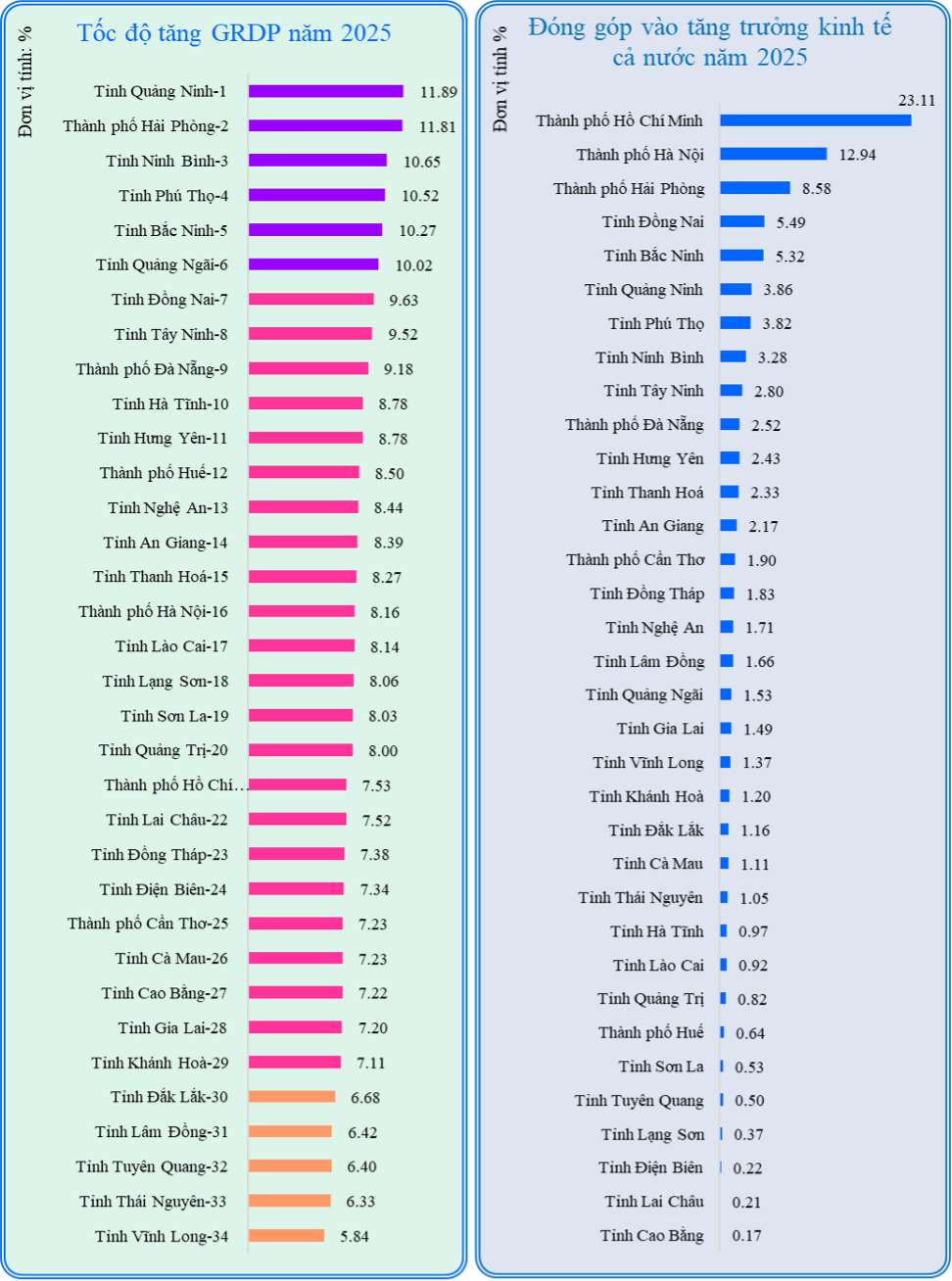
The group of provinces and cities with stable growth from 7-10% accounts for the majority (with 23/34 provinces and cities), reflecting the general recovery and expansion trend of the economy, as well as the relatively uniform spillover effects of macroeconomic policies.
The low-growth group is below 7% (5/34 provinces), showing that although there are still difficulties, no localities fall into a state of stagnant growth. The growth gap between the leading group and the bottom group raises the requirement to strengthen regulation and allocate resources more reasonably, in order to limit the risk that localities in the "bottom boundary group" are not left too far behind in the overall economic development of the country.
Localities including Hanoi, Ho Chi Minh City, Hai Phong, Dong Nai and Bac Ninh continue to play the pillar role of the economy, contributing the most to the country's GDP growth. These are 5 localities with the largest economic scale in the country; in 2025, this group contributed up to 55.4% to the country's growth. Hanoi City achieved GRDP growth of 8.16%, Ho Chi Minh City increased by 7.53%, these two localities contributed 36.1% percentage points to the country's growth.
Besides localities with high growth rates, some localities have GRDP growth rates lower than the general average, including Vinh Long, Thai Nguyen, Tuyen Quang with growth rates ranging from 5.84 - 6.4%.
Explaining the reason, the Deputy Director of the Statistics Office said that it mainly stems from objective and specific economic barriers.
First, the economic structure is still dependent on industries with low added value. Vinh Long and Tuyen Quang still rely heavily on small-scale agriculture and processing industry, strongly affected by weather, fluctuations in input prices and consumption markets, while the high-quality service sector is developing slowly. For Thai Nguyen, although industry plays a key role, growth is heavily dependent on some large-scale FDI enterprises, causing the growth rate to be affected when electronics production and global exports stagnate.
Second, the investment momentum is not strong enough and there is a lack of large-scale, breakthrough projects; the progress of implementing some infrastructure and industrial projects is still slow, limiting the spillover effect to the construction, service and commercial sectors.
Third, the scale of the local consumer and service market is still limited due to small urban population and low average income, causing purchasing power and service demand not to create significant pull for growth.
In addition, adverse impacts from external factors such as: World economic fluctuations, increased input costs and local natural disasters have affected agricultural production and processing industry, reducing growth space in the short term.


