Gasoline and oil prices decrease, food services are still in a state of waiting for adjustment
Fuel prices fall, transportation pressure reduced, supporting production
Ho Chi Minh City currently has a large passenger transport network with more than 2,100 routes and 2,700 vehicles, of which fuel costs account for 30-40% of total operating costs. When gasoline and oil prices increased sharply before, many businesses were forced to cut trips, operate sparingly or suffer losses because the number of passengers was not enough to cover costs.
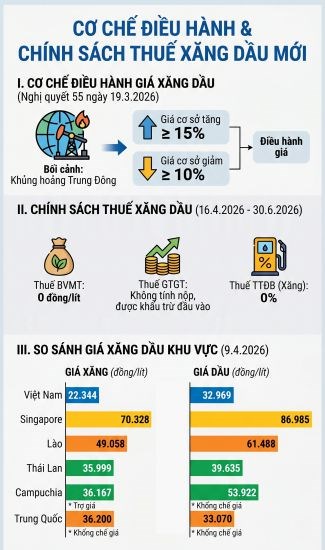
Reality shows that increased fuel costs have caused difficulties for many long-distance bus routes, revenue is not enough to cover expenses such as salaries, road tolls and depreciation. However, the cooling down of gasoline prices and tax reduction policies are helping businesses reduce cost pressure, creating conditions to maintain more stable operations and limit the need to increase fares.
Experts believe that reduced fuel costs not only help transport businesses improve profits but also contribute to stabilizing freight rates, supporting the recovery of operations and increasing competitiveness. At the same time, this also has a spillover effect, helping to reduce logistics costs, support production - business and contribute to controlling inflation. See more...
Stock market conquers the 1,800 point mark
The stock market on April 15 continued to increase strongly and officially conquered the 1,800 point mark, mainly thanks to the pulling force from the Vingroup duo of stocks, VIC and VHM. Although the number of declining stocks was more than increasing, these two stocks still played a pillar role, helping VN-Index increase by 25 points.
Market liquidity is at an average level with more than 910 million shares, trading value of about 24,430 billion VND; of which HPG and SHB are two codes with a trading value of over 1,000 billion VND. Foreign investors returned to net selling strongly by more than 3,500 billion VND, focusing on selling VHM, while net buying VIC.
Experts believe that low interest rates are a positive supporting factor, promoting cash flow to move to stocks. However, to form a sustainable upward trend, the market still needs more factors such as economic growth, inflation control and geopolitical stability. In the short term, the market may still fluctuate, but in the medium term there is still an opportunity to accumulate good fundamental stocks to welcome a new upward cycle. See more...
Business households are allowed to adjust their social insurance contribution salaries after 12 months
According to the 2024 Law on Social Insurance, business households participating in compulsory social insurance are entitled to re-choose the salary level as a basis for contribution after paying according to the registered level for at least 12 months. This regulation helps participants flexibly adjust the contribution level according to financial conditions at each stage.
The salary level used as a basis for contributions must be within the prescribed framework, not lower than the reference level and not exceeding 20 times the reference level at the time of contribution. This is to ensure both flexibility for participants and maintain long-term social security benefits.
The law also clearly stipulates how to determine social insurance contribution salaries according to each group of subjects, from state-salaried people, employees in enterprises to groups that can choose their own contribution levels. Allowing adjustments after 12 months is considered to help business households be more proactive, while still ensuring social insurance benefits according to regulations. See more...