
Gasoline prices decrease, service prices are still slow to adjust
When gasoline and oil prices increase, from bowls of sticky rice, bowls of pho to cups of coffee, prices simultaneously increase. However, to date, when gasoline and oil prices have decreased sharply compared to peak levels, many stores have not yet adjusted selling prices down.
Ms. Luc Thu Minh (Hoan Kiem ward, Hanoi), who regularly uses out-of-town dining services, said: "Dining and shopping services are now all higher than before. Especially, fast and convenient dishes such as vermicelli, glass noodles, and pho have all increased by at least 3,000 - 5,000 VND/bowl".
According to Ms. Minh, some stores have shown positive signs thanks to the State's support policies. However, many familiar services have not shown signs of price reductions.
I hope that in the future, when prices gradually stabilize, services will also be adjusted more reasonably. Just stabilize compared to the present, not expecting to return to low prices as before" - Ms. Minh shared.
Not only goods and services are increasing in price, consumers are also worried about travel costs when bus ticket prices have not shown signs of corresponding decrease.
Regularly traveling the Hanoi - Hai Phong route by limousine, Ms. Nguyen Nhat Mai (23 years old) prioritizes choosing this means of transport thanks to on-site pick-up and drop-off service and fast travel time.
According to her, increasing ticket prices when gasoline prices increase is understandable. "However, this is a common fluctuation, so both businesses and passengers need to share. Passengers accept reasonable increases, and businesses should also reduce a part of profits, instead of transferring all costs to passengers" - Ms. Mai said.
Ms. Mai expects car companies to have a more transparent price adjustment mechanism, especially reducing fares when input costs decrease.
Sharing the same view, Ms. Vu Thi Thu (Le Chan ward, Hai Phong) - a passenger traveling regularly 2 times/week on the Hai Phong - Hanoi route - said that bus companies have adjusted prices 2-3 times in the past time. The initial ticket price ranged from 220,000 - 250,000 VND/sEAT, then increased by about 30,000 VND, at times up to 280,000 - 300,000 VND/sEAT.
After gasoline prices decreased, "core" car companies have adjusted them, currently at 260,000 - 280,000 VND/seat depending on location. However, the price difference between car companies is still about 10,000 VND/ticket.
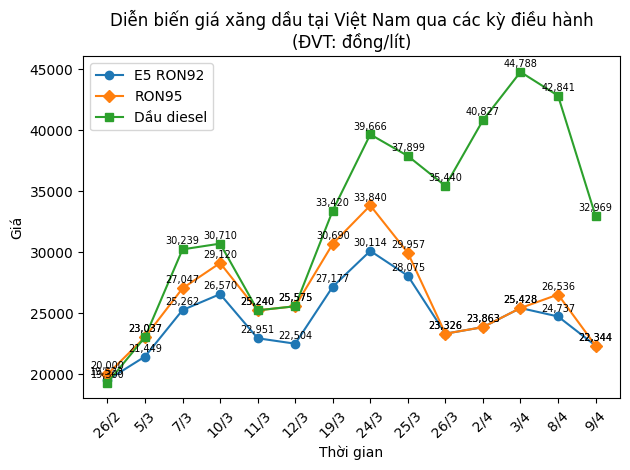
In fact, from the beginning of March to now, domestic gasoline and oil prices have been continuously adjusted according to world developments. Notably, diesel oil prices peaked at 44,788 VND/liter on April 3, then decreased sharply by 11,819 VND/liter (equivalent to 26.4%) in the operating periods on April 8 and 9.
Similarly, the price of RON95 gasoline until April 9 also decreased by 10,297 VND/liter (30.4%) compared to the peak of 33,840 VND/liter on March 24.
The above domestic retail gasoline and oil prices are maintained and adjusted by the inter-Ministry of Industry and Trade - Finance from 3:30 PM on April 9, 2026.
Existence of latency
Talking to Lao Dong Newspaper, Dr. Nguyen Minh Phong - former Head of Economic Research Department, Hanoi Institute for Socio-Economic Development Research - said that the impact of gasoline and oil prices on the prices of goods and services is difficult to measure in proportional or direct, linear ways, because there is always a delay.
When gasoline and oil prices increase, usually after about a week, commodity and service prices will adjust accordingly. Conversely, when gasoline and oil prices decrease, it may take about a month for commodity prices to decrease" - Mr. Phong assessed.

Explaining further, Dr. Nguyen Minh Phong said that the level and time of adjustment depend on market behavior. Sellers often tend to delay price reductions. If consumers do not put pressure or there is no decisive bargaining, the old price level can continue to be maintained.
According to him, there needs to be synchronous solutions from the State and the market such as increasing supply, improving competitiveness and promoting propaganda to change the behavior of both buyers and sellers.
Assessing the impact of tax policies related to gasoline and oil, Mr. Phong said that the adjustment of environmental protection tax, value-added tax (VAT) and special consumption tax will bring positive effects to the economy.
Tax reduction helps reduce production and business costs, while increasing market liquidity. Tax reduction will contribute to stimulating total demand with payment capacity, thereby creating a general positive impact" - Mr. Phong emphasized.


