
As the economy enters a new stage of development with a higher growth target, the need for capital for infrastructure investment, industry, energy transition and technological innovation is increasing. In that context, mobilizing and effectively allocating financial resources becomes one of the key factors to maintain the growth momentum of the economy.

Exchanging at the workshop "Effectively mobilizing capital sources, serving double-digit growth goals" organized by Lao Dong Newspaper in coordination with the Ministry of Finance and the State Bank of Vietnam in Hanoi, Mr. Nguyen Quang Ngoc - Deputy Head of Credit Policy Department of Vietnam Bank for Agriculture and Rural Development (Agribank) said that to achieve high growth targets, the economy needs a large amount of capital to be mobilized in a timely manner and allocated effectively.

To support economic growth effectively, Agribank's goal in the coming period is not only to expand credit scale but more importantly to orient capital flows into sectors that create growth momentum and sustainable development," Mr. Ngoc said.
Bank credit continues to play a key role
According to Mr. Nguyen Quang Ngoc, in the current capital mobilization structure of the economy, bank credit is still the most important capital supply channel and accounts for the largest proportion of total social investment capital.
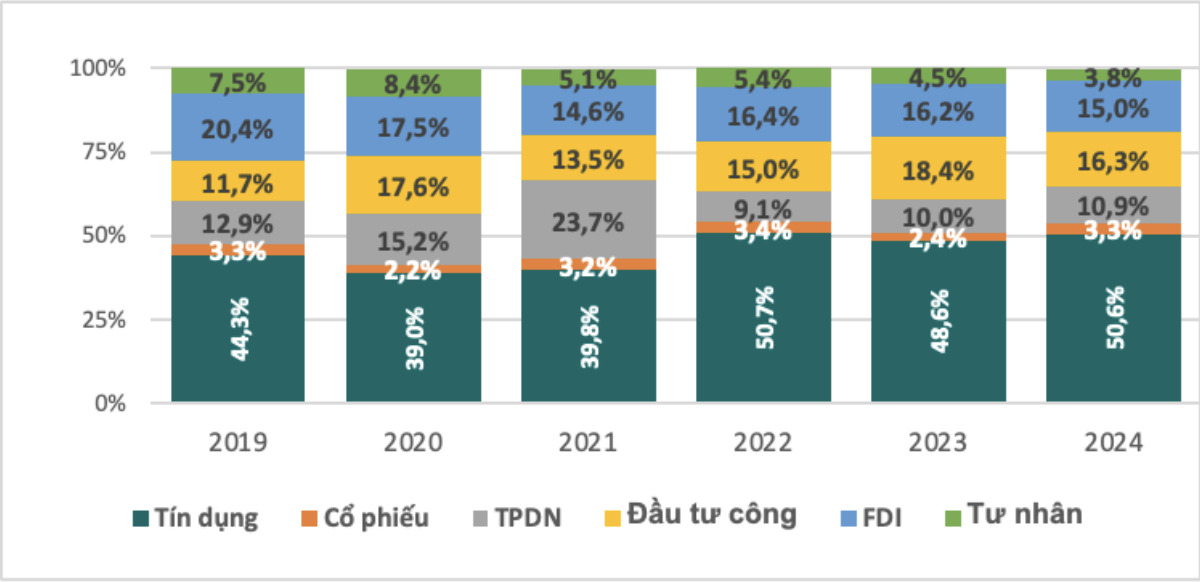
Although the bond market and other capital mobilization channels have developed somewhat in recent years, the ability to provide medium and long-term capital for the economy is still limited. Meanwhile, public investment mainly focuses on infrastructure projects and is unlikely to expand strongly in scale in the short term.
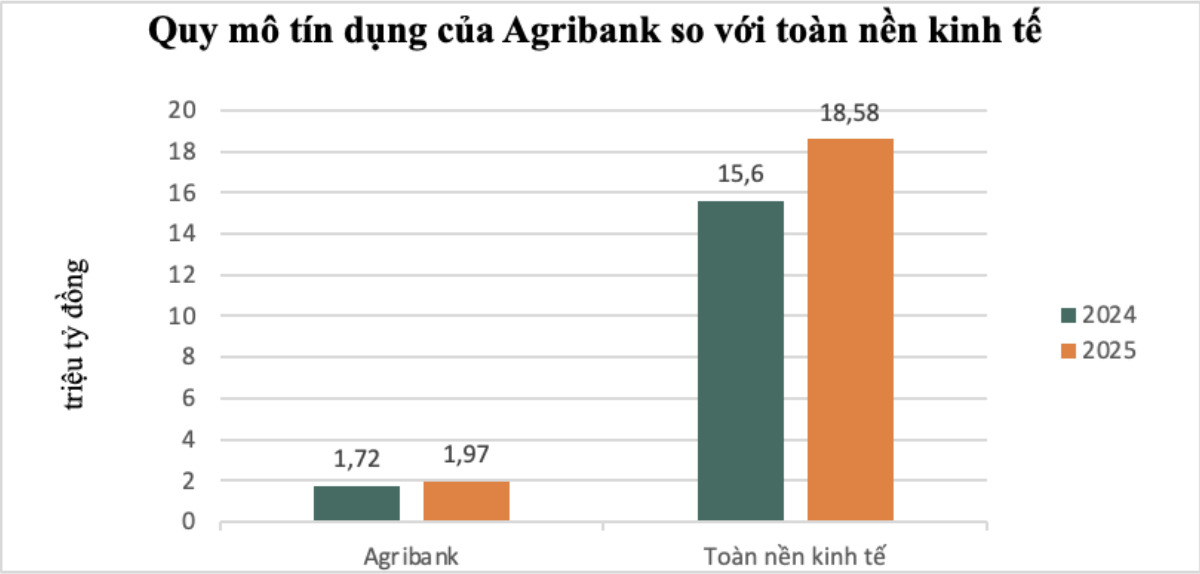
By the end of 2025, Agribank's total outstanding credit balance reached nearly 2 million billion VND, an increase of nearly 15% compared to the end of 2024. In which, outstanding loans for the agricultural and rural sector reached about 1.3 million billion VND, accounting for about 64% of the bank's total outstanding debt and is the highest level in the entire banking system.
Agribank's credit capital has now covered communes, wards and towns across the country, playing an important role in supporting agricultural production, rural development and promoting agricultural product value chains," Mr. Ngoc shared.
The bank also implements many credit programs under the direction of the Government and the State Bank such as lending to the forestry and fishery sectors or the program to link production, processing and consumption of high-quality, low-emission rice in the Mekong Delta.
In addition, Agribank also strengthens credit for processing industrial projects associated with the value chain, and at the same time implements a preferential credit package of 60,000 billion VND for businesses investing in infrastructure and digital technology.
In addition to expanding credit scale, Agribank is also promoting green credit development. By the end of 2025, the bank's green credit balance will reach 28,356 billion VND, focusing on areas such as clean agriculture, renewable energy, environmental treatment and circular economy.
The capital market needs to develop to supplement long-term resources
Besides bank credit capital, the development of the capital market is considered an important factor to expand the ability to mobilize resources for the economy.
According to a representative of the Japan International Cooperation Agency (JICA), the financial system of an economy can be likened to a "two-wheel drive", including the banking system and the capital market. These two parts need to develop in parallel and complement each other in the process of mobilizing and allocating resources to the economy.
For many years, the banking system has played a leading role in providing capital to businesses, especially the production and business sector. However, as the scale of the economy expands and long-term investment demand increases, excessive dependence on bank credit can create limitations to the balanced development of the financial system.
In that context, the capital market, especially the stock market, plays an important role in providing medium and long-term capital for the economy. The capital market not only helps businesses mobilize resources for investment but also contributes to improving transparency, improving corporate governance and forming an effective valuation mechanism for financial assets.
International experience shows that balanced development between the banking system and the capital market is an important factor in improving the resilience of the financial system to economic fluctuations.
Improve market quality to attract international capital flows
According to JICA representatives, although the Vietnamese stock market has made much progress in recent years, there is still much room to improve operational efficiency and attract stronger international capital flows.
One of the challenges is that the number of enterprises conducting initial public offerings (IPOs) and new listings on the stock market is still limited, making the supply of high-quality stocks in the market not really abundant.
In addition, the issue of limiting the foreign ownership ratio in some industries also partly affects the participation capacity of international investors.
According to JICA, to enhance the attractiveness of the capital market, Vietnam needs to continue to improve the quality of listed companies, complete the IPO process according to international practices and enhance information transparency.
When the capital market is developed more effectively and deeply connected with the international financial market, domestic enterprises will have more opportunities to access medium and long-term capital sources to serve investment and expand production.
The effective combination of bank credit capital and capital mobilization channels in the financial market will help the economy expand resources for investment, thereby creating more room for growth in the coming years.



