
Faced with increasing concerns about food safety in schools, especially after some recent incidents, improving the quality of school meals is becoming an urgent requirement in Ho Chi Minh City.
Not only stopping at improving menus, many new management solutions, including the "Responsibility Green Tile" application to make the supply chain transparent, have been implemented.
Ms. Nguyen Thi Be Ngoan - Chairwoman of Tan My Ward People's Committee said that pressure from public opinion and parents forces localities to comprehensively re-examine the organization of school meals. In the context of increasingly high monitoring requirements, the application of technology is considered an inevitable trend. With the support of the Department of Industry and Trade, solutions for tracing origin and managing meal quality have been introduced to control the entire supply chain.
Systematic and transparent food origin management will help functional agencies monitor more effectively, while creating trust for parents" - Ms. Ngoan emphasized. This is also the foundation for schools, suppliers and families to closely coordinate in ensuring food safety for students.
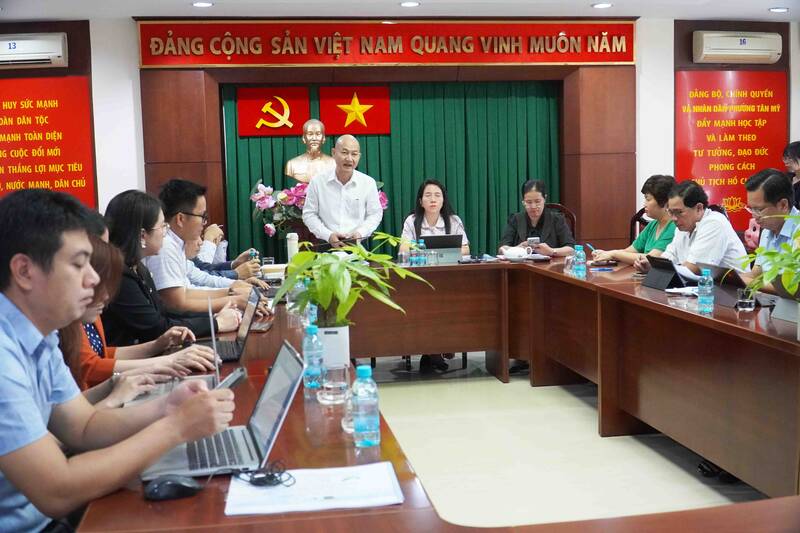
From a management perspective, Mr. Nguyen Nguyen Phuong - Deputy Director of Ho Chi Minh City Department of Industry and Trade said that food safety work is still mainly based on a centralized model, while the scope of management is wide and resources are limited, making control difficult. Traditional practices, handling violations that have occurred, are likened to "leaving chickens to the garden and then going to catch them".
Another inadequacy is that production enterprises that meet standards often face difficulties in the domestic market due to high costs, while some units chasing cheap prices ignore standards, posing risks for consumers.
From there, the industry and trade sector orients market transparency: standard units will publicly disclose information, be confirmed and connected for distribution; conversely, they will gradually be screened. This model will continue to expand, including a pork trading floor, in order to increase supply-demand connection and improve transparency.
For the field of school meals, this is considered a potential direction. Currently, many suppliers and distribution systems are ready to participate, supplying standard ingredients at reasonable prices, and at the same time supporting training and improving service quality" - Mr. Phuong said.
However, representatives of schools said that management pressure is currently very high. Although highly appreciating the transparency of the solution, many units are still concerned about the feasibility because they have signed contracts to provide meals from the beginning of the school year, and have not integrated new criteria. In addition, the issue of costs and financial mechanisms also needs to be clarified.
Schools propose that there should be a suitable roadmap, and at the same time collect parents' opinions to create consensus before implementation. Although there are still obstacles, this is still considered a positive direction to improve the quality and transparency of school meals.


