
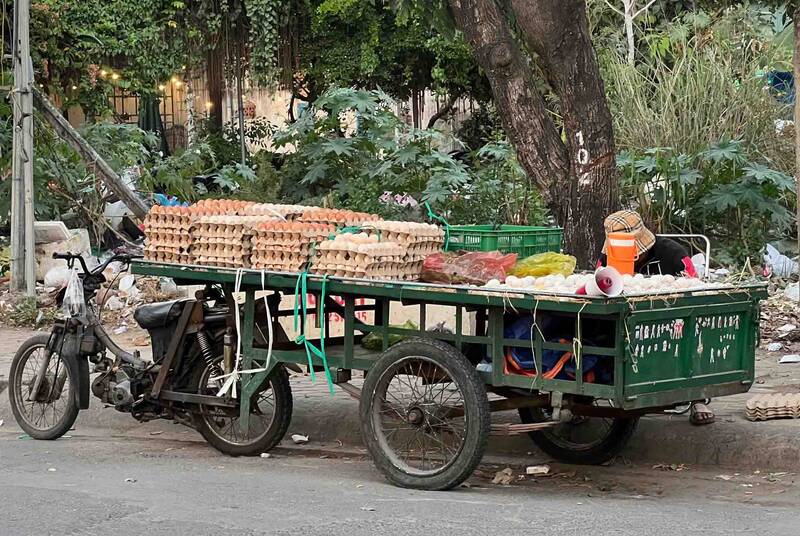
Recently, the situation of chicken eggs being sold rampant in front of industrial park gates or on sidewalks in Ho Chi Minh City at a price of about 30,000 VND/bag of 30 eggs, equivalent to about 1,000 VND/egg, is attracting many consumers. This price is much lower than the selling price in supermarkets, about 2,800 VND/egg.
According to Ms. Lam Thuy Ai - General Director of Mebi Farm Joint Stock Company, the type of egg sold at a price of about 1,000 VND/egg is actually near the expiration date (expired date) or has run out, mainly chicken eggs smuggled from large farms that are not in time for consumption. Consumers, especially workers and low-income people, are easily attracted to cheap prices, so they are willing to choose without fully anticipating the potential food safety risks. According to Ms. Ai, this situation is unintentionally strangling clean products on the market.
Meanwhile, livestock businesses are currently not only under competitive pressure from cheap goods but also have to bear increasing production costs.
According to Ms. Ai, the cost of animal feed alone has caused the cost of an egg at the farm to fluctuate around 1,700-1,800 VND. If adding the costs of preliminary processing, testing, packaging and transportation, the actual cost of a clean egg is about 2,200-2,400 VND/egg. This means that the price of 1,000 VND/egg currently sold on the market is almost impossible to be a product that meets all standards if the production cost is correctly calculated.
Faced with this situation, management agencies also recognize the difficulties that livestock businesses are facing in the market.
Mr. Nguyen Nguyen Phuong - Deputy Director of Ho Chi Minh City Department of Industry and Trade - said that he understands the difficulties of well-invested businesses but must compete with cheap goods of unknown origin. Ho Chi Minh City is the largest consumption market in the country, with a huge amount of goods from many places pouring in, including both imported and smuggled goods, while legal regulations and control capacity have not kept up with reality.
From the perspective of the livestock industry, many opinions believe that competitive pressure is also forcing businesses to change production models to survive.
Talking to Lao Dong Newspaper, Mr. Nguyen Tri Cong - Chairman of Dong Nai Livestock Association - said that according to businesses in the industry, price competition pressure is forcing the livestock industry to restructure strongly. Currently, many countries have changed livestock models to reduce production costs. For example, in China, livestock costs in many areas have decreased quite deeply, creating great pressure on the regional market.
In Vietnam, the livestock industry must also innovate in the direction of improving productivity and reducing costs, especially in the context that about 70% of input materials still depend on imports. Therefore, the Ministry of Agriculture and Environment has oriented livestock enterprises to focus on the survival problem of reducing production costs to approach the world price level.
To do this, many businesses are promoting innovation in livestock technology, upgrading barn systems and operating equipment. In particular, AI technology is considered an important solution to help manage livestock more effectively, control diseases and monitor to each individual.
Businesses believe that Vietnam's livestock industry is forced to change to bring production costs closer to world levels. Only then can domestic farmers maintain their competitiveness and sustainable development.


