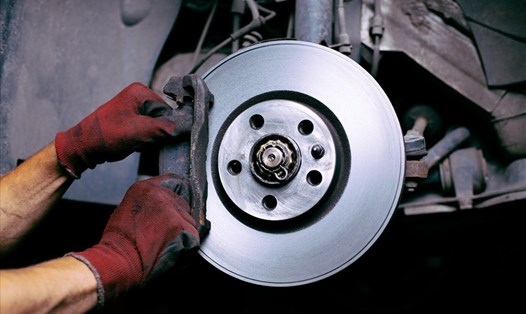
According to a technician at the Ninety Eight Auto Repair, Maintenance and Care Center (Thu Duc City, Ho Chi Minh City), after washing a car, many car owners may notice brown or yellow patches on the brake discs that look like rust.
This situation often occurs when a cast iron brake disc surface comes into contact with water, especially after the car has just come into contact with water and parked for a long time.
In fact, this is usually a surface oxidation layer formed in a short time, which does not mean that the brake disc has been seriously damaged. The brake disc regularly comes into contact with the external environment, so this phenomenon may appear after encountering water or in high humidity conditions.
The technician explained that when the car is operated again, the brake pads will come into contact with the disc surface during braking, helping to remove the thin oxidizing layer. After a few brakes in normal operating conditions, the oxidizing layer is usually removed and the disc surface returns to a brighter, relatively even state.
Therefore, if only a thin oxidizing layer appears on the brake disc surface after washing the car or driving in the rain, the car owner does not need to worry too much. When the car operates again, you should drive slowly in the safe area and brake lightly a few times to dry the friction surface, and check the feel of the pedals and braking ability.
In addition, car owners should not immediately see that the brake disc is brown and then drive the car away conveniently or smoothly on the disc surface. Reworking the disc surface should only be carried out when there is an appropriate technical basis, for example, the disc has a rotation exceeding the limit, the surface has deep grooves, damaged or uneven thickness, and after inspection, it still meets the minimum thickness limit according to the manufacturer's regulations.
Using discs or unnecessary flatting the brake disc surface can reduce the material thickness of the brake disc. When the disc is close to or below the permissible limit, the appropriate option may be to replace it instead of continuing processing.
In addition, if the brown layer does not disappear after normal braking, the disc appears with deep grooves, has a deviation exceeding the limit, the car vibrates when braking, abnormal noises appear or signs of uneven braking, the car owner should take the car to a repair facility to check the brake disc, brake pads and brake calipers.