
The newspaper of resistance and determination to win
The Lao Dong Newspaper issues released in early 1954, towards welcoming the Year of the Horse, were imbued with the atmosphere of preparing to enter the decisive stage of the resistance war against the French colonialists. The red canvas highlighted the words "Lao Dong" - Central Agency of the Vietnam General Confederation of Labor, above which was the words "Democratic Republic of Vietnam". The newspaper was then published weekly, simple in form but containing great spiritual strength.
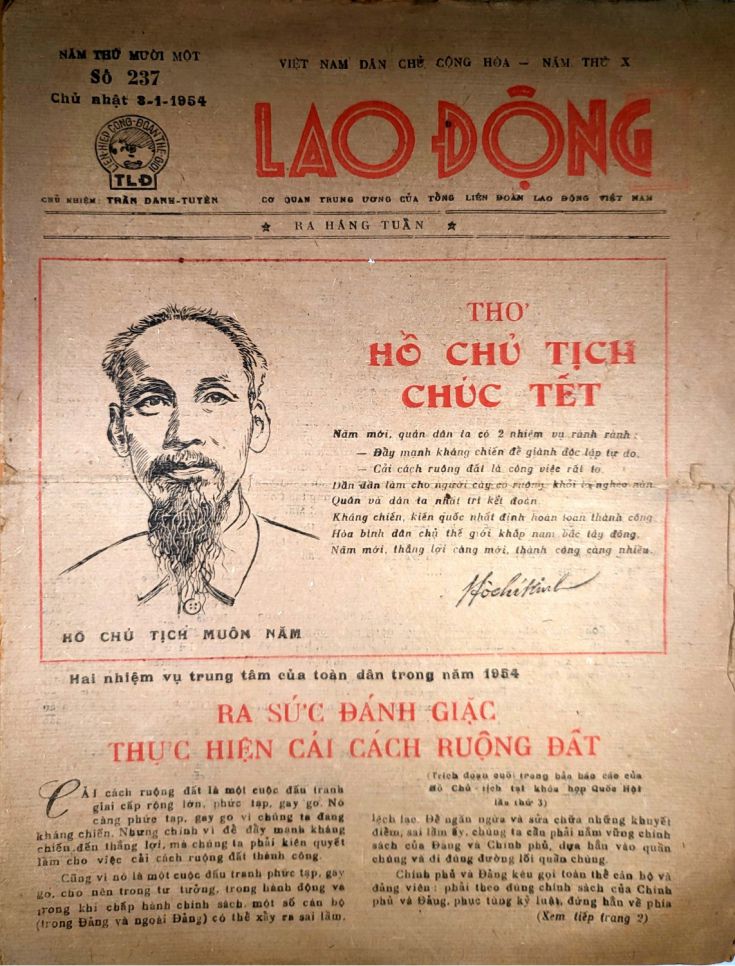
No. 237, dated January 3, 1954, the front page is solemnly framed with "Poems of President Ho wishing Tet" - 8 concise verses containing the strategic direction of the revolution. Among them are the last 4 verses:
Our army and people unanimously unite
Resistance war, national construction must be completely successful
World peace and democracy across the south, north, west, and east
New Year, the more new victories, the more successes.
Below the poem is Uncle Ho's signature; on the left is his portrait. Also on the front page, Lao Dong Newspaper published an article about the two central tasks of the entire people in 1954, excerpted from President Ho Chi Minh's report at the National Assembly session. The newspaper page that year was both information and a call to arms, fostering the belief in complete victory for the entire nation before the decisive campaign of history.
Construction Spring on newspaper pages
24 years later, the country entered the Mau Ngo Spring of 1978 in the spirit of peaceful reunification and the cause of building socialism. Lao Dong Newspaper No. 1 (2903), dated January 5, 1978, solemnly published the message "Happy New Year" of President Ton Duc Thang, calling on the entire Party, people, and army to unite, enthusiastically work and produce, and successfully implement the 5-year plan for 1976 - 1980.
Those early issues of the year with many images of beloved Uncle Ho, his advice: "Need to have a spirit of daring to think, dare to do, rise to the top, become an advanced worker". The small corner at the last page introduces the Lao Dong Xuan Mau Ngo publication - "a useful spring gift" for workers and trade union officials... across the country.
Notably, the special issue of Spring Mau Ngo 1978 (numbers 5 (2907) and 6 (2908) consists of 24 pages, many colors, rich content and is a mark of journalistic art in the early post-unification period. The front page is filled with Spring colors: A woman in a pink ao dai playing the flute, an ancient peach tree is brilliant, behind is a factory chimney, a construction crane, a high-voltage power pole - a symbol of industrialization and reconstruction of the country. In the distance, a group of young men and women playing musical instruments evokes a vibrant mass art movement of workers.
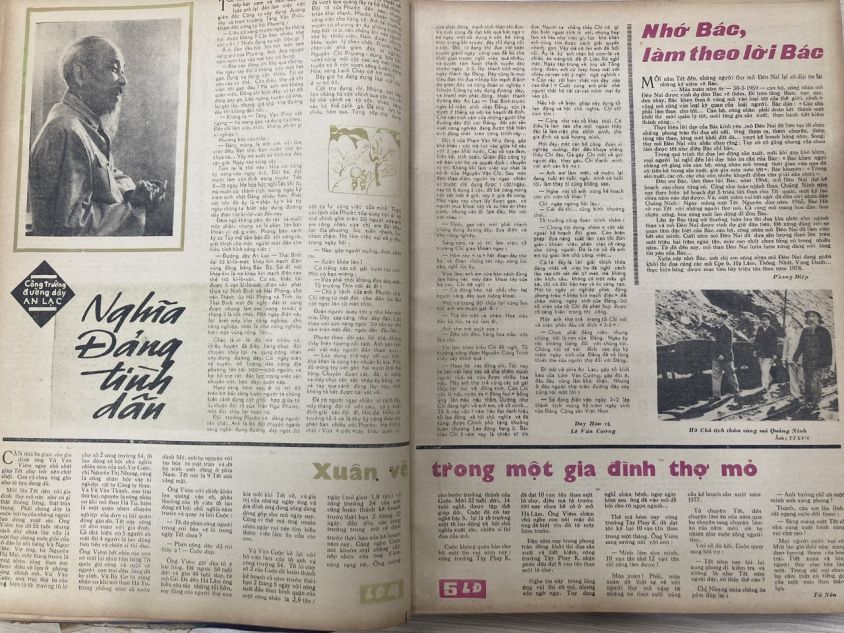
Pages 2 and 3 post the article "Spring of the Country" by author Nguyen Khoat - a political commentator full of emotions, in direct dialogue with readers: "This is the third Spring since the peaceful reunification of the Fatherland...", "You and I look out at the country this Spring...". The lines reflect the belief in the upward trend of the country, but also frankly look at the negative habits and affirm that the heat of the socialist construction will "cut out those dirties".
The following pages alternate between political commentary, documents and life: construction sites, miner families, movements to study and follow Uncle Ho's words, daily labor stories. The newspaper also dedicates a separate column for the "Year of the Horse" with many articles such as: Years of the Horse with great significance; Horse image in ancient Vietnamese shaping art; Horse racing; Horsepower... The "Year of the Horse telling horse stories" column with many short stories about horses such as "Horse ears"; "Horse's memory"; "Football players"... horses. Poems, short stories, and short stories about horses both create a Spring atmosphere and send metaphors about the resilience and breakthrough of the nation on the road to the future.
The poem "Years of the Horse have great meaning" collected by author Nguyen Vy has the following content: "Independent Vietnam named Dai Viet right in the year of the Horse (1054). Our Party was born in 1930, which is also the year of the Horse. The Dien Bien Phu victory that shook the globe, ending the fate of French colonialism, also in the year of the Horse (1954). Uncle Ho's call for determination to fight against the US and save the country, stating the bright truth "Nothing is more precious than independence and freedom" also in the year of the Horse (1966). This year, 1978 is the "Year of the Horse" of the 5-year plan.
The special issue of Lao Dong Spring Mau Ngo 1978 is therefore not only a journalistic publication, but a vivid cut of documents about the country's mindset in the early years of construction: Many aspirations, many hardships, but full of faith.
Breath of innovation and integration
Stepping into the 21st century, Spring Nham Ngo 2002 marked a new period: Vietnam accelerated on the path of renovation and integration. Lao Dong Newspaper released a special publication with 124 pages with the theme "Advancing strongly on the path of renovation and integration".
In the early spring letter, the Editor-in-Chief of Lao Dong Newspaper reviewed the development figures at that time: Foreign investment capital of over 3 billion USD (up 25% compared to the previous year), GDP increasing by nearly 7%, Vietnam is assessed as a stable country in development, politically and socially safe. "In that optimistic context, we are proud of a socialist regime with a radiant future imbued with Vietnamese identity and bravery that is constantly shining" - the letter wrote.
The Spring newspapers that year spanned many fields: from politics, trade unions, economy, society to international affairs. The issue had many unique articles in many different content areas, including the Politics - Trade Union section with the article: "Spring returns, remembering Uncle Ho" and Uncle Ho's first published photo in Paris (1946) showing respect for the value of origin. Reprinting Uncle Ho's letter to Lao Dong Newspaper in 1950 is a way to affirm the principles, purposes and glorious traditions of the newspaper for the working class. Or the portrait article of Ms. Nguyen Thi Binh - "steel rose" of Vietnamese diplomacy - is vividly depicted, both honoring female talents and affirming Vietnam's position in the international arena through memories at the Paris Conference.
The issue has many articles on reform, integration, working people's lives, socio-economic movements... reflecting a country that is stepping out into the world with a confident, proactive mindset and strong aspirations for development.
The Lao Dong Spring Nham Ngo 2002 publication is therefore imbued with the breath of intersection: Between traditional Tet and modernization spirit; between revolutionary memories and integration vision; between sustainable values and aspirations to the future.
The pages of Lao Dong Newspaper have accompanied the turning points of the country. Each issue is a documentary milestone, a voice of the times, a testament to the continuous development of the Vietnamese nation on the journey of independence, unity, renovation and integration.


