
Every time space technology is mentioned, many people often think of rockets, space stations or expeditions thousands of kilometers away from Earth. However, the journey to conquer infinite space is creating values very close to daily life. Many technologies developed to solve harsh problems in outer space have found their way back to serve humans on the ground. From wireless headphones, infrared thermometers, scratch-resistant glasses to GPS navigation systems or Earth observation satellites, the mark of the space industry is present in many fields that users sometimes do not realize.
Along with the development of the space economy, the gap between technology serving outer space missions and the daily needs of humans is increasingly narrowing. The report of the MacKinsey World Economic Forum forecasts that the global space economy scale could reach 1.8 trillion USD by 2035, showing that space applications are gradually becoming an important infrastructure of the economy as well as modern life.
No longer distant things
Space was once considered a place only for scientists and astronauts. But reality shows that many familiar products in life originate from research serving extraterrestrial flights.
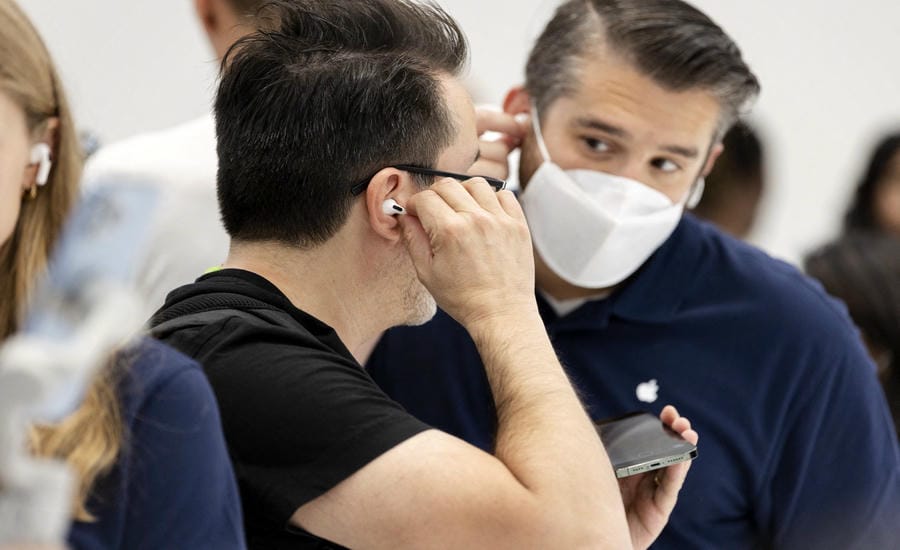
One of the most obvious examples is wireless headphones, which many current smartphone users own. From the need to build hands-free communication systems for pilots and astronauts in the 1960s, NASA cooperated with sound experts to develop the first wireless headphones. Over time, that technology platform continued to improve and became the basis for the popular Bluetooth headphones today.
In medicine, infrared thermometers also originate from the technology of observing celestial bodies at very long distances. Initially, researchers at NASA's Jet Propulsion Laboratory developed an infrared system to measure the heat emitted from objects in space. Later, this technology was transformed into infrared thermometers widely used in hospitals and homes.
Even the scratch-resistant coating on the glasses we wear every day is the result of solving the lunar dust problem. The extremely fine glass and rock dust particles on the surface of the Earth's natural satellite have a very strong erosion ability, forcing researchers to develop new protective coatings. This achievement was later applied to the medical and sunglasses manufacturing industry.
The list of technologies "going from space to Earth" also extends with CMOS image sensors appearing in most smartphones, water filtration systems, activated sponge materials or battery-powered handheld devices.
The usefulness of aerial observation technology
If technology transfers from the space industry appear in every consumer product, satellites are operating like an invisible infrastructure of the modern world.
More than 85% of the data serving current weather forecast models is collected from satellites. From orbit, these devices continuously record temperature, humidity, wind and many atmospheric parameters to build storm and weather forecasts for many days, while monitoring forest fires, floods and extreme phenomena almost in real time.
Satellites are also an important tool in monitoring climate change when monitoring ocean temperatures, sea levels, greenhouse gases, ice and forest area on a global scale. Observation data from space also supports monitoring drought, plant health and water resources, helping managers make more appropriate decisions in the face of environmental challenges.
As space technology increasingly develops, applications that were once created for the journey to explore the universe are increasingly closely associated with life on Earth. The achievements of space missions are therefore not only in scientific milestones, but also present in every daily activity of humans.
Satellite navigation systems have become the foundation for modern transportation and logistics. Smartphones, cars or wearable devices all use satellite signals to locate, find directions, support rescue and optimize transportation operations.
Wireless headphones, scratch-resistant glasses or infrared thermometers, items that are very familiar to us today, are all the result of technologies developed to take people further and deeper into space.


