
Model shift from Conservation to Sustainable Development
The history of world economic development in the 21st century witnessed a shift from resource-using industries to creative industries. In that flow, cultural heritage plays a role as an irreplaceable resource for the cultural industry.
For Vietnam, a country with a thousand-year history, repositioning the role of cultural heritage is an urgent requirement. Heritage should not only exist as frozen objects in museum glass or archival documents, but must become a vivid entity, directly participating in the global value chain.
The strategy for developing Vietnam's cultural industries to 2020, with a vision to 2030, has set a target for the revenue of these industries to contribute 7% of the national GDP. This figure reflects ambition and is also a pressure forcing us to change management thinking: Switching from a subsidy and ask-give mechanism to a socialist-oriented market mechanism, where culture both preserves its identity and generates economic profits to reinvest in itself. The problem posed is not only what we have, but how we "sell" those values without eroding the core of national culture.
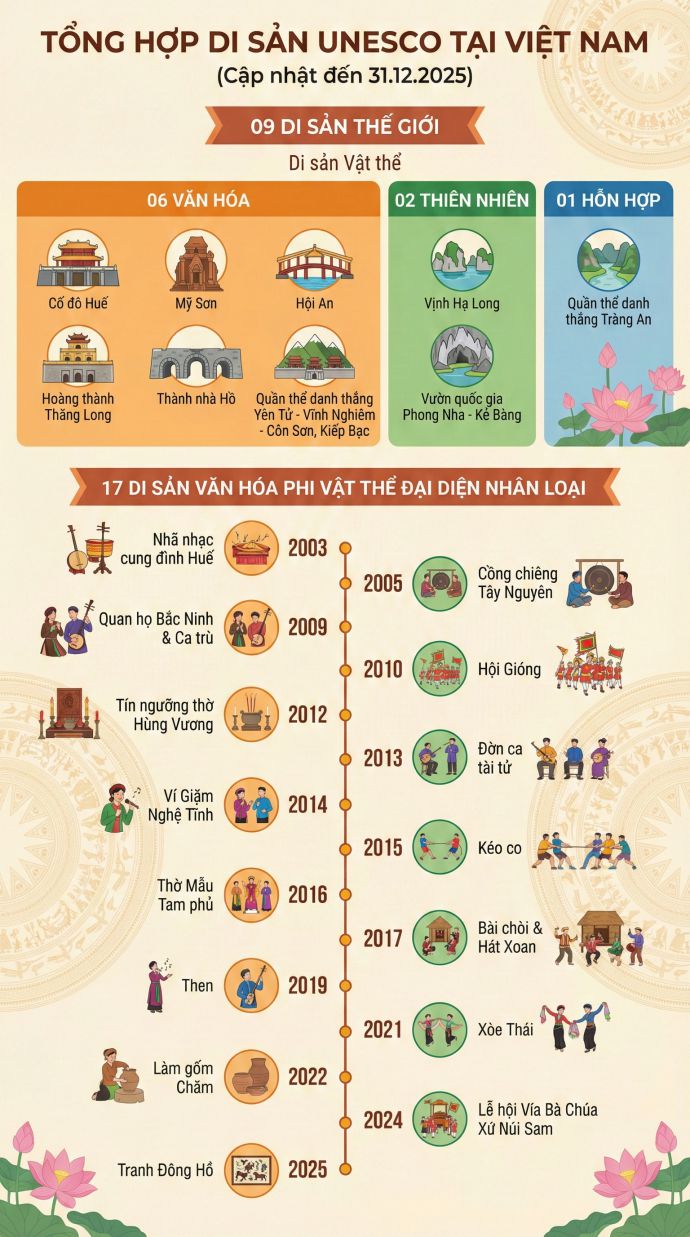
Vietnam currently holds a treasure trove of remarkable tangible and intangible cultural heritage on the world cultural map. Up to now, Vietnam owns 9 World Cultural and Natural Heritages recognized by UNESCO, along with 17 Representative Intangible Cultural Heritages of Humanity. The system of national historical and cultural relics reaches over 40,000, of which nearly 150 are special national relics.
This is a huge "resource" for the creative industry. However, the paradox that exists is that resource wealth is not proportional to the economic efficiency it brings. Data from the Ministry of Culture, Sports and Tourism shows that although cultural tourism contributes about 10-15% to total tourism revenue, this figure is still modest compared to potential. The added value of Vietnamese cultural products today is mainly still based on superficial exploitation, lack of creative depth and not yet formed a complete value chain.
We need to frankly recognize that most of the current heritages are only at the level of traditional tourism exploitation and ticket collection. Typical examples such as Trang An Scenic Landscape Complex or Hue Ancient Capital, although the number of tourists grows steadily every year, revenue from increased services, creative souvenirs or in-depth cultural experiences still accounts for a low proportion.
Compared to South Korea, a country that has successfully built the Hallyu Wave based on traditional culture combined with modern technology, Vietnam is missing the opportunity to transform cultural capital into economic capital. We export cultural resources in raw form, while the world needs refined products with high intellectual and technological content. The lack of creative spaces, the breakdown between heritage researchers and the creative business community has created large gaps in the national cultural industrial ecosystem.
Identifying bottlenecks
The biggest barrier hindering the takeoff of Vietnam's cultural industry does not lie in the lack of capital, raw materials or human resources, but in the backwardness of the legal framework and management thinking. The subsidy mindset deeply rooted in the cultural management subconscious for decades has created great inertia. Heritage is often defaulted to being a sector that spends budget money rather than a profitable sector. The public-private partnership (PPP) mechanism in the cultural sector, although mentioned in the Law on Investment in the form of public-private partnership in 2020, but its implementation in practice faces countless obstacles. Valuating public assets as cultural heritage to put into joint ventures and associations is a problem that does not have a satisfactory legal solution. How to value historical relics or intangible heritage to calculate the State's capital contribution? This confusion makes many private investors hesitant, or leads to the situation of privatizing heritage in a negative way, infringing on the originality of the relics.
In addition, the issue of copyright infringement and lax implementation of the Law on Intellectual Property are destroying the motivation for creativity. Cultural products derivative from heritage that have just been born have immediately been copied and counterfeited rampant on the market without sufficient deterrent sanctions. This makes creative businesses not dare to invest heavily in R&D (research and development) of high-quality cultural products. Moreover, the current education and training system is lacking the connection between historical cultural knowledge and creative business skills. We have many knowledgeable architectural historians and cultural researchers, but we are seriously lacking a team of cultural entrepreneurs - people who are capable of seeing business opportunities from historical fragments, knowing how to tell heritage stories in the language of the modern market. This double human resource shortage is the reason why cultural projects often fall into two extremes: either too academic and picky, or too commercialized to the point of vulgarity.
From digitization to creating a creative ecosystem
To realize the goal of cultural industry contributing 7% of GDP by 2030, Vietnam is forced to implement a revolution in approaches, in which digital transformation plays a pioneering role. Heritage digitization is not only limited to storing 2D or 3D data for preservation, but must create "Digital Museums", "Virtual Heritage"... allowing unlimited commercial exploitation in terms of space and time. The 3D restoration project of Thang Long Imperial Citadel or virtual reality tours at the Vietnam Fine Arts Museum recently are positive signals, but need to be replicated into a national overall strategy. Building a national database on Cultural Heritage integrated with a big data system (Big Data) will provide accurate input materials for content creators, games, and cinematographers to exploit, avoiding historical distortions often seen in recent artworks.
In parallel with technological factors, the strategy of developing creative spaces (Creative Hubs) needs to be seen as the nucleus of cultural industrial infrastructure. The lesson from Gia Lam Railway Factory transforming into a Creative Complex or art spaces in Hanoi and Ho Chi Minh City shows the strong vitality of this model. The government needs to have special preferential mechanisms on land rent tax and corporate income tax for organizations and individuals investing in turning old industrial heritages and abandoned urban spaces into creative centers. This will be a breeding ground for cultural startups, a place for the intersection of traditional artisans and modern designers. This model helps solve the problem of conflict between preservation and development, when heritage is regenerated in a new form, serving the entertainment and art enjoyment needs of the Generation Z and the international public. The combination of ancient heritage space and contemporary breath will create unique attraction for cultural tourism, extending the stay time and level of culture.
Building national brands and soft cultural power
The last and most important step in the cultural industry value chain is building brands and exporting culture. The cultural industry is the most effective tool to exercise soft power, increasing the political and diplomatic influence of the nation. Cinema, fashion and cuisine are 3 strategic spearheads that need to be prioritized for investment to bring Vietnamese heritage to the world.
Cinema is not only entertainment but also the most vivid heritage promotion channel. The success of the movie "Kong: Skull Island" filmed in Ninh Binh or music videos exploiting folk literature material recently proves the appeal of Vietnamese culture. However, instead of waiting for international film crews, Vietnam needs to proactively have policies to sponsor and order high-quality film works exploiting historical and legendary themes with a global mindset. Filmmakers need to be facilitated to access historical archives, support filming locations at relics and tax incentives.
In the field of design and fashion, the application of motifs and patterns from heritage such as Dong Son bronze drums, Chu Dau ceramics or Hue royal court costumes into high-end application products will enhance the value of Vietnamese goods. We need to encourage young designers to decipher the visual language of their ancestors and codify it in contemporary design language. For cuisine, the World's Kitchen strategy needs to be upgraded to a culinary cultural experience. Pho or banh mi... are not just dishes but must tell stories about wet rice, about the intersection of East and West cultures. Standardizing the process, building a national brand identity for culinary heritages is a necessary step to franchise brands to the international market, creating sustainable foreign currency flows.
Financial solutions and perfecting the legal framework
All strategies will only be on paper if there is a lack of financial resources for implementation. It is time for Vietnam to establish a Fund to support the development of cultural industries operating under a business model, independent of the State budget, capable of mobilizing capital from society and venture capital for creative projects. This fund will play a role as a prey, sharing risks with private investors in the early stages of the project. At the same time, the tax system needs to be reformed to nurture revenue sources. Tax exemptions and reductions for businesses financing cultural and artistic activities are common policies in developed countries that need to be applied in Vietnam to encourage capital flows from the business sector into culture.
In terms of law, the National Assembly needs to soon study and promulgate the Law on Cultural Industry or amend the Law on Cultural Heritage in the direction of expanding economic exploitation rights for heritage management entities. It is necessary to clearly define ownership rights and exploitation rights. The State maintains heritage ownership rights to ensure integrity, but service exploitation rights should be transparently bid for private individuals to implement.
This mechanism will take advantage of management capacity, flexibility and private capital sources, while reducing the budget burden for restoration and embellishment work. Profits from heritage economic activities must be set a mandatory fixed percentage to reinvest in conservation work, creating a sustainable closed circle: Conservation creates Value - Value creates Economy - Economic nurturing Conservation.
The journey to make Cultural Heritage a driving force for the growth of Vietnam's cultural industry is a long-term process, requiring courage to change thinking from macro to micro levels. Cultural Heritage is not a burden of the past but a passport for Vietnam to enter the global value chain in a dignified and distinctive posture.
Our potential is infinite, but the opportunity is not waiting. If we are slow in digital transformation, lack decisiveness in removing institutions and lack a key investment strategy, we will face the risk of cultural invasion right on our home soil and waste of the most precious human resources.
The strategy for developing the cultural industry, therefore, is not only an economic strategy, but also a survival strategy and affirming the national position in the era of integration. Only when culture truly becomes an industry, when heritage truly "lives" and is profitable, can we protect and pass on those values in the most sustainable way to future generations.
Recently, the Government Office issued document No. 36/VPCP-KGVX dated January 2, 2026 to the Minister of Culture, Sports and Tourism; Chairman of the People's Committees of provinces and cities: Hanoi, Hung Yen, Ninh Binh, Hai Phong to convey the direction of Deputy Prime Minister Mai Van Chinh on the preparation of scientific dossiers for the intangible cultural heritage "Pho" and "Water puppetry" requesting to be included in the UNESCO Lists.
It's a bit of a bit of a bit of a bit of a bit of a bit.
It's a bit of a bit of a bit of a bit of a bit of a bit.


