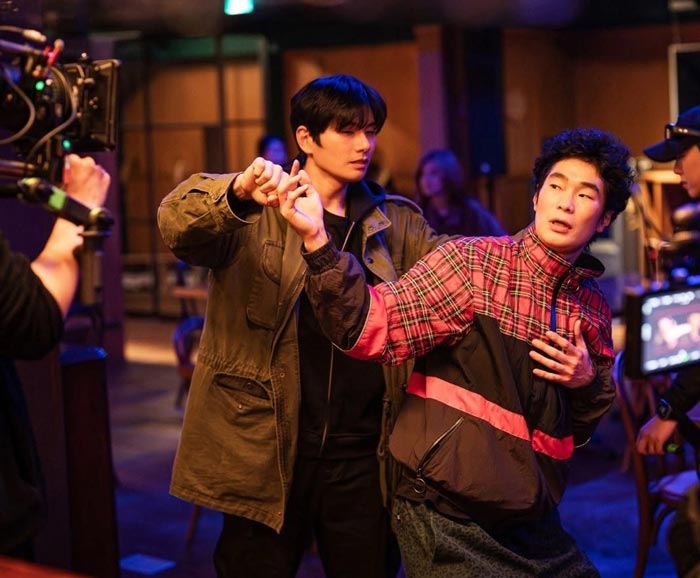
Behind those handshakes is not only the box office story but also reflecting the change in the position of Vietnamese cinema on the regional map.
When Vietnam becomes a rendezvous for international stars
If a few years ago, it was still considered rare for a Korean or Thai star to participate in Vietnamese films, now this trend is happening with an increasing frequency.
After the success of the movie "Mang me di bo", Vietnamese cinema continued to witness the release of "Me oi, ve nha", a Vietnam-Korea cooperation project gathering actors Lee Yi Kyung, Choi Daniel, Hoang Yen Chibi, Minh Ha... Previously, the movie "Tay anh giua mot vi sao" with the participation of Lee Kwang Soo and Hoang Ha also created a good impression on audiences when cooperating between the two film industries.
The noteworthy point is that these projects no longer have the appearance of "inviting foreign stars to create media effects". International actors all take on important roles in the storyline, have significant appearance time and participate throughout the promotion process.
That is a big change compared to the previous period, when foreign artists usually only appeared in a few scenes or played the role of guests.
The success of the movie "Mang me di bo", with revenue of more than 170 billion VND, partly proves that Vietnamese audiences are willing to welcome international collaborative works if the story is emotional enough and professional quality is guaranteed.
This is also a positive sign for foreign investors to boldly seek opportunities in Vietnam.
Not only Korea, Thai cinema also continuously expands cooperation. Previously, "Ghost Bride" gathered Rima Thanh Vy and actor JJ Krissanapoom, creating a connection between two cinemas that have many cultural similarities but differ in storytelling.
The fact that many countries choose Vietnam for cooperation projects shows that the domestic film market is no longer simply seen as a place to consume foreign films. Vietnam is gradually becoming a potential production partner.
From an artist's perspective, standing in the same frame with international stars also creates a strong media effect. Images of Lee Yi Kyung wearing ao dai, a conical hat, babbling Vietnamese, or Lee Kwang Soo appearing in a Vietnamese project quickly spread on social networks, contributing to bringing the film's name closer to the public even before its release.
These factors show that the appeal of Vietnamese cinema no longer lies in the market size of nearly 100 million people but also comes from the ability to create stories with local identity but with universality, enough to make international audiences sympathize.
Great opportunity but cannot only rely on the aura of foreign stars
However, the appearance of international stars does not mean that all projects are successful.
Reality shows that audiences are increasingly strict with script quality. If the story lacks depth, owning a cast of famous actors is also difficult to save the film.
Mother, Come Home" is a typical example. The work scores points thanks to the emotional motherhood story and the deeply emotional performance of Lee Yi Kyung and Minh Ha. The director also created many moments of contemplation when depicting the journey of a son bringing his foster mother's ashes back to his homeland.
However, the film still reveals weaknesses in the script when it embraces too many storylines. The character Park Ha played by Choi Daniel is invested in quite a lot of time but lacks connection with the main thread, causing the film's pace to be distracted.
That shows that a famous actor cannot replace the role of a tight script.
Similarly, Vietnamese-Korean cooperation projects in the past have mainly revolved around family, love, or tear-jerking stories. This is a safe direction but also raises questions about diversity. Vietnamese cinema can completely expand into action, crime, science fiction or drama films on a larger scale if it wants to maximize the advantages of international cooperation.
In the opposite direction, Vietnamese artists also face great pressure when performing with influential names in the region.
There is no longer a gap between "guests" and "main actors", they have to compete directly in acting, emotional expression ability as well as working style.
Minh Ha once shared that she had difficulty because of language barriers when acting with Lee Yi Kyung. The two actors had to communicate with their eyes, emotions and observations on set to understand each other better. Such experiences have become valuable lessons for young Vietnamese actors.
Many artists also admit that working with international crews helps them change their professional thinking, from character preparation, script research to discipline in each filming session.
From a market perspective, the fact that international stars continuously accept invitations to participate in Vietnamese films also reflects another reality: Vietnamese cinema is possessing a significant attraction.
Box office revenue has continuously increased in recent years, the number of expanded cinemas and the ability to distribute to regional markets have made Vietnam a new "gold mine" for many foreign producers and actors.
However, to maintain that attraction, Vietnamese cinema cannot only rely on the names of international stars.
What audiences expect most are still good scripts, deep characters and stories that can touch viewers' emotions.
At that time, the presence of foreign artists will no longer be a "trick" for promotion, but become a natural part of the development journey of Vietnamese cinema.
If that is done, Vietnam will not only be an attractive market for international stars to come to, but also a true creative partner, contributing to creating works that are competitive in the region and further on the world film map.