Each exam season always comes with expectations of fairness, transparency and accuracy. That is the time when millions of students enter one of the important milestones of their learning journey, while educators must ensure that all stages take place seriously. As the scale of exams grows, the requirements for objectivity also become stricter, making technology gradually an indispensable part of organizational work.
In that flow, artificial intelligence is opening up a new approach. If AI was previously mainly mentioned as a learning support tool, now this technology has begun to participate in stages that require a lot of human resources and close supervision. From monitoring exam rooms, detecting abnormal signs to supporting the development of exam questions and grading, AI is contributing to changing the way exams operate. The steps of China and South Korea show that technology is no longer on the sidelines of education, but is gradually becoming an important link in efforts to improve the quality of assessment and ensure fairness for learners.
Machine supervisor in China
China is one of the countries that early introduced AI into exam organization when it started applying this technology from 2024 to strengthen anti-fraud. In the Cao Khao University entrance exam in 2025, which serves more than 13.35 million candidates, AI continues to be used to ensure fairness and security for the entire organization process.
Many localities in China have deployed smart real-time monitoring systems with the ability to detect unusual behaviors of both candidates and invigilators. Expressions such as exchanging, looking at papers or losing concentration can be identified by the system to support monitoring work.
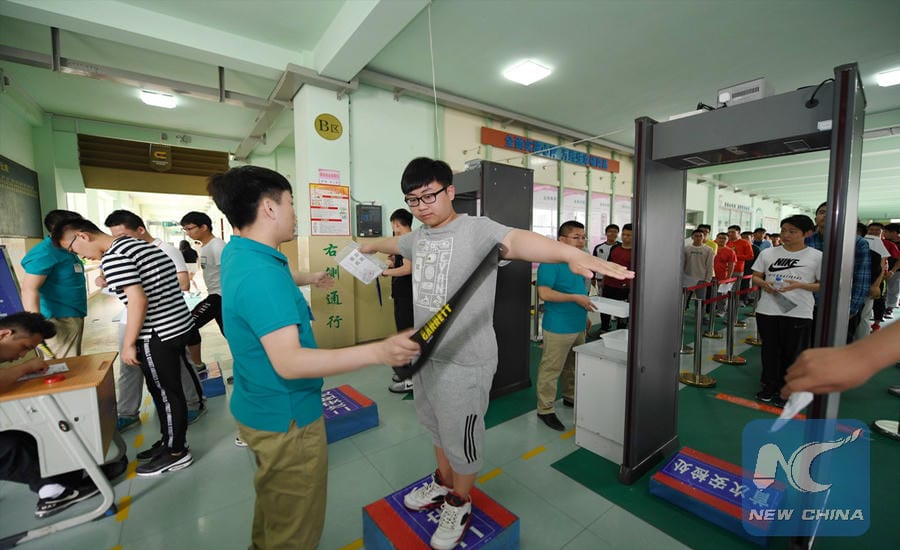
In parallel with AI, the Chinese Ministry of Education has also strengthened many technological solutions to tighten the prevention of fraud. Exam sites use smart test gates, metal detectors, radio signal blocking systems and biometric recognition. Candidates must complete the verification step by facial recognition, fingerprints or iris scanning to prevent proxy exams. Functional agencies also monitor and prevent illegal communication signals to limit the use of electronic devices in exam rooms.
Not only focusing on technology, many localities also coordinate to implement social support measures such as temporarily suspending some cultural activities, adjusting working hours, reducing traffic congestion and organizing free shuttle buses for candidates. These solutions contribute to creating favorable conditions for the exam to take place safely and stably.
AI participates in building and judging in Korea
Unlike the approach focusing on exam room supervision in China, South Korea is building a roadmap to bring AI to participate more deeply in the education assessment system, towards the possibility of application for the Suneung National University exam in the future.
In the early stages, AI is oriented to be used to grade essays and written questions. Technology will play a supporting role for teachers, helping to improve consistency in the grading process and reduce the workload for graders.
The Korean Ministry of Education also hopes that AI will contribute to promoting assessment forms that focus more on thinking ability, problem-solving ability and creativity, instead of just relying on traditional multiple-choice models. Along with that, AI is being researched to support the development of exam questions and quality testing of sets of questions before putting them into use.
These orientations show that artificial intelligence is not only seen as a technical tool, but is also expected to accompany humans in improving the quality of education assessment. When appropriately applied, AI can contribute to helping exams operate more efficiently, while opening up methods of testing competencies to meet the requirements of education in the digital age.
Research results from Kyoto University (Japan) show that the capacity of AI in academic exams has progressed very quickly in just the past few years.
From 2024, Beijing upgraded its AI monitoring system with the ability to recognize small actions such as turning around, bowing, or exchanging in the exam room.