
From the role in legends of building and defending the country to the vivid presence in tomb sculpture, pagoda architecture and worship paintings, horses carry profound symbolic values of strength, loyalty and aspiration to reach complete beauty.
The introduction of the Horse image into Vietnamese culture
From a biological evolutionary perspective, horses represent the peak development of the animal world. After about 50 million years of evolution, the body structure of this animal has had a miraculous adaptation, shifting from moving with many fingers to running and jumping leaning on the sole middle finger, creating a distinctive hoodie. This characteristic has bestowed on horses the ability to move at lightning speed, likened to "running horses" or running as fast as birds. Although Vietnam is not the homeland of horses - which originated from vast grassland areas - but through the process of economic and cultural exchange, this animal has joined indigenous livestock breeds and quickly left its mark on the spiritual, literary and artistic life of the nation.
The presence of horses in Vietnamese culture did not appear from the early days of nation-building. The Hung Kings era has not recorded traces of statues or carvings of this animal. It took thousands of years of Northern domination, through forced contact with Northern culture in parallel with the process of peaceful exchange with Indian culture, for the Vietnamese nation to gradually receive and attach to horses good symbolic meanings, with prominent "yang" characteristics.
In the Can Chi system, the horse trấn holds the 7th position among the 12 zodiac animals. In terms of time, the Horse hour corresponds to midday (from 11 am to 1 pm), and the Horse month corresponds to mid-summer. These are the times when yang energy is extremely strong, everything is brilliant and the heat radiates most strongly.
Symbol of positive power
Precisely because of its extremely prosperous yang characteristics, the image of the horse has been associated with heroic legends about the nation's first national defense. The image of Saint Giong riding an iron horse spraying fire to sweep away the An invaders is the most powerful proof of this thinking. In the context of archeology recording the appearance of ironware with superior strength, hardness and sharpness compared to stone or bronze, our ancestors felt the sacred, even mysterious power of this material. The combination of iron horses and the hero of Giong village not only reflects advances in military technology but also has a profound symbolic meaning: Using "yang prosperity" to drive away "evil spirits".
Enemy An in the Vietnamese mind symbolizes the northern invading power, carrying a darkness. In contrast, Saint Giong and the iron horse represent light, the strength of justice. Saint Giong's victory is synonymous with daylight dispelling darkness. This philosophy is still preserved in today's Giong festival, where people only bring palanquins and white horses to battle at noon - Ngo hour, the time when the yang energy is strongest - to perform the act of fighting the enemy. The iron horse bringing its owner back to heaven to become a Saint after the victory also affirms the role of the horse as a means of connecting the mundane world and the sacred realm, honoring the glory of the hero who masters natural power.
However, the horse symbol in the Vietnamese mind is not only limited to the glory of victory but is also associated with historical tragedies and the function of leading the soul. The legend of An Duong Vuong losing the magic crossbow to Trieu Da leading to failure is a typical example. The image of An Duong Vuong and his daughter Mi Chau riding a horse to the South, going into the sea after slashing their daughter, has transformed the meaning of the horse. At this time, the horse becomes a guide in the dark, capable of galloping in water and carrying the function of a sacred animal associated with the underworld. It leads the soul of the defeated person into eternity, showing a different depth in primitive religious thinking about this animal.
The divine horse and the patronage for Thang Long Capital
Stepping into the era of independence, the role of horses was strongly affirmed in the cause of national construction. When King Ly Thai To moved the capital from the Hoa Lu mountains to the Thang Long Delta, the construction of the citadel encountered many obstacles, and after completion, it collapsed. The event of the king praying to the god Long Do at Bach Ma Temple and the appearance of a white horse coming out of the temple has become a legendary foundation for the stability of the capital. The fact that the white horse galloped in a counterclockwise circle and then disappeared into the temple has drawn a footprint for the king to build a solid citadel. From then on, the god Long Do was conferred the title of Thanh Hoang Thang Long with the surname Bach Ma Dai Vuong.
The poem by Grand Tutor Tran Quang Khai after the victory over the Mongol Yuan army affirms the immortality of the White Horse god, like a flame that burns forever without extinguishing, and the dust cannot tilt it. To this day, the White Horse Temple still preserves a white horse statue that can move on wheels, proving the enduring vitality of this legend. The image of the white horse in the White Horse Temple, as well as Giong Temple and many other relics, shows the similarity in human cultural thinking. Whether in the East or the West, the white horse is always a symbol of majesty, a vehicle of saints and heroes, consistent with sunlight and the sublimation of the universe.
Horse imagery in visual art
A unique feature in Vietnamese cultural thinking is the combination of Northern and Southern cultural elements. Southern culture has valued the image of the snake - a symbol of the flowing time and rebirth. When the two cultures met, the snake (later raised to become a dragon) and the horse harmonized to create the image of the Dragon Horse - the dragon's head and the horse's body. The Dragon Horse is a complete symbol of the universe, combining both the "tung" axis (dragon's rising direction) and the "hoanh" axis (horse's horizontal running direction). According to legend, the Dragon Horse carried the edict to King Fuxi, thereby giving birth to the Ha Do, the basis of the I Ching and yin-yang mathematical thinking. This is a clear demonstration of the Vietnamese people's ability to adapt and create culture, turning foreign elements into symbols imbued with Eastern philosophy.
Although not the homeland of horses, when this image entered folk consciousness, it sparked endless inspiration for shaping artists through dynasties. Each period, the horse image carries its own style and meaning.
During the Ly Dynasty, at Phat Tich Pagoda (Bac Ninh), sculpture art reached an outstanding level with a pair of large stone horse statues of real size. According to Buddhist mythology, the white horse is the rider of the Buddha in his journey to find the Way, so when there are no riders, the horse becomes a replacement symbol for the Buddha himself Thich Ca Mau Ni. From the perspective of Buddhism Theravada, the white horse is also the embodiment of Bodhisattva Avalokiteśvara, symbolizing the power of grace spreading throughout the four directions. Artists during the Ly Dynasty, with keen observation and understanding of animal life, sculpted round, smooth shapes, depicting animals in a relaxed lying position but still exuding strong inner vitality.
Moving to the early Le dynasty, the image of horses became popular in the space of tombs. In Lam Kinh (Thanh Hoa), the tombs of kings and queens gathered a pair of horse statues. However, the statue size in this period was quite modest, only about 60-70cm high. The shaping style leaned towards simplicity, the shape was somewhat crude with a large neck, short legs and quiet posture. Although in later tombs, the details of the saddle are carved more carefully, but the overall still has a suggestive, closer nature to the gentleness of folk art than detailed realistism.
By the Le Trung Hung period, the scale and style of horse statues in mandarin mausoleums, especially the eunuch class, had a significant change. Horse statues are carved with real-sized sizes, fully equipped with elaborate saddles and reins, often accompanied by horse-drawn carriage statues. Realism is emphasized through the vividness of the shape, but to ensure the stability of the work, the belly between the four legs is often dented, forming a closed block.
The pinnacle of the art of carving horse statues in tombs must be mentioned in the Nguyen Dynasty in Hue. Imperial artists paid attention to portraying the biological characteristics of animals: running fast, resilient and healthy. Muscle masses are processed to be round, slender, with high legs, and especially the stone under the abdomen has been completely removed, creating the most realistic elegance. Here, horses play the role of sacrificial animals, serving the souls of the deceased, expressing the filial piety and care of the living for the underworld.
Horses in architectural space and folk worship paintings
Besides the tomb art, the image of horses is also brilliantly present in the architecture of communal houses and pagodas and folk paintings. At relics such as Giong Temple, Bach Ma Temple, Keo Pagoda, Hang Kenh communal house..., white horse statues standing on wooden frames with wheels are indispensable mascots in the god processions. Decorated with flags, signs, and canopies, the horse in the festival is both majestic and brilliant, harmonizing with the joyful atmosphere of the village community.
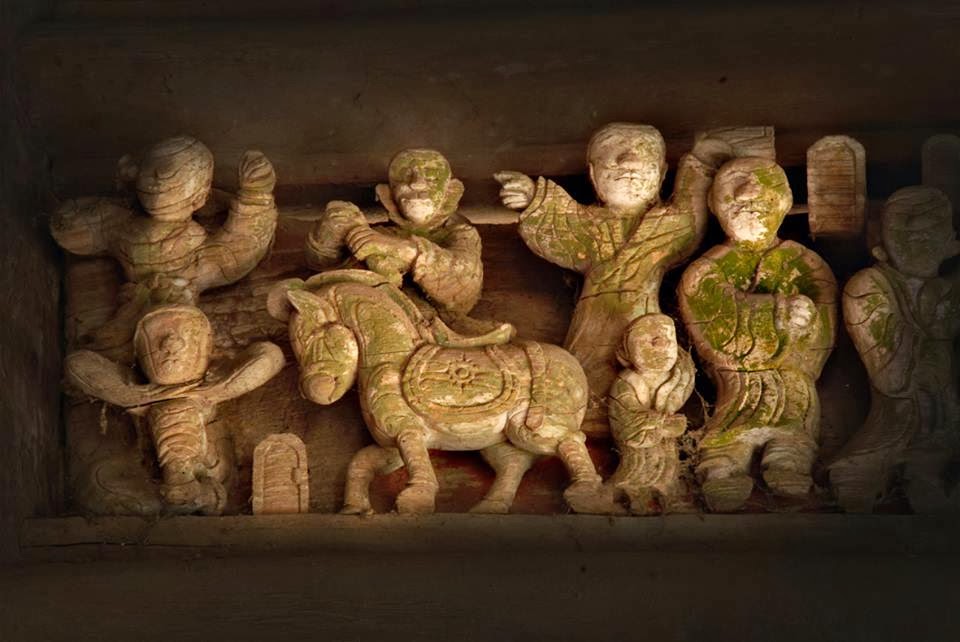
Even more unique are decorative wood carvings at village communal houses. Folk artisans have breathed life into wood, creating extremely vivid sculptures. At Dinh Bang communal house (Bac Ninh), the carving of 8 horses (Bat ma quan phi) under the bars shows 8 different shapes, continuously moving rhythmically. The carving at But Thap Pagoda or on the cốn, wind planks at Ha Hiep communal house, Tay Dang communal house... depicts scenes of horses and people dancing martial arts and playing. Exquisite carving techniques create layers, blocks of impact, making viewers feel the bustling festival atmosphere, community cohesion and unique traditional village cultural appearance of Vietnam.
In the category of worship paintings, typical is the Hang Trong painting genre, the images of "Pink Horse" and "White Horse" are expressed with utmost solemnity. The horse is painted in an independent standing posture, with a magnificent saddle, a head with a hump like a large flower, and legs tapping the ground as if waiting to start. Although there are no riders, the spirit of the animal evokes a feeling of the presence of gods, creating a solemn religious space. Vietnamese people have few specialized horse painters like Tu Bi Hong of China, but the hobby of playing horse painting at the beginning of the year with the belief "Ma dao thanh cong" is still a sustainable cultural beauty.
Looking back at history, the Year of the Horse often marks important milestones, new developments in the process of nation-building and defense of the nation. The image of horses in Vietnamese culture, from the iron horse of Saint Giong, the white horse of the god Long Do to sculptures and folk paintings, has escaped the ordinary biological meaning to become a symbol of strength, loyalty, and aspiration to perfection.


