
Vung Tau seafood is not inferior to any region because this is a land surrounded by the East Sea, with seafood granaries and seafood markets that overwhelm people like Long Dat, Long Hai. Therefore, Vung Tau's specialties are nothing other than seafood such as banh khot (shrimp and squid filling), stingray salad, mai fish salad, shark hotpot (snakehead shark) and now squid noodle soup.
It is also necessary to say in advance that squid noodle soup is not the first dish that Vung Tau people come up with or cook. It originates from the Mekong Delta. In the Mekong Delta provinces, squid noodle soup is sold everywhere because this dish is very simple, consisting only of fresh squid, minced meat, dried noodle strands, onions, chives and Ingredients.
Initially, this was a dish of Chinese people settling in Cho Lach (Ca Mau), they brought along the traditional Hu Tieu recipe and combined it with abundant local ingredients such as squid and other seafood. Over time, squid Hu Tieu has been absorbed and modified by local people to suit their taste.
Instead of just using squid, people also combine minced pork and shrimp to enrich the bowl of Hu Tieu. However, squid is still the main ingredient and the soul of the dish.
Compared to Nam Vang Hu Tieu or My Tho Hu Tieu - two other famous Hu Tieu brands in the Mekong Delta - squid Hu Tieu has clear differences. The first is about the broth. Nam Vang Hu Tieu has a light, sweet and clear taste due to being stewed from bones, while the broth of squid Hu Tieu is richer, dark brown due to being stewed thoroughly with squid heads and characteristic spices.
The second is about the filling. Squid noodle soup mainly focuses on making filling from seafood such as squid, shrimp, and crab. While Nam Vang and Go Cong noodle soup often favor pork parts such as lean meat, tenderloin, heart, liver, and kidneys. In addition, there are also black tiger shrimp and quail eggs.
Hu Tieu strands are also a factor that makes the difference. Squid Hu Tieu usually uses large, cloudy white rice noodle strands, when eaten you can feel the chewiness and aroma of rice. The other two popular Hu Tieu lines often use dry noodle strands, with a smaller cross-section.
The origin and difference of this dish are like that. Now, let's return to the squid noodle soup of Vung Tau. It must be admitted that the Vung Tau squid noodle soup has a unique feature that creates excellence: the squid is perfectly fresh, caught right in the local sea area, so it ensures the highest quality in sweetness and crispness.
Squid noodle soup is a harmonious combination of chewy and soft noodles, light and sweet broth with fresh squid. The noodles here are usually small, white, transparent strands, which still retain their natural chewiness when cooked. The broth is simmered from braised bones with fresh shrimp and squid, creating a light sweetness, very different from other noodle dishes.
Squid (tube squid or leaf squid) are carefully selected, not too big, because large squid are often tough, replaced by medium-sized squid, about 10-15cm long, but must be thick in flesh, and still retain their crunchy and natural sweetness when cooked. Squid must be fresh, with a shiny skin.
A sign to identify fresh squid is to look at the squid body, the brown part must be dark brown, and the skin should be glossy white, with good elasticity and transparent eyes. Squid is washed, cut into round slices or left whole depending on the size. Squid is briefly boiled in boiling water with ginger to reduce fishy smell and maintain crispness.
When the squid is cooked, take it out immediately to avoid being tough. Then, the squid is cut into bite-sized pieces. The shrimp is also boiled, peeled. Minced pork is stir-fried with spices until cooked. That's the main filling of the squid noodle soup.
The broth is simmered from pork bones, squid heads, squid bones to create a light sweetness, rich flavor of seafood, especially the smell of squid. The broth is simmered for many hours with spices such as shallots, garlic, grilled ginger to create a brown color for the broth.
It must be simmered over low heat to make the broth clear and sweet. The broth must be moderately thick, not salty, and have a strong aroma of seafood. When poured into hu tieu, the broth evenly absorbs into the noodles, creating a harmonious flavor between the sweetness of bones, the saltiness and the characteristic light sweetness of squid.
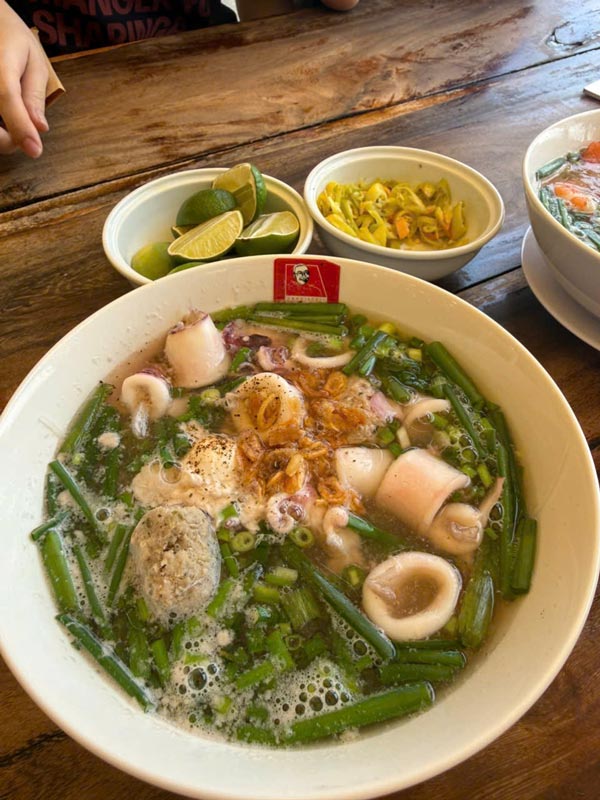
When eating, blanch the noodle soup in boiling water, put it in a bowl, then successively add minced meat, shrimp and squid, along with chives, bean sprouts, chopped scallions, cilantro and fried shallots, then pour the broth over the surface. And we have a bowl of sparkling brown broth noodle soup, highlighting the pinkish white color of the squid, the red color of the shrimp, the brown color of the meat and the ivory white color of the noodle strands, along with the green color of the vegetables. Squid noodle soup needs to be eaten hot, but the cooler it is, the less delicious it will be.
A bowl of standard squid noodle soup is usually served with raw vegetables such as lettuce, bean sprouts, chives and a little chili powder - usually finely ground chili powder, spicy - to create accents and enhance the flavor. Raw vegetables help balance the richness of the broth and meat, creating a cool feeling.
In addition to squid noodle soup, Vung Tau also has a specialty of braised squid, which is very suitable for drinking snacks. It is a type of milky squid, as small as the fingertip, braised with fish sauce and sugar to create a dish that is both sticky and chewy.


