
Amidst the harsh reality that many traditional cultural spaces are gradually shrinking due to modernization and urbanization, Thai Hai village is a rare exception - where Tay ethnic culture is not only preserved, but also nurtured and practiced every day in community life itself.
Rare solidarity
More than 20 years ago, Ms. Nguyen Thi Thanh Hai, currently the head of Thai Hai village, began a journey unlike anyone else. She quietly returned to the ATK Dinh Hoa Special National Historical Relic Site (Thai Nguyen province), knocking on the doors of every Tay family to ask to buy back ancient stilt houses.
She wants to build a community to join hands in preserving the Tay ethnic culture. Therefore, from the stilt houses rebuilt in the still pristine land in Tan Cuong, Thai Nguyen province at the end of 2003, a community gradually formed with a rare spirit of solidarity.
Eating in the same pot, money in the same bag" is the "guide" in the lifestyle of people in Thai Hai village. This is also a rare unique point in a tourism community in Vietnam.
Tourism development is one of the main economic activities of Thai Hai village. However, tourism here is not considered the ultimate goal, but a means to maintain community life and nurture Tay culture naturally. Not exchanging identity is the overarching principle of Thai Hai village.
Instead of chasing after the number of tourists, the village focuses on building experiential activities associated with the real life of the Tay people such as herbal foot soaking, gold and silver praying... Traditional festivals such as Long Long festival, Gratitude festival, and Mu worshiping ceremony are not only for the villagers but also become an opportunity for tourists to participate.
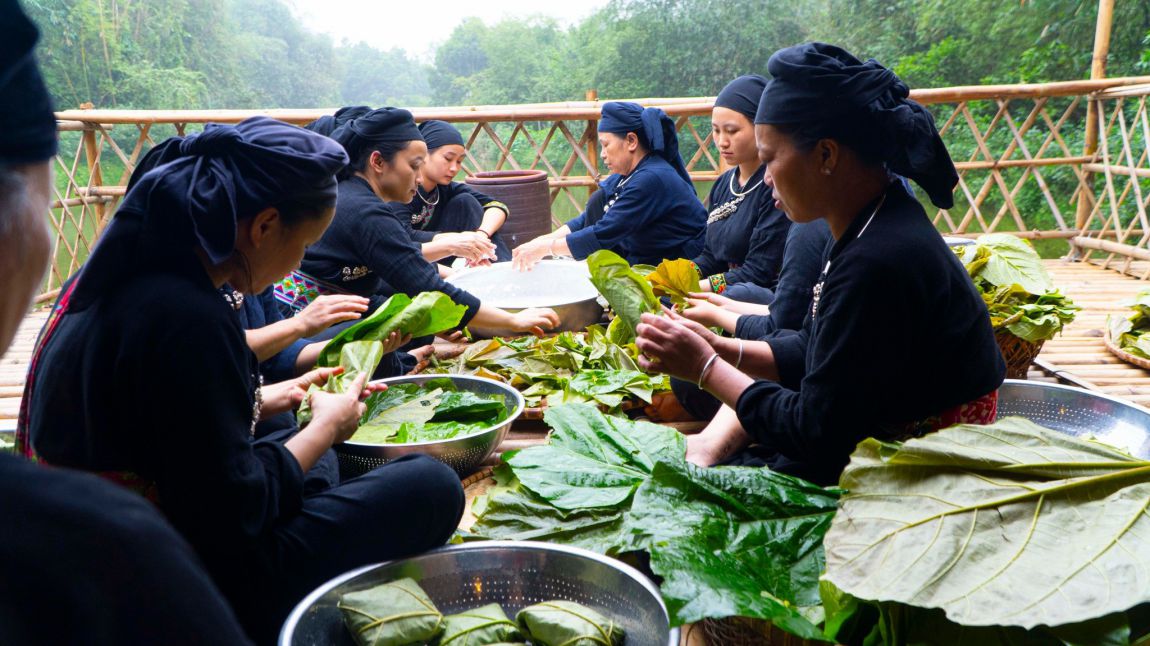
Cuisine is also an unmissable highlight of Thai Hai. Currently, the village preserves more than 100 typical dishes of the Tay people, from nuggets, braised carp to wild banana flower salad, five-color sticky rice or traditional cakes. Each dish here is like a story telling about customs, knowledge and lifestyle of the community, passed down from generation to generation as a unique heritage.
Ms. Le Thi Nga, Deputy Head of Thai Hai village, said: "We want tourists to truly feel and immerse themselves in local culture, starting from Then songs, vivid melodies from Dan Tinh to activities that go deeper into the culture of the Tay people such as making traditional swallow feasts to prepare for holidays, making five-colored necklaces for good luck, or making fruits to go to festivals.
In the new year, we want to organize more long experience days for tourists so that they can feel the depth of the spiritual life of the Tay people. Although we come from many different ethnic groups such as: Tay, Nung, Dao, Kinh... and many provinces and cities such as Thai Nguyen, Tuyen Quang, Ha Giang, Phu Tho, we always work together to preserve and develop Tay culture in the purest way," Ms. Nga added.
Continuing to preserve the soul of culture
One of the factors that make up the lasting vitality of Thai Hai village is the continuation of the young generation. Ms. Tran Thi Thuy Linh, a kindergarten teacher in the village, is Kinh ethnicity but has been attached to the village with her family for nearly 20 years.
Graduating from Hanoi National University of Education, she decided to return to the village to teach about 20 children who are descendants of the village. The children are taught according to the program of the Ministry of Education and Training, and at the same time are focused on learning English, learning Then singing, playing Tinh zither, and experiencing the village's work during holidays and Tet.
Learning is associated with life, helping children grow up with culture naturally. Not only is she a teacher, Ms. Linh is also a bridge between generations, conveying to young children pride and love for Tay cultural identity.
She recounted: "The first day I returned to the village, I still had little knowledge of Tay culture. But every day, when the village chief shared his story, confidences and passion for culture, that love gradually permeated me naturally. Since then, I have always wished to return after graduating, take care of the children and contribute to preserving these precious traditional values.
Also choosing to return to the village, Ms. Thuy An is another typical face of Thai Hai's youth class. From her high school years, she followed her father to the village to plant trees, build houses and keep in her memory the early images of the village.
Oriented to learn English, she graduated from the Foreign Language School - Thai Nguyen University and returned to work in the village in 2016. Currently, she both teaches English to children and adults, and directly welcomes international delegations, supports communication and connects Thai Hai village with foreign partners.
The decision to stay in the village came to me very naturally," Ms. An shared, considering being attached and contributing to the community as part of life.
The choice of young people like Ms. Linh and Ms. An to stay shows that Thai Hai is not only a place to preserve cultural memories, but also a vibrant community, capable of self-recreating and continuing. This village still persistently proves that traditional culture can exist, if placed in the true life of the community.
It's a bit of a bit of a bit of a bit of a bit of a bit.
It's a bit of a bit of a bit of a bit of a bit of a bit.


