
From the stands of My Dinh Stadium
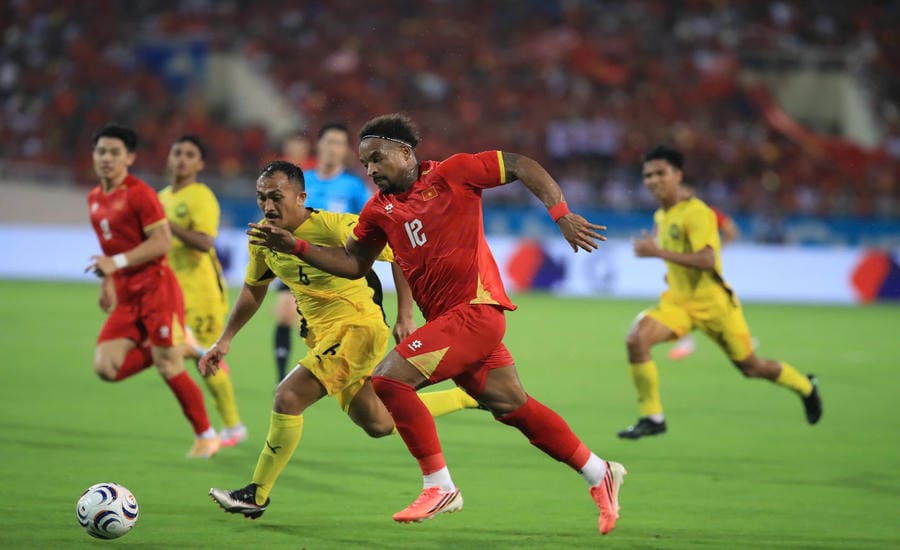
On the evening of August 19, the Vietnamese team entered the second leg semi-final of ASEAN Hyundai Cup 2026 against Malaysia at My Dinh National Stadium (Hanoi) with a 2-0 victory in the first leg. The winning team in the match will meet Thailand in the final.
With a 2-0 victory right at My Dinh with 2 goals from Xuan Son, the Vietnamese team officially participated in the final match against Thailand.
But, looking at the bustling ASEAN Cup atmosphere, especially the bright red flag of more than 40,000 fans at My Dinh, there is another noteworthy story: That is the economic value behind a football match.
Tickets for the Vietnam - Malaysia match are sold at 4 price levels from 300,000 VND to 1 million VND. The fact that the Vietnam Football Federation continues to organize direct ticket sales on August 19 shows that the demand for stadium visits is still very high.
According to reporters of Lao Dong Newspaper, before the second leg semi-final match, black market ticket prices were pushed up quite high. In the area around My Dinh stadium and the gate of the Vietnam Football Federation, ticket scalpers directly offered many different prices. Accordingly, tickets for stands C and D with a original price of 300,000 VND/ticket are resold at about 600,000 - 700,000 VND/ticket.
In stand B on the 5th floor, tickets with a face value of 500,000 VND/ticket are offered for sale at about 900,000 VND/ticket. Meanwhile, the price of 700,000 VND/ticket has increased to 1.1 million VND/ticket, and the type of 1 million VND/ticket is pushed up to about 1.7 million VND/ticket. With stand B on the 2nd floor - doors 1-2, the original 1 million VND/ticket is resold by ticket scalpers for about 2 million VND/ticket.
The higher price difference appeared at stand A on the 2nd floor. Original tickets priced at 700,000 VND/ticket are offered from 1 - 1.1 million VND/ticket. Tickets for gates 1 - 2 alone cost up to 5.5 million VND/pair, while the original price is 2 million VND/pair. On ticket buying and selling groups on social networks, ticket prices continue to be pushed up by region.
In the past matches, the number of Vietnamese fans was recorded as the largest in the region with a total of more than 100,000 spectators through 4 matches. Tens of thousands of people coming to the stadium each match means tens of thousands of tickets being sold, thousands of trips by taxi, technology car, bus; the demand for food, parking, buying jerseys, flags, scarves, souvenirs increased. If fans from other provinces and cities come to Hanoi to watch the match, the spending chain also extends to hotels, airlines, railways and tourism.
The match also created a huge amount of content on television, newspapers, social networks; created advertising space for brands; increased the image value of players, teams and tournaments. A goal can take place in seconds, but goal videos, celebration images or stories behind players can continue to be exploited for many days afterwards.
Has seen the market
Director of the Vietnam Sports Administration - Nguyen Danh Hoang Viet said that sports are no longer just cultural and social activities but are fields capable of creating economic value, associated with media, sponsorship, copyright, tourism, consumption, technology and healthcare services. He emphasized: "It is time to consider sports as an economic sector, of course a specific economic sector associated with cultural, social, educational and human development goals.
The heat of the ASEAN Cup is a fairly clear proof of that assessment. Vietnam is not lacking fans. Football is even more lacking in markets. What is lacking is the ability to turn the love of millions of people into sustainable revenue streams to return to investing in sports itself.
According to reports, the scale of Vietnam's sports economy in the period 2024 - 2025 is estimated at about 3 - 5 billion USD. With a growth rate forecast of 8 - 15% per year, the market may reach 8 - 10 billion USD by 2030 and 20 - 30 billion USD by 2040. These are forecast levels mentioned at the 2026 Sports Economic Forum, showing great development potential but also reflecting the low starting point of the market.
Football is perhaps the most potentially visible field. A professional team in theory can have revenue from ticket sales, sponsorship, television rights, player transfers, jerseys, souvenirs, brand exploitation, digital content and commercial activities associated with the fan community.
But many Vietnamese clubs are still heavily dependent on owned businesses or "bosses". Revenue from ticket sales, jerseys and copyrights is not enough to support the team. When businesses encounter difficulties or investors withdraw, clubs can immediately fall into crisis.
This shows that Vietnamese football has a lot of viewers but does not have a market commensurate with the number of viewers.
Director Nguyen Danh Hoang Viet pointed out that Vietnamese sports has many tangible and intangible assets that have not been fully exploited. Tangible are stadiums, gymnasiums, training centers. Intangible are the image of the team, athlete brand, tournament value, television rights, fan data, federation brand, club and the strength of the fan community.
A famous player not only creates value when scoring goals. His image can create advertising contracts, sell jerseys, attract sponsorship and increase the attractiveness of the tournament.
A Vietnam - Malaysia match not only generates revenue from about 40,000 seats at My Dinh Stadium. Millions of people not present at the stadium can still create value through television rights, digital platforms, advertising and post-match content.
The problem is that that value is being lost quite a bit through fake shirts, counterfeit goods, illegal livestreaming, illegal broadcast websites or the exploitation of athlete images without clear contracts.
Deputy General Director of Vietnam Professional Football Joint Stock Company (VPF) - Nguyen Tien Dung once called on fans to use official television units, copyright holders, because this is a resource to help the professional football system have more revenue, improve quality and create more income for players.
From this perspective, buying a genuine shirt or watching a match on a copyrighted platform is not just a consumer behavior. It is also how fans' money returns to the football ecosystem. If you want the sports economy to grow, that cash flow must be kept.
Sports tourism - time to pay attention
A marathon with tens of thousands of participants not only requires registration fees. Runners need hotels, means of transportation, food, shopping, and experiencing destinations. Accompanying relatives also become tourists.
A marathon race in Bangkok (Thailand) in 2025 attracted nearly 48,000 runners from 86 countries and territories. The Tourism Authority of Thailand estimates that the event generated about 48 million USD in direct and indirect economic value, of which about 40 million USD came from tourism.
The State not only sees a race as an event that requires organizational costs but also sees it as a product to attract customers and stimulate consumption.
Vietnam currently has more than 100 annual running races, according to data cited in documents, but most do not have complete statistics on the amount of money a race brings to hotels, restaurants, transportation and destinations.
Especially with football as well! If a big final is held in Hanoi, the tourism industry can completely build products for fans from provinces and international visitors: match tickets combined with hotels, city tours, culinary tours, and heritage tours.
A 90-minute football match can completely create a 2-3 day trip.
Deputy Director of Hanoi Department of Culture and Sports - Pham Xuan Tai said that it is necessary to improve the capacity to organize large-scale sports events, thereby promoting service industries such as tourism, accommodation, transportation and commerce. According to him, the development of the sports economy must be associated with a synchronous ecosystem, taking businesses as the center and increasing links between sports and tourism, culture, education, communication, and technology.
This is the thinking needed after the ASEAN Cup. Don't just calculate how much ticket money is collected from the match. Calculate how much fans have spent in the entire journey to the stadium.
However, Vietnam's sports economy still faces many bottlenecks. Infrastructure is one of the biggest problems. Many stadiums and gymnasiums have been built for a long time, mainly serving competition but not designed for commercial exploitation all year round. When there are no matches, a large stadium can almost "hibernate".
Currently, some stadiums with large capacity and meeting standards are being built in Hanoi and Ho Chi Minh City, creating expectations for the development of sports infrastructure in the future.
Meanwhile, Korean experience mentioned in the document shows that Seoul Olympic Park maintains a high rate of exploitation thanks to its versatile use for sports, concerts, museums and many other activities, generating revenue of more than 40 million USD per year.
Modern stadiums must be a complex with shops, restaurants, entertainment, museums, commercial services; can organize Saturday evening football, Sunday concerts, conferences next week and community activities in the remaining time.
Another bottleneck is the procedures for organizing events, investment attraction policies and the participation capacity of businesses. Experts believe that the State needs to gradually shift from the role of directly doing everything to the role of "ecosystem architect": Creating a legal corridor, opening up opportunities to exploit public assets, encouraging investment and allowing professional businesses to participate more deeply.
Director Nguyen Danh Hoang Viet also raised the issue of changing the way sponsorship is done. According to him, sports "cannot always mobilize sponsorship in the way of "asking for sponsorship", but must create value for businesses to accompany long-term.
This is probably one of the most important changes in thinking. A business that puts money into football should not just be for sentiment or words. They must see specific benefits: How many people access the brand, how many new customers, how much image exploitation rights, how valuable are fan data?
If viewers are transformed into customers, tournaments become brands, stadiums become assets exploited year-round, athletes become protected image assets, events become tourism products, and copyright becomes a sustainable source of revenue, the sports economy will have the opportunity to become a new growth space.
Sports not only target the budget, but can create resources. Sports not only bring home medals, but also create health, pride, jobs, services, tourism, national brands and development momentum.
Director of the Department of Sports - Nguyen Danh Hoang Viet


