
In the draft Law amending and supplementing the Law on Environmental Protection in 2020, the Ministry of Agriculture and Environment proposed two options for classifying domestic waste: Option 1 is to maintain a three-group model including reusable and recycled waste; food waste and other domestic waste. Or option 2 simplifies to two groups, in which food waste is combined into domestic waste.
Talking to Lao Dong Newspaper, Assoc. Prof. Dr. Nguyen Dinh Tho - Deputy Director of the Institute of Strategy and Policy on Agriculture and Environment (Ministry of Agriculture and Environment) said that in the past time, the implementation of waste classification and collection in Vietnam, especially in the transportation stage, still faced many difficulties. The transshipment station system has not been built synchronously and effectively.

With about 25–26 million households, Vietnam consumes up to 100 million nylon bags every day. However, due to poor sorting and lack of separate collection solutions for organic waste, the waste treatment process is facing many obstacles.
Therefore, the Ministry of Agriculture and Environment is seeking opinions to complete a suitable plan. Accordingly, if applying the model like some countries, people only need to sort waste in two bins, thereby facilitating the organization of collection, transportation and treatment. Meanwhile, if implemented according to current regulations, a more detailed sorting system will help optimize recycling and reuse costs, especially for organic waste" - Deputy Director of the Institute of Strategy and Policy for Agriculture and Environment said.
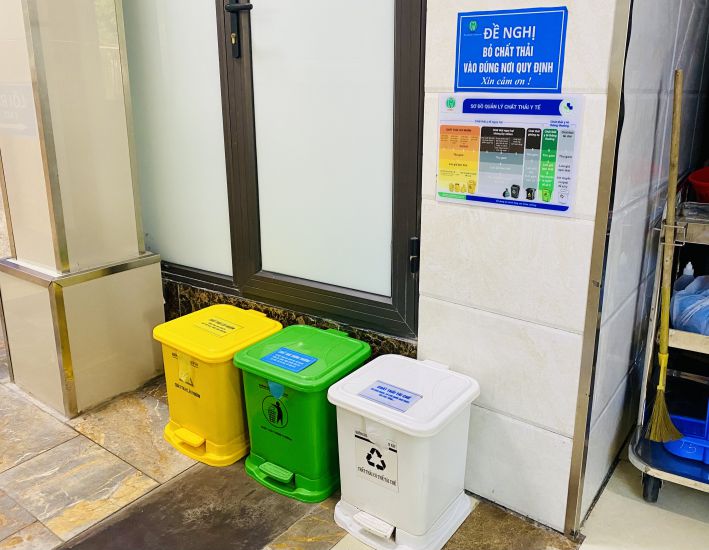
Expressing his opinion, Dr. Tran Van Mieu - Vice Chairman of the Vietnam Association for Conservation of Nature and Environment said that according to the provisions of the 2020 Law on Environmental Protection, waste is classified into three types, which means that each household needs to arrange three separate trash cans. However, with limited living space conditions, especially in small kitchens, this requirement is not really appropriate.
Similarly, in collective housing areas, schools or agencies, the simultaneous arrangement of three trash cans in all locations also faces many inadequacies in actual implementation.

Therefore, I agree with the option of classifying waste into two groups. This approach is both simple, easy to implement, and suitable for current conditions, while still creating a foundation for organizing collection and more effective treatment. Reality shows that the three-group source waste classification model has not yet achieved the expected efficiency. Therefore, adjusting to the two-group option is necessary and more feasible in the current period" - Dr. Tran Van Mieu stated his opinion.
The report evaluating the implementation of the 2020 Law on Environmental Protection shows that after many years of implementation, waste sorting at source has mainly stopped at pilot level, not being implemented synchronously nationwide. The biggest reason is the lack of synchronization between regulations, collection and treatment infrastructure and implementation organization mechanisms.


