
First published in China and quickly creating an "earthquake" in both academia and the public, "Money War" is not a dry economic book.
The author tells the story of world financial history like a large-scale detective novel: from the rise of central banks, the role of the US Federal Reserve (FED), to the profound influence of financial corporations and famous banking families like Rothschild.
Each chapter is like a piece, gradually forming a panoramic picture of how the currency can manipulate the economy, politics and destiny of nations.
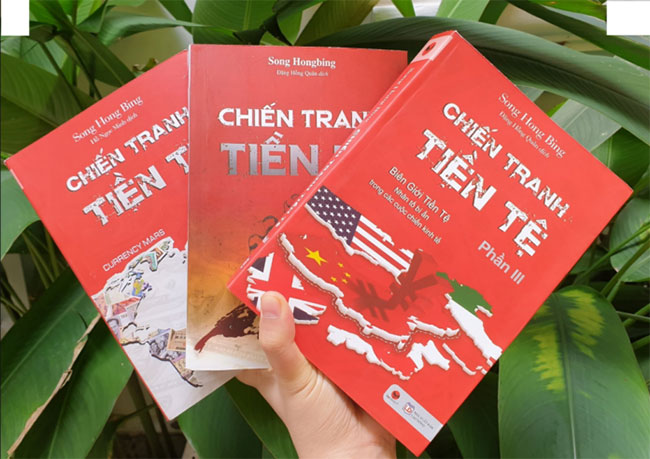
The special attraction of "Currency Wars" lies in its bold and critical perspective. Song Hong Bing raises questions that make readers ponder: Who really controls the currency? Is the financial crisis a random accident or a consequence of deliberate calculations? Why do some countries collapse after just one currency fluctuation? Although still controversial, that frankness and decisiveness has made the book a phenomenon, translated into many languages and widely discussed around the world.
Not only for experts, the book series published by Bach Viet in Vietnam is also suitable for ordinary readers interested in economy, investment and current affairs. With a writing style rich in images, vivid historical evidence, the author helps complex concepts such as inflation, gold position, financial crisis become easy to understand and attractive. Reading this book, people realize that money is not only a means of exchange, but also a lever of power that can shape the world order.
Song Hong Bing is a Chinese scholar, economic researcher, famous for his independent thinking and strong critical views of the global financial system. He was born in China, studied and worked for many years in the fields of technology and finance in the United States. It was the experience of living between two major economies that helped Song Hong Bing have a multi-dimensional, sharp view of the role of currency and international financial power.
But Hong Bing not only wrote an economic book, but also opened up a major debate about the world financial order. Despite receiving both support and opposition, he is still considered one of the authors with great influence in popularizing critical financial thinking to the Asian public.
It's a bit of a bit of a bit of a bit of a bit of a bit.


