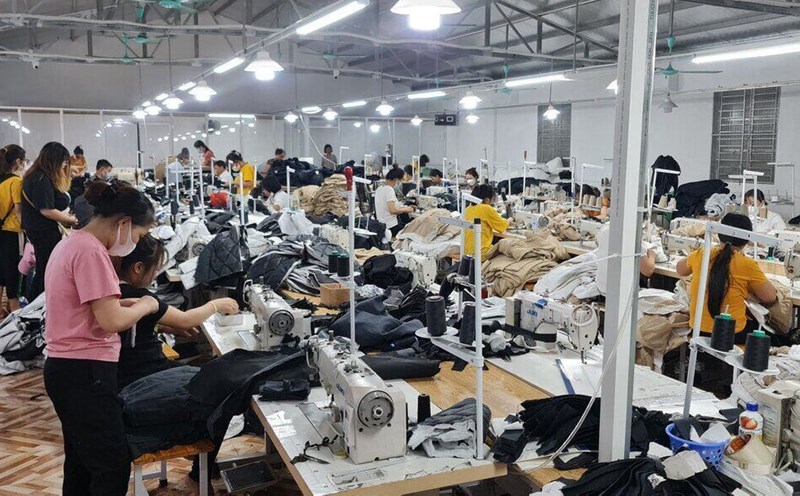
On the morning of June 18, discussing the socio-economic development plan at the National Assembly, delegate Thai Thu Xuong - Permanent Vice President of the Vietnam General Confederation of Labor (Hau Giang Delegation) proposed to urgently consider, adjust, and increase the regional minimum wage from July 2025.
There is a paradox that electricity prices have increased fourfold since 2023 and food prices, accommodation prices, tuition fees, medical expenses - essential items for workers, have also increased sharply.
However, during this period, the regional minimum wage only increased once with an increase of 6%.
In that context, the proposal to adjust the minimum wage from July 2025, according to delegate Thai Thu Xuong, is an urgent requirement from the practical life of workers.
At the same time, the regional minimum wage must truly meet the minimum living standard, in accordance with the spirit of the provisions of the Labor Code.
From a policy perspective, the minimum wage is not just an index adjusted according to CPI fluctuations or labor productivity. And that is also a legal commitment of the State in protecting the minimum right to life of workers.
Once that commitment cannot keep up with market reality, the minimum wage will no longer be a "safe net", but will become a formal number, not accurately reflecting the standard of living, and will accidentally eliminate the working motivation of those who are directly creating wealth for the economy.
In a broader context, it is impossible to speak of a solid recovery economy if the majority of the workforce still lives in difficulty. No savings, limited spending, constant psychological pressure... on workers are factors that not only reduce labor productivity but also reduce social quality.
More worryingly, when the salary is not enough to live on, workers can easily accept withdrawing social insurance at one time, working illegally, or falling into the black credit trap. That not only affects each individual but also erodes the foundation of national security.
The increase in regional minimum wages should therefore be seen as a strategic investment to maintain purchasing power, stimulate domestic consumption, retain labor and stabilize society.
In the context of businesses also facing a lot of pressure, salary increases need to be accompanied by support policies such as tax exemptions and reductions for businesses that employ many workers, or postponing social insurance payments for a short time... But it is certain that the reason for "common difficulties" cannot be used to delay the payment of worthy salaries.
Workers are the direct productive force. If a basic salary is not enough to live on, it is not expected that they will accompany businesses for a long time or make a sustainable contribution to the economy.
Therefore, increasing the minimum wage early and sufficiently is not only an obligation, but also a way to nurture trust, retain the workforce and lay the foundation for fair and inclusive development.